Tarot / The 78 cards / Cups / Knight of Cups
Knight of Cups: tarot card meaning, upright and reversed
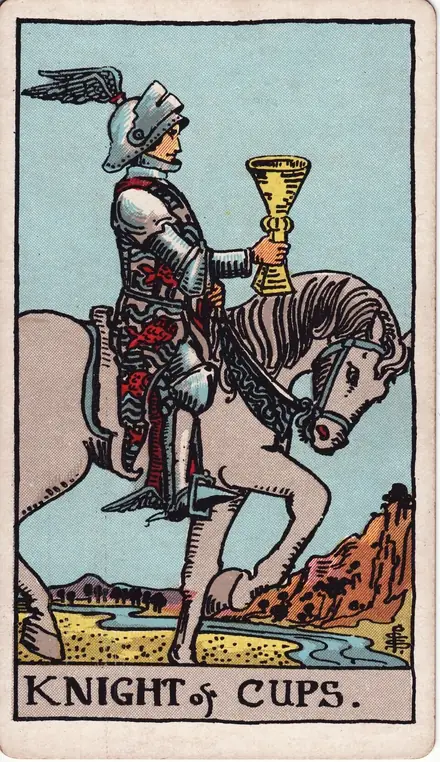
The Knight of Cups is the romantic riding slowly with his cup held out: a proposal, an invitation or a dream that has set out on the road.
Draw this card · Its correspondences
- Arcana: Minor, court card (Knight)
- Suit and element: Cups, Water
- Golden Dawn title: Lord of the Waves and the Waters
- Nature: Fire of Water
- Sephirah: Chokmah
- Signs: Aquarius, Pisces
- Keywords: Romance, charm, imagination, beauty
- Yes or no?: It depends
- Archetype: The Wandering Lover
What the card shows
In the deck Pamela Colman Smith drew for Arthur Edward Waite in 1909, the Knight of Cups rides a white horse that moves at a walk, head lowered, in no hurry. He wears armour, a winged helmet and wings at his heels too, and over the armour a tunic patterned with fish. He holds a golden cup at arm’s length, as if offering it to someone not yet in view. Ahead runs a river the horse is about to cross, and in the distance rise hills and mountains.
Each detail has its reading. The white horse and the slow pace set this Knight apart from the other three: he moves forward, with no charge and no battle. The wings on his helmet and heels recall Hermes, the messenger, and are linked with imagination taking flight. The fish on his tunic tie him to the water of the suit. The outstretched cup is the proposal, the heart on offer. The river is the emotion that must be crossed to reach the other person.
Waite describes him as graceful and unwarlike, with a winged helmet referring to the higher graces of the imagination, and adds that he is also a dreamer, haunted by visions of the senses. The Golden Dawn swaps King and Knight: its Knight is the fire of the suit and its King the air. In Book T, this card is titled the Lord of the Waves and the Waters, of the nature of fire of water, sits in Chokmah and rules from the end of Aquarius through much of Pisces. In The Book of Thoth, Crowley assigns it hexagram 54 of the I Ching, The Marrying Maiden.
Knight of Cups upright
Upright, the Knight of Cups reads as the arrival of a proposal that touches the heart. Waite gives him the meanings of arrival, approach, advances, proposition and invitation: someone appears with something to offer, often a feeling, sometimes an idea or a project. Knights are the court cards of action and movement, and the Knight of Cups acts through affection and imagination.
His kind of action is particular. He advances slowly, with grace, and would rather charm than impose. That is why the tradition links him with romance, charm, poetry and beauty. In a spread he can point to a declaration, a date, an invitation to travel or the decision to follow a dream. He also has an artistic side: the person who throws themselves into a creative project because they have fallen in love with it.
The Knight of Cups as a person is romantic, sensitive and charming, with a rich imagination and a gift for moving others. He might be a suitor, an artist, an idealistic friend or someone who lives by what they feel. His virtue is delicacy and a passion for beauty; his risk, inconstancy and a tendency to fall in love with the idea more than with the person.
As advice, the card invites you to offer what you feel sincerely and to set out towards what you desire. It also asks you to look at the river before you cross it: a dream needs a little solid ground to reach the far bank.
Knight of Cups reversed
Many readers never use reversals. They read every card upright and let the neighbouring cards shade the meaning. Those who do read reversed cards tend to see the Knight of Cups reversed in one of two ways.
The first is charm that deceives. Waite gives it the meanings of trickery, artifice, subtlety, swindling, duplicity and fraud: lovely promises that are never kept, an offer too good to be true, someone who seduces with words and vanishes. Read this way, the card asks you to look at actions more than speeches.
The second is the dreamer who never arrives. The Knight stays on the riverbank, in love with an image, unable to decide or to move from fantasy into action. The card then speaks of idealisation, mood swings and projects abandoned once they stop being exciting.
In both cases the advice is to keep your feet on the ground while holding on to the dream: check, make it concrete, and stand by what you promise.
In love
In love, the Knight of Cups is the card of romance. For someone single, it reads as a suitor arriving, a declaration or an exciting date, often with someone thoughtful and charming. For a couple, it usually points to a season of renewed courtship, an important proposal such as a trip together or an engagement, or the wish to fall in love all over again with the same person.
Reversed, in love
Reversed, in love, it speaks of promises that are not kept, of someone who seduces without committing, or of a relationship lived more in fantasy than in reality. As advice, it asks you to look at what is done as well as what is said.
Career and money
For career and money, the Knight of Cups reads as an attractive offer, an invitation to collaborate or a creative project that fires your enthusiasm. It favours the arts, design, music, writing and work with people. Financially, run the numbers on whatever excites you.
Reversed, in career
Reversed, it points to unclear offers, projects that stay at the idea stage, or a lack of follow-through. The advice is to read the small print and set concrete commitments.
Health and mood
For health and mood, the Knight of Cups is linked with emotional sensitivity and the wellbeing that art, music and tenderness bring. It is also connected with the mood swings of someone who lives very much inside themselves. A tarot card cannot diagnose anything: for any symptom or worry, the person to see is a qualified health professional.
Yes or no? It depends
The Knight of Cups reads as an “it depends”. He brings a sincere proposal or feeling, so he leans towards “yes” in questions of love and creative projects. He also moves slowly and sometimes stays in the dream, so the answer depends on whether what is promised becomes concrete action.
Ask the card: a yes or no tarot reading with one card or three.
The archetype: The Wandering Lover
As an archetype, the Knight of Cups is the character who goes out into the world guided by a feeling. The lover who crosses the city to deliver a letter, the poet chasing an image, the idealist who falls for a cause or for someone they barely know. He embodies emotion turned into movement: what the Page felt on the shore, the Knight carries in his hand and sets out to offer.
In the structure of a story, the Knight of Cups is often the engine of a romantic plot or a quest. He is the one who makes the proposal that sets the story going, or who spends years pursuing a dream that gives his life meaning. His most interesting arc runs from idealisation to the encounter with reality: he discovers that the beloved is different from the person he imagined, or that his dream has a price.
Waite gives a very useful key for writing him: he is a dreamer haunted by visions of the senses. That tension between the ideal and desire gives the character his depth. His shadow, the deceiving seducer, makes for charming antagonists, the ones who promise the earth and disappear. Written well, the Knight of Cups wins a double sympathy from the reader: we admire his capacity for devotion and dread the blow that reality has in store for him.
In literature
- The Great Gatsby (F. Scott Fitzgerald, 1925). Jay Gatsby builds an entire life to offer it to Daisy, like a man holding out a cup across the bay. His love is above all an image, the green light at the end of her dock, and the novel shows the beauty and the ruin of a Knight of Cups who mistakes the dream for the person.
- Cyrano de Bergerac (Edmond Rostand, 1897). Cyrano writes the love letters that Christian gives to Roxane, pouring into them everything he dares not say in his own voice. It is the Knight of Cups as poetic messenger: the most beautiful proposal in the theatre arrives in someone else’s name.
- Don Quixote (Miguel de Cervantes, 1605). Don Quixote takes to the roads for a lady he has invented, Dulcinea, and offers every exploit in her name. Cervantes turns the dreaming knight into one of the great characters of world literature: imagination that sets the body moving, and reality that keeps blocking the road.
For writers
The conflict
The Knight of Cups sets up a conflict between the ideal and the real person. The character falls in love with an image, of someone, a place or a vocation, and rides towards it with all his delicacy, blind to whatever does not fit. To prepare the card, let the reader see the details the character overlooks, and make his offering so beautiful that imagining its rejection hurts.
The twist
As a plot twist, the Knight of Cups is the proposal that arrives and changes everything: a declaration, an invitation to run away, a letter. It also works in reverse, when the lover discovers that the person of his dreams is someone else. The river in the drawing offers a good clue: set the decisive moment at a crossing, just before reaching the other bank.
Prompts
- Write a declaration of love made with an object in place of words, and the reaction of the one who receives it.
- Have your character travel a long way to offer something to someone, only to discover on arrival that they are no longer the same person.
- Tell the scene in which a charming seducer promises something he knows he will never deliver, from the point of view of the one who believes him.
Its correspondences
- Element: Water. Source: Golden Dawn (tradition).
- Sephirah: Chokmah. Source: Golden Dawn (tradition).
- Sign: Aquarius. Source: Golden Dawn (tradition).
- Sign: Pisces. Source: Golden Dawn (tradition).
- Hexagram: 54 · The Marrying Maiden. Source: Crowley, The Book of Thoth (modern system).
In the Golden Dawn the Knight is the fire of the suit and the King its air. Many modern readings of the Rider deck swap the two.
Combinations
Knight of Cups and The Lovers
With The Lovers, the Knight of Cups strengthens the romantic meaning. It reads as a proposal of commitment, or a declaration that forces a choice, usually made with the heart leading the way.
Knight of Cups and Page of Cups
The Page and the Knight of Cups together speak of a romance moving from message to action. First comes the shy signal; then the proposal. They read as a story getting under way.
Knight of Cups and Two of Cups
Beside the Two of Cups, the Knight’s proposal finds an answer. It reads as a mutual meeting, a date that works out, or the start of a balanced relationship.
Knight of Cups and The Chariot
With The Chariot, the Knight of Cups picks up speed. It reads as a journey for love, a move to be near someone, or a creative project that finally takes off with resolve.
Knight of Cups and Seven of Cups
The Seven of Cups beside the Knight heightens fantasy. It reads as too many dreamed-of options, or a proposal that excites more than it delivers, and asks you to choose calmly.
Knight of Cups and Seven of Swords
With the Seven of Swords, the Knight’s charm becomes suspect. It reads as fine words hiding another intention, and advises checking before you trust.
Knight of Cups and Temperance
Beside Temperance, the Knight of Cups tempers his impulse. It reads as a romance that moves forward with patience and balance, or a dream that finds the right measure to become real.
Knight of Cups and The Moon
With The Moon, the Knight’s imagination fills with shadows. It reads as idealisation, misunderstanding or an ambiguous proposal, and asks you to wait for the water to clear.
Frequently asked questions
What does the Knight of Cups mean in tarot?
The Knight of Cups stands for emotion set in motion: a proposal, an invitation, a declaration or a dream being pursued. The tradition reads him as the romantic of the tarot, charming and imaginative, riding slowly with his cup held out.
What does the Knight of Cups mean in love?
In love he is the card of romance. For singles, he reads as a suitor arriving or an exciting date; for couples, as renewed courtship or an important proposal. Reversed, he warns of promises that will not be kept.
Is the Knight of Cups a yes or no?
He reads as an “it depends” that leans towards yes in love and creative projects. The proposal is sincere, and the card asks you to check that what is promised turns into action before counting on it.
What does the Knight of Cups reversed mean?
Readers who use reversals usually see him as charm that deceives, with empty promises or seduction without commitment, or as the dreamer who cannot decide and stays on the riverbank. The advice is to look at actions and make things concrete.
What is the Knight of Cups like as a person?
As a person, the Knight of Cups is romantic, sensitive and charming, with a vivid imagination: an attentive suitor, an artist or an idealistic friend. His virtue is delicacy and devotion; his risk, inconstancy and loving the idea more than the person.
What are the Golden Dawn correspondences of the Knight of Cups?
In Book T he is titled the Lord of the Waves and the Waters, of the nature of fire of water, and sits in Chokmah. He rules from the end of Aquarius through much of Pisces. In *The Book of Thoth*, Crowley assigns him hexagram 54, The Marrying Maiden.
Do your readingPrevious: Page of Cups · Next: Queen of Cups
The 14 cards of Cups
- Ace of Cups
- Two of Cups
- Three of Cups
- Four of Cups
- Five of Cups
- Six of Cups
- Seven of Cups
- Eight of Cups
- Nine of Cups
- Ten of Cups
- Page of Cups
- Knight of Cups
- Queen of Cups
- King of Cups
By Style Optimizer · published November 22, 2026.