Tarot / The 78 cards / Cups / King of Cups
King of Cups: tarot card meaning, upright and reversed
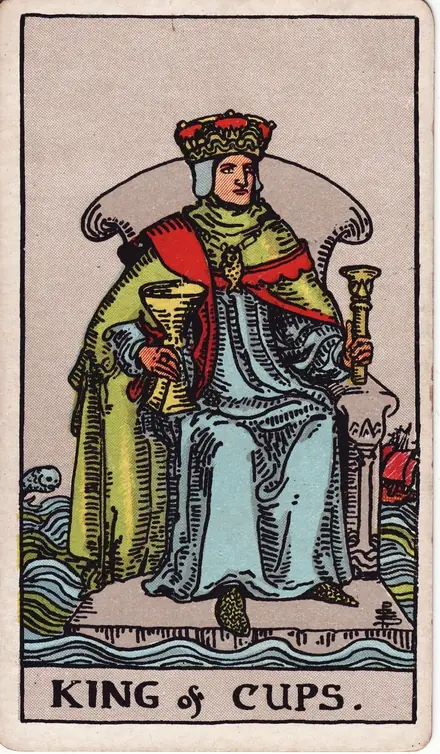
The King of Cups is emotion governed with maturity: the calm counsellor who stays steady above a restless sea and helps without imposing.
Draw this card · Its correspondences
- Arcana: Minor, court card (King)
- Suit and element: Cups, Water
- Golden Dawn title: Prince of the Chariot of the Waters
- Nature: Air of Water
- Sephirah: Tiphareth
- Signs: Libra, Scorpio
- Keywords: Emotional balance, control, generosity
- Yes or no?: Yes, with conditions
- Archetype: The Calm Counsellor
What the card shows
In the deck Pamela Colman Smith drew for Arthur Edward Waite in 1909, the King of Cups sits on a grey stone throne that seems to float in the middle of the sea. Dark, restless waves rise all around, and yet the water never reaches the king. He wears a blue tunic and a yellow mantle, a crown, and a fish-shaped amulet hanging from his neck. In his right hand he holds a large cup; in his left, a short sceptre. On one side of the background a sailing ship crosses the water; on the other, a fish or dolphin leaps.
Each detail has its reading in the tradition. The rough sea is the emotional world, his own and other people’s, with all its storms. The steady throne above it speaks of someone who knows how to stay in the middle without sinking. The cup is affection, the sceptre authority, and holding both at once defines the card: power exercised with sensitivity. The fish on his collar and the one leaping from the water recall that the King knows those depths from the inside; the ship, that he also knows how to cross them and bring others safely to harbour.
In The Pictorial Key to the Tarot (1910), Waite links him with a man of business, law or divinity, responsible and disposed to oblige, and with creative intelligence. In the Golden Dawn this figure is the Prince of the Chariot of the Waters, air of water, in Tiphareth, between Libra and Scorpio. That system swaps King and Knight: its Knight is the fire of the suit and its King the air.
King of Cups upright
Upright, the King of Cups reads as outward mastery of water: the authority of someone who governs his emotions and can therefore help others with theirs. The Queen feels inwardly; the King carries that same wisdom into the world, the home, the workplace, the community. He speaks of emotional balance, diplomacy, generosity and a patience that soothes conflict. In a spread he usually marks a moment to respond calmly, hear every side and decide with heart and head together.
The tradition dwells on the rough sea in the drawing. The King of Cups feels as intensely as anyone; his merit lies in holding that intensity without letting it steer his actions. That is why the card appears when someone needs to keep calm in the middle of another person’s crisis: a bereavement, a family quarrel, an overwhelmed team.
The King of Cups as a person reads as someone mature, affectionate and trustworthy, of any age or gender, though the tradition pictures an adult man. He is the family doctor who reassures, the teacher who understands the difficult pupil, the even-handed lawyer or judge, the priest, the therapist, the father who listens before giving an opinion. He gives good advice, keeps secrets and rarely loses his temper. He loves the arts and cultivates them quietly. His shadow is excessive restraint: so much control that no one ever knows what he feels. As advice, the card asks for that generous composure, and also for opening the cup now and then.
King of Cups reversed
Many tarot readers work with upright cards only and let the surrounding cards shade the meaning. Those who do read reversals tend to see the King of Cups reversed as the throne sinking into the water.
One reading is repressed emotion that finally bursts: the ever-calm man who suddenly explodes, coldness used as a shield, a feigned calm that hides resentment. Another is sensitivity put to self-serving use. Among the reversed meanings, Waite lists the dishonest, double-dealing man, roguery, injustice and scandal. As a character, he is the seducer, the confessor who manipulates, the protector who demands in return a debt that can never be fully repaid.
The reversal can also speak of seeking refuge in whatever numbs the spirit, in place of facing it. The advice of the reversed card is to recognise what you feel, say it in time, and be wary of help that comes with hidden conditions.
In love
In love, the King of Cups reads as emotional stability and maturity. For a couple, he speaks of a calm relationship, of a partner who cares, listens and knows how to stand by you in bad times without drama. It is a card of steady commitment and loyalty.
For someone single, he can herald a meeting with a mature, protective person, or invite you to love from a place of calm, with no rush or urgency. As a person in a love reading, or as someone’s feelings, the King of Cups usually describes someone generous, attentive and a little reserved about what he feels.
Reversed, in love
Reversed, in love, the King of Cups points to emotional distance, coldness, or tenderness used to control. It can also speak of promises left unkept. He asks for plain talk about what each of you feels and expects.
Career and money
For career, the King of Cups favours mediation, leading teams with tact and the helping professions: medicine, law, teaching, psychology, the arts. He reads as a good moment to negotiate and ease tensions. With money, he advises measured generosity and unhurried decisions.
Reversed, in career
Reversed, he warns of murky dealings, a boss who manipulates with kind words, or decisions driven by wounded pride. Read the small print.
Health and mood
For health and mood, the King of Cups is linked with managing emotions and with the risk of holding them in too long. He invites you to find healthy ways to release tension and to ask for help when you need it. A tarot card cannot diagnose anything: for any symptom or worry, the person to see is a qualified health professional.
Yes or no? Yes, with conditions
The King of Cups reads as a “yes” with conditions. The card favours whatever is faced with calm, patience and good faith, especially in love, family and agreements. The condition is to keep your composure: a decision taken in the heat of the moment, with emotion in charge, loses the card’s support. With time and dialogue, the answer leans towards “yes”.
Ask the card: a yes or no tarot reading with one card or three.
The archetype: The Calm Counsellor
As an archetype, the King of Cups is the character who holds others up from a calm won through effort. The kindly mentor, the village doctor, the fair judge, the bishop who forgives, the father who never raises his voice. Characters turn to him when everything is shaking, and he gives them back their composure with a word or a gesture. His authority is born of affection, which is why it lasts.
In the structure of a story, the King of Cups is usually a supporting figure: the mentor who appears in the first act and vanishes in the second, the adult who teaches the protagonist self-mastery. When he takes centre stage, the story turns on his restraint. What matters is the sea he carries inside, which the reader senses beneath the calm surface.
This archetype gives its best scenes when the throne starts to rock. A character who always masters his feelings becomes unforgettable on the day he cannot: the death of a child, a betrayal, an injustice that strikes close to home. His dark version is just as fertile. The kindly man who knows everyone’s weaknesses can use them to dominate, and the novel that exposes him has a formidable antagonist precisely because no one suspects him.
The ship and the fish in the drawing sum up his double nature for a writer: the one who sails and the one who lives inside the water. A good fictional King of Cups has both, the skill to bring others safely to harbour and a depth of his own that he almost never shows.
In literature
- To Kill a Mockingbird (Harper Lee, 1960). Atticus Finch defends a Black man falsely accused in a small Alabama town and raises his children with patience in the midst of hatred. He is the King of Cups as a man of law: firm in what is right, calm in the face of hostility, affectionate without any need for display.
- Les Misérables (Victor Hugo, 1862). Bishop Myriel takes in Jean Valjean, who robs him of his silver, and saves him from the gendarmes by giving him the candlesticks as well. That act of quiet generosity changes the thief’s life. It is the King of Cups as a man of the Church, the authority that forgives.
- The Scarlet Letter (Nathaniel Hawthorne, 1850). Roger Chillingworth is the King of Cups reversed: a physician who moves in with the ailing minister Dimmesdale, earns his trust and uses that intimacy to probe and torment him. Beneath a surface of learned calm and care lies a patient, consuming need for revenge.
For writers
The conflict
The King of Cups sets up a conflict between the calm on display and the sea within. The character is everyone’s pillar, which is exactly why he cannot afford to fall. To make it work, let the reader see small cracks in his restraint: a hand that trembles as he pours the wine, an answer that is a little too measured, a night alone staring at the water.
The twist
As a plot twist, the King of Cups offers two roads. On one, the composed man loses control and his outburst stuns everyone, because no one had ever seen him like this. On the other, the protector turns out to have been manipulating from the start, and every kind gesture in the earlier pages changes its meaning.
Prompts
- Write the scene in which the calmest character in your story receives terrible news and has to comfort others before he can feel it himself.
- Tell a conversation between a mentor and his pupil in which the pupil discovers, through a single detail, that the mentor is afraid too.
- Narrate from the inside a confessor, doctor or judge who knows a secret about every neighbour and decides, for the first time, to use one.
Its correspondences
- Element: Water. Source: Golden Dawn (tradition).
- Sephirah: Tiphareth. Source: Golden Dawn (tradition).
- Sign: Libra. Source: Golden Dawn (tradition).
- Sign: Scorpio. Source: Golden Dawn (tradition).
- Hexagram: 61 · Inner Truth. Source: Crowley, The Book of Thoth (modern system).
In the Golden Dawn the Knight is the fire of the suit and the King its air. Many modern readings of the Rider deck swap the two.
Combinations
King of Cups and Queen of Cups
The King and Queen of Cups together form the emotional couple of the suit: she keeps, he governs. They read as a mature and stable relationship, or as one person who unites deep intuition and composure.
King of Cups and The Emperor
With The Emperor, authority becomes complete: firmness and sensitivity at once. It reads as fair leadership, a protective father figure, or a balance between rules and affection.
King of Cups and Justice
Justice beside the King of Cups reinforces his side as a man of law. It reads as a fair agreement, a mediation that succeeds, or a decision taken with even-handedness.
King of Cups and The Hierophant
With The Hierophant, the King of Cups becomes a spiritual guide or teacher. It reads as wise counsel, a trusted figure, or a formal commitment entered into calmly.
King of Cups and King of Swords
With the King of Swords, heart and reason share command. It reads as the need to combine empathy and logic in a decision, or as two advisers with opposite styles.
King of Cups and Nine of Cups
The Nine of Cups with the King speaks of emotional satisfaction and generosity: someone who enjoys what they have and shares it. It is a favourable pairing for sincere wishes.
King of Cups and Temperance
Temperance beside the King of Cups underlines patience and measure. It reads as a slow process of reconciliation, or as a calm built up day by day.
King of Cups and The Moon
With The Moon, the King of Cups’ sea grows dark. It reads as unspoken emotions, suspicion, or an apparent calm hiding confusion. Clear things up before you trust.
Frequently asked questions
What does the King of Cups mean in tarot?
The King of Cups stands for outward mastery of water: emotion governed with maturity and placed in the service of others. In the tradition he reads as emotional balance, diplomacy, generosity and an authority grounded in affection.
What does the King of Cups mean in love?
In love he reads as emotional stability and maturity: a calm, loyal and protective partner who stands by you in bad times. For singles, he can speak of meeting someone mature, or of learning to love from a place of calm.
What is the King of Cups like as a person?
He reads as someone mature, affectionate and trustworthy: the counsellor, the doctor, the fair judge, the father who listens. He rarely loses his temper and keeps secrets well. His shadow is holding in his feelings so tightly that no one knows what he is going through.
Is the King of Cups a yes or no?
He reads as a yes with conditions: he favours what is faced with calm, patience and good faith. If the decision is taken in the heat of the moment, with emotion in charge, the card withdraws its support.
What does the King of Cups reversed mean?
Readers who use reversals see him as repressed emotion that bursts out, coldness used as a shield, or manipulation through kind words. Waite lists the double-dealing man. The advice is to say what you feel while there is still time.
What are the King of Cups’ signs, and why does the Golden Dawn call him a Prince?
The Golden Dawn swaps King and Knight: its Knight is the fire of the suit and its King the air. So this figure there is the Prince of the Chariot of the Waters, air of water, in Tiphareth, between Libra and Scorpio. Crowley assigns him hexagram 61, Inner Truth.
Do your readingPrevious: Queen of Cups · Next: Ace of Swords
The 14 cards of Cups
- Ace of Cups
- Two of Cups
- Three of Cups
- Four of Cups
- Five of Cups
- Six of Cups
- Seven of Cups
- Eight of Cups
- Nine of Cups
- Ten of Cups
- Page of Cups
- Knight of Cups
- Queen of Cups
- King of Cups
By Style Optimizer · published November 22, 2026.