Tarot / The 78 cards / Swords / Three of Swords
Three of Swords (3 of Swords): tarot card meaning, upright and reversed
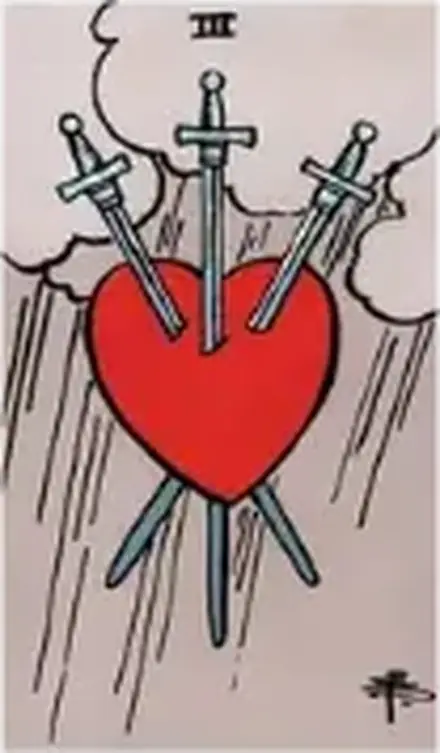
The Three of Swords is grief that pierces the heart: a painful truth, a separation or a loss that needs time, tears and patience.
Draw this card · Its correspondences
- Arcana: Minor, number 3
- Suit and element: Swords, Air
- Golden Dawn title: Lord of Sorrow
- Sephirah: Binah
- Decan: Libra II, Saturn (10° to 20° Libra)
- Keywords: Heartbreak, separation, sorrow, rejection
- Yes or no?: No
- Archetype: The Heart That Understands
What the card shows
In the deck Pamela Colman Smith drew for Arthur Edward Waite in 1909, the Three of Swords is one of the simplest and most memorable images in the whole pack. There is no human figure at all. A large, clean red heart floats in the centre, pierced by three swords. One enters vertically from above and the other two cross it diagonally from the sides, their points emerging below. Behind it the sky is covered in grey cloud and a fine rain falls in slanting lines.
Each element has its reading. The heart is the emotional centre: what you love and what you feel. The swords belong to the suit of air, the suit of ideas, words and judgements, so the tradition understands that this wound comes through a truth, a sentence or a decision more than through a physical blow. The number three brings in a third party that breaks the pair, whether a person, a piece of news or a circumstance. The clouds and rain are sorrow being released, and in many readings the rain also washes clean and prepares the ground.
In The Pictorial Key to the Tarot (1910), Waite sums up the scene as three swords piercing a heart, with cloud and rain behind, and gives as meanings removal, absence, delay, division, rupture and dispersion. The Golden Dawn titled the card Lord of Sorrow, placed it in Binah, the sephirah of understanding and of the shaping mother, and gave it the second decan of Libra, ruled by Saturn, from 10° to 20° of the sign: the weight of the scales when one pan is emptied.
Three of Swords upright
Upright, the Three of Swords reads as pain that comes through a truth. A goodbye, a betrayal brought to light, a word that wounds, a loss that was expected or one that arrives out of nowhere. The card shows the wound at its clearest. The heart is in plain view and so are the swords. There is little to interpret here, and the meaning of the Three of Swords in tarot is direct.
The tradition adds a nuance worth keeping in mind. Swords are the suit of the mind, and the pain of this card usually comes with understanding. Something you could not see before becomes clear: why a relationship was failing, who a person really was, what a decision was going to cost. It hurts precisely because it is true. The Golden Dawn title, Lord of Sorrow, and the card’s place in Binah, the sephirah of understanding, both point that way.
In a spread, the Three of Swords tends to mark a period of grief, and grief keeps its own pace. The rain in the background is a reminder that tears are part of the process. Beside cards of comfort such as The Star or the Six of Cups, the wound reads as something beginning to close. Beside cards of exhaustion such as the Nine or Ten of Swords, the emphasis falls on rumination and on the time healing will take.
As advice, the card asks you to let the sadness in without covering it up or making it bigger. Name what happened, find company and let it rain for a while before deciding anything big.
Three of Swords reversed
Many readers never read reversals and let the surrounding cards supply the nuance instead. Those who do usually read the Three of Swords reversed in one of two ways.
The first is the wound beginning to close. The swords come out slowly, the rain eases and you can look at what happened from a little further away. There is forgiveness, understanding, or simply moving on, even if a scar remains.
The second follows Waite, who gives the reversed card mental alienation, error, loss, distraction, disorder and confusion. Read this way, the Three of Swords reversed shows pain that is never processed: denied, suppressed or replayed again and again. It can also point to sorrow that is inflated or fed, a wound reopened on purpose.
In both cases the advice is to give grief its own place and time, and to ask for help if the sadness lingers or weighs too heavily.
In love
In love, the Three of Swords is one of the most searched-for cards, and its meaning is plain: heartbreak. In a relationship it can point to a break-up, an affair discovered, a fight that leaves scars, or a third person, real or symbolic, who upsets the balance. Sometimes it is the sadness of knowing the relationship has run its course.
If you are single, the card speaks of grieving a past love, of rejection or of feelings that go unreturned. The Three of Swords in love invites you to cry what needs crying before you open yourself to someone new.
Reversed, in love
Reversed in love, the card reads as a wound starting to heal: a possible reconciliation, forgiveness or enough distance to understand what happened. It can also warn of hurt being papered over. The advice is to talk honestly about what took place.
Career and money
For career and money, the Three of Swords reads as a disappointment: a rejected project, harsh criticism, a colleague leaving or a split with a business partner. It can also signal painful financial news, such as a loss or an investment that went wrong. The tradition advises absorbing the blow, working out what it teaches and keeping the personal hurt apart from the professional decision.
Reversed, in career
Reversed, it points to recovery after a setback at work, or to a conflict that festers because nobody names it. Speak plainly and put what was agreed in writing.
Health and mood
For health and mood, the Three of Swords is linked with sadness, grief and the weight sorrow leaves in the body: a heavy chest, broken sleep, a lack of energy. It reads as a call to look after yourself and to seek support. No card can diagnose anything: if the sadness lasts or worries you, the right person to see is a health professional.
Yes or no? No
The Three of Swords reads as a no. The card shows a wound, a separation or a painful truth, and suggests that what you are asking about, as things stand, brings more sorrow than joy. It is a protective no: accepting the answer now often spares a deeper hurt later. If the question is whether something will hurt, the answer is yes.
Ask the card: a yes or no tarot reading with one card or three.
The archetype: The Heart That Understands
As an archetype, the Three of Swords is less a character than a wound that transforms whoever receives it. When it takes human form, it is the person in mourning: the widow who keeps her husband’s clothes, the abandoned lover rereading old letters, the daughter who uncovers her mother’s secret. It can also be embodied by the one who wounds, the bearer of bad news or the third person who enters a couple, though the card always looks at the pierced heart.
In the structure of a story, the Three of Swords holds the moment of loss that changes a character’s direction. It can be the inciting incident, the death or desertion of the first chapter, or the mid-novel wound that forces the protagonist to rethink who they are. Its dramatic power lies in its clarity. The reader sees the heart and the swords, and knows what hurts and why.
As a person, the Three of Swords is someone who has suffered and, because of it, understands. They may seem fragile, melancholy or withdrawn, and also clear-sighted, because grief has stripped away their illusions. The natural arc is mourning: denial, anger, sadness and, at last, an understanding they would never have reached without the wound. That is the lesson of Binah that the Golden Dawn set into the card.
For the archetype to work in fiction, the loss has to matter before it happens. The reader must have loved what breaks. If the heart was already empty, the swords pierce nothing.
In literature
- Wuthering Heights (Emily Brontë, 1847). Catherine chooses Edgar, and Heathcliff overhears only half of her confession. That broken sentence is the first sword; the wedding, Catherine’s death and the long revenge are the other two. The whole novel lives under the card’s rainy sky, on moors where mourning never ends.
- Blood Wedding (Federico García Lorca, 1933). The Bride runs off with Leonardo on her wedding day and leaves three broken hearts: her own, the Bridegroom’s and the Mother’s. Lorca turns the card’s third party into tragedy, and the final knife seals a grief the Mother has carried since the opening scene.
- The Year of Magical Thinking (Joan Didion, 2005). Didion recounts the year after her husband’s sudden death. With the precision of the suit of Swords, she examines grief with the mind, noting what she thinks and what she refuses to think. It is the Three of Swords as Binah: pain turned into understanding.
For writers
The conflict
The Three of Swords sets up a conflict between what is loved and a truth that wounds it. It works best when the hurt arrives through something said or discovered: a letter found in a drawer, a confession, a conversation half overheard. The card’s three suggests a third party that breaks the pair, whether a person, an illness or a duty. Plant the affection first, so the reader feels the blow alongside the character.
The twist
As a plot twist, the Three of Swords lets pain reveal something new. The loss forces the character to understand what they had ignored: who the person who left really was, why they went, what share of the blame is theirs. The richest moment comes after the news, when all three swords are still in the heart and someone has to decide what to do with them.
Prompts
- Write the scene where your protagonist receives bad news without ever stating it: show only what their hands do in the minutes that follow.
- Tell a break-up from the point of view of the card’s third person, the one who enters the couple knowing someone will be hurt.
- Narrate a rainy day in the life of someone in mourning, and let something small, a cup or a song, reopen the wound and begin to close it.
Its correspondences
- Element: Air. Source: Golden Dawn (tradition).
- Sephirah: Binah. Source: Golden Dawn (tradition).
- Decan: Libra II. Source: Golden Dawn (tradition).
Combinations
Three of Swords and Ace of Cups
With the Ace of Cups, the wounded heart opens again. Together they read as comfort arriving after a recent sorrow: a new affection or a reconciliation that starts to heal, even with the scar still visible.
Three of Swords and Queen of Swords
The Queen of Swords beside the Three shows where her clarity came from: a heartbreak or a loss. Together they read as grief that, worked through well, leaves lucidity, independence and firmer judgement.
Three of Swords and The Star
With The Star, the rain of the Three becomes healing water. Together they read as hope after sorrow: the wound begins to close and trust in what lies ahead returns.
Three of Swords and Five of Cups
The Five of Cups beside the Three of Swords underlines mourning. Together they read as a loss still being wept over that needs time, though the cups left standing are a reminder that something remains.
Three of Swords and The Lovers
With The Lovers, the wound touches a choice of the heart. Together they read as a love triangle, a decision between two people or the disappointment of finding the bond was other than it seemed.
Three of Swords and Four of Swords
The Four of Swords after the Three reads as the pause that follows the blow. The pair advises withdrawing for a while, resting and letting the mind settle before any decision is made.
Three of Swords and Ten of Swords
With the Ten of Swords, pain reaches its lowest point. Together they read as a hard ending that, once rock bottom is reached, makes room for the dawn breaking on the Ten’s horizon.
Frequently asked questions
What does the Three of Swords mean in tarot?
The Three of Swords stands for grief that pierces the heart: a separation, a betrayal, a loss or a truth that hurts. The tradition reads it as pain and also as understanding, because the wound comes from something true that can finally be seen.
What does the Three of Swords mean in love?
In love it reads as a break-up, infidelity, rejection or a third person entering the relationship. It is the card of heartbreak. The Three of Swords in love invites you to live through the grief before opening up to something new.
Is the Three of Swords a yes or no card?
It reads as a no. The card shows a wound and suggests your question leads to more pain than joy. Accepting the answer usually protects you from a deeper hurt. If you are asking whether something will hurt, the answer is yes.
What does the Three of Swords mean reversed?
Readers who use reversals see it as a wound starting to heal through forgiveness or distance, or, following Waite, as confusion and error: pain that is denied or replayed without being processed. The advice is to give grief its place.
What is the decan and Golden Dawn title of the Three of Swords?
In the Golden Dawn’s Book T, the Three of Swords is titled Lord of Sorrow. It corresponds to the second decan of Libra, 10° to 20°, ruled by Saturn, and to the sephirah Binah, the sphere of understanding. Its element is air.
Why are there no people on the Three of Swords?
Pamela Colman Smith drew only a heart, three swords and the rain. Leaving out figures lets the card work as a pure symbol of pain that anyone can recognise themselves in. The inner scene fills the whole space.
Do your readingPrevious: Two of Swords · Next: Four of Swords
The 14 cards of Swords
- Ace of Swords
- Two of Swords
- Three of Swords
- Four of Swords
- Five of Swords
- Six of Swords
- Seven of Swords
- Eight of Swords
- Nine of Swords
- Ten of Swords
- Page of Swords
- Knight of Swords
- Queen of Swords
- King of Swords
By Style Optimizer · published November 22, 2026.