Tarot / The 78 cards / Cups / Page of Cups
Page of Cups: tarot card meaning, upright and reversed
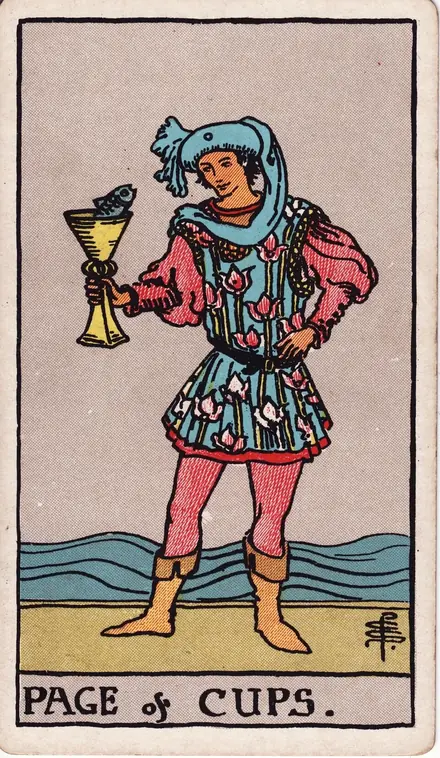
The Page of Cups is a message from the heart: a new feeling, a dreamy idea or a tender surprise that is still learning how to speak.
Draw this card · Its correspondences
- Arcana: Minor, court card (Page)
- Suit and element: Cups, Water
- Golden Dawn title: Princess of the Waters
- Nature: Earth of Water
- Sephirah: Malkuth
- Signs: Libra, Scorpio, Sagittarius
- Keywords: A creative message, curiosity, possibility
- Yes or no?: Yes, with conditions
- Archetype: The Dreaming Apprentice
What the card shows
In the deck Pamela Colman Smith drew for Arthur Edward Waite in 1909, the Page of Cups is a young man standing on the shore, the sea at his back and rippling waves behind him. He wears a blue tunic patterned with pink flowers and a cap with a long scarf falling over his shoulder. He holds a golden cup in one hand and gazes, with an expression of calm surprise, at the fish peeking over the rim and looking back at him.
Each detail has its reading. The sea is the water of the suit in its widest form, the unconscious and the world of feeling. The Page stands outside it, on firm ground, looking at it up close, which is why he is linked with emotion observed for the first time. The fish rising from the cup is the unexpected, an image that surfaces on its own from the imagination, something alive where you expected only water. The flowers on his tunic speak of youth and sensitivity, and his relaxed stance of someone who lets himself be surprised without fear.
Waite describes the figure as a fair, studious and intent page contemplating a fish rising from the cup to look at him, and sums it up as pictures of the mind taking form. The Golden Dawn arranges the court in its own way and swaps King and Knight: its Knight is the fire of the suit and its King the air. There, the figure that corresponds to the Page is the Princess of the Waters, the earthy part of water, seated in Malkuth, the last sefirah on the Tree of Life. In her cup a turtle appears in place of the fish, and the Princess rules a quarter of the heavens spanning Libra, Scorpio and Sagittarius. In The Book of Thoth, Crowley assigns her hexagram 41 of the I Ching, Decrease.
Page of Cups upright
Upright, the Page of Cups reads as a message that touches the heart. It can be emotional news, an invitation, a shy declaration, the arrival of a child or the first stirring of a feeling that does not yet know what it is. Pages are the court cards of learning and messages, and the Page of Cups is learning the language of emotion: he listens, he wonders, he tries things out.
The tradition gives the card a strong creative sense. The fish leaping from the cup is the idea that arrives unbidden, the image that appears in a dream, the sentence that presents itself whole. Waite links it with reflection, meditation and study. That is why it is often read as a good moment to start writing, painting or learning an artistic craft, as long as you are willing to be a beginner.
The Page of Cups as a person is someone young, or young at heart, sensitive, imaginative and kind. It might be a student, a child, a dreamy friend or the person who always carries a notebook in their pocket. Waite describes someone ready to render a service, with whom the querent will be connected. Their virtue is tenderness and a capacity for wonder; their risk is naivety and moods that shift easily.
As advice, the card invites you to pay attention to small messages: a hunch, a coincidence, an idea that keeps returning. It asks you to treat them with curiosity and to let them stay small for now.
Page of Cups reversed
Many readers never use reversals. They read every card upright and let the neighbouring cards shade the meaning. Those who do read reversed cards tend to see the Page of Cups reversed in one of two ways.
The first is immature emotion. Waite gives it the meanings of taste, inclination, attachment and seduction, along with deception and artifice: a fickle feeling, someone who becomes infatuated and then bored, an illusion lived as if it were love. Read this way, the card asks you to tell a passing desire from an affection that lasts.
The second is blocked inspiration. The fish stays inside the cup: a lack of ideas, fear of looking foolish, a sensitivity that hides to avoid being hurt. The advice is to recover play and curiosity, to allow yourself to do things badly at first, and to look into your own cup again without hurry.
In love
In love, the Page of Cups reads as a shy beginning. For someone single, it can point to a message from someone you like, an unexpected date or a gentle crush, the kind that starts with glances. For a couple, it usually speaks of tenderness, little attentions and romantic gestures, a season of play and closeness, and in some readings news of a pregnancy or the wish to have children.
Reversed, in love
Reversed, in love, it speaks of an immature or fickle feeling: promises that will not hold, youthful jealousy, or an idealisation that keeps you from seeing the other person. As advice, it asks for honest, calm conversation.
Career and money
For career and money, the Page of Cups reads as a creative proposal, a course of training or a first job in a field that excites you. It favours the arts, teaching, caregiving and work that calls for sensitivity. Financially, it points to modest beginnings, richer in enthusiasm than in figures.
Reversed, in career
Reversed, it points to poor concentration, ideas that stay as daydreams, or a casual attitude towards a responsibility. The advice is to set a deadline and finish something small.
Health and mood
For health and mood, the Page of Cups is linked with emotional sensitivity and the wellbeing that play, creativity and rest bring. It is also connected with childhood and fertility. A tarot card cannot diagnose anything: for any symptom or worry, the person to see is a qualified health professional.
Yes or no? Yes, with conditions
The Page of Cups reads as a soft “yes” with conditions. What you are asking about has a good emotional foundation, and it is only just beginning and still fragile: a piece of news, an idea or a feeling that needs care to grow. The “yes” holds if you give it time and take seriously what looks small today.
Ask the card: a yes or no tarot reading with one card or three.
The archetype: The Dreaming Apprentice
As an archetype, the Page of Cups is the character beginning to discover their inner world. The child who makes up stories, the teenager who writes poems in secret, the apprentice who has no idea yet that they have talent. They embody the first look at feeling, full of wonder and clumsiness, before experience hardens it.
In a story, the Page of Cups tends to appear in two ways. As protagonist, they are the figure of the sentimental coming-of-age novel: someone who learns to love, to lose and to say what they feel, with an arc that runs from naivety to a wiser tenderness. As a secondary character, they are the heart’s messenger: the servant who carries love letters, the child who says aloud what the adults keep quiet, the friend who brings the news that changes everything.
Their dramatic power lies in surprise. Like the fish rising from the cup, the Page brings something nobody expected, sometimes comic and sometimes revealing. Their weakness, which also offers plenty to work with, is naivety: they believe what they imagine, and the story can test them with disillusionment. Waite’s shadow, seduction and artifice, suits young characters who play with other people’s feelings without measuring the harm. Written well, the Page of Cups reminds the reader what it was like to feel something for the first time.
In literature
- Anne of Green Gables (Lucy Maud Montgomery, 1908). Anne Shirley arrives at Green Gables with an overflowing imagination: she gives poetic names to ponds and lanes and talks endlessly about what she feels. The novel follows her education in affection, with comic mistakes and disappointments, and she never loses her capacity for wonder.
- Letters to a Young Poet (Rainer Maria Rilke, 1929). A young would-be poet writes to Rilke for advice, and Rilke answers that he should look inward and be patient with everything still unresolved in his heart. It is the Page of Cups in its purest form: the message, the apprenticeship and a sensitivity taking shape little by little.
- The Secret Garden (Frances Hodgson Burnett, 1911). Mary Lennox, a sour and lonely child, finds a key, a locked door and a garden everyone thought was dead. As she tends it, green shoots appear, and so does her own tenderness. Burnett captures the Page’s gift: looking closely at something small and discovering it is alive.
For writers
The conflict
The Page of Cups sets up a conflict between sensitivity and the world that judges it. The character feels a great deal and shows it without a filter, and around them are people who mock, who refuse to take them seriously, or who take advantage. To prepare the card, give them a concrete way of expressing what they feel, such as a notebook, a song or a drawing, and put that outlet in danger.
The twist
As a plot twist, the Page of Cups is the unexpected message: a letter, a note, a confession from someone young that overturns what everyone thought they knew. It works especially well when the messenger does not fully understand what they carry. The fish in the cup offers another clue: make whatever surfaces strange, small and alive, a surprise that forces everyone to look.
Prompts
- Write the scene in which a child delivers a message without knowing it contains a declaration of love.
- Have your character find in an old notebook something they wrote as a teenager that now strikes them as true.
- Tell of an afternoon by the sea when something small and unexpected comes out of the water and changes the mood of the one who finds it.
Its correspondences
- Element: Water. Source: Golden Dawn (tradition).
- Sephirah: Malkuth. Source: Golden Dawn (tradition).
- Sign: Libra. Source: Golden Dawn (tradition).
- Sign: Scorpio. Source: Golden Dawn (tradition).
- Sign: Sagittarius. Source: Golden Dawn (tradition).
- Hexagram: 41 · Decrease. Source: Crowley, The Book of Thoth (modern system).
In the Golden Dawn the Knight is the fire of the suit and the King its air. Many modern readings of the Rider deck swap the two.
Combinations
Page of Cups and Ace of Cups
With the Ace of Cups, the Page brings news of an emotional beginning. It reads as a new feeling announced by a message, a date or a gesture, with all its growing still ahead.
Page of Cups and The High Priestess
Beside The High Priestess, the Page of Cups reads as an intuition speaking in dreams or images. It is a fine pairing for creative work and for listening to what has no words yet.
Page of Cups and The Moon
With The Moon, the Page’s imagination grows confused. It reads as fantasies taken for facts, or an ambiguous message worth confirming before you get your hopes up.
Page of Cups and Knight of Cups
The Page and the Knight of Cups together speak of romance in two beats: the shy message and the proposal that follows. They read as a love story starting to move.
Page of Cups and Page of Wands
With the Page of Wands, emotion meets enthusiasm. It reads as exciting news that spurs you to act, or a creative project born with plenty of drive.
Page of Cups and Page of Swords
Beside the Page of Swords, heart and intellectual curiosity cross paths. It reads as a message worth reading carefully, or a learning process that blends sensitivity and analysis.
Page of Cups and The Sun
With The Sun, the Page of Cups reads as childlike joy, play and good news. In family matters, the tradition links it with a birth or with the excitement of the children in the house.
Frequently asked questions
What does the Page of Cups mean in tarot?
The Page of Cups stands for a message from the heart: emotional news, a new feeling or a creative idea that arrives by surprise. The tradition reads it as the figure learning the language of emotion, with curiosity, tenderness and a touch of naivety.
What does the Page of Cups mean in love?
In love it reads as a shy beginning: a message from someone you like, a date or a gentle crush. For a couple, it speaks of tenderness and romantic gestures, and in some readings of the wish to have children or news of a pregnancy.
Is the Page of Cups a yes or no?
It reads as a soft yes with conditions. The matter has a good emotional foundation and is still young and fragile, so the outcome depends on giving time and care to what looks small today.
What does the Page of Cups reversed mean?
Readers who use reversals usually see it as immature or fickle emotion, a seduction that toys with feelings, or inspiration blocked by fear of looking foolish. The advice is to tell a whim from real affection and to recover your curiosity.
What is the Page of Cups like as a person?
As a person, the Page of Cups is someone young or young at heart, sensitive, dreamy and kind: a student, a child, a budding artist or a friend who always brings good news. Their virtue is wonder; their risk, naivety and changing moods.
What are the Golden Dawn correspondences of the Page of Cups?
In Book T, the equivalent figure is the Princess of the Waters, of the nature of earth of water, seated in Malkuth. She rules a quarter of the heavens spanning Libra, Scorpio and Sagittarius. In *The Book of Thoth*, Crowley assigns her hexagram 41, Decrease.
Do your readingPrevious: Ten of Cups · Next: Knight of Cups
The 14 cards of Cups
- Ace of Cups
- Two of Cups
- Three of Cups
- Four of Cups
- Five of Cups
- Six of Cups
- Seven of Cups
- Eight of Cups
- Nine of Cups
- Ten of Cups
- Page of Cups
- Knight of Cups
- Queen of Cups
- King of Cups
By Style Optimizer · published November 22, 2026.