Tarot / The 78 cards / Swords / King of Swords
King of Swords: tarot card meaning, upright and reversed
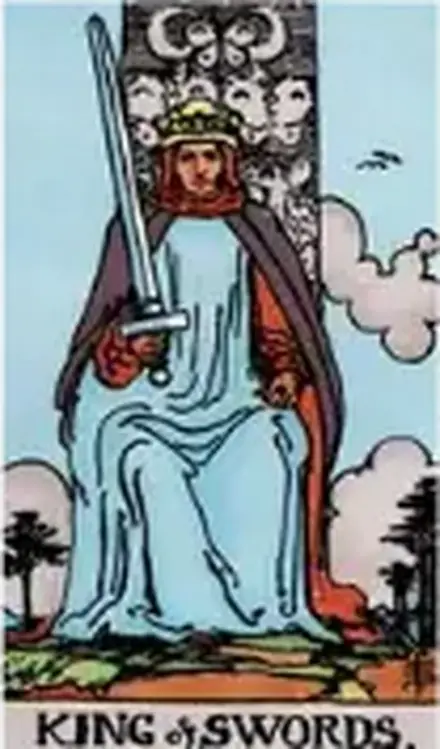
The King of Swords is the authority of reason: judgement based on facts, the law applied firmly and a word that carries weight in public.
Draw this card · Its correspondences
- Arcana: Minor, court card (King)
- Suit and element: Swords, Air
- Golden Dawn title: Prince of the Chariot of the Winds
- Nature: Air of Air
- Sephirah: Tiphareth
- Signs: Capricorn, Aquarius
- Keywords: Intellectual truth, authority, discipline, justice
- Yes or no?: Yes
- Archetype: The Judge Who Holds the Sword
What the card shows
In the deck Pamela Colman Smith drew for Arthur Edward Waite in 1909, the King of Swords sits facing forward, looking straight at whoever holds the card. In his right hand he holds his bare sword, raised and slightly tilted. He wears a blue tunic, a purple cloak and a crown. The tall grey stone back of his throne is carved with butterflies and crescent moons, and a small winged figure peers out from it. Behind him, low clouds cover the horizon, a few tall trees sway in the wind and two birds cross the sky.
Each element has its reading. The frontal pose and the raised sword recall Justice among the Major Arcana, and Waite says so explicitly: the King sits in judgement. The unsheathed blade is the power to decide and to separate true from false. The blue of the tunic is calm thought, and the purple is authority. The butterflies and the winged figure are air, the mind in transformation, and the moons are the part of judgement that also looks at what is hidden. The two birds, against the Queen’s single one, suggest a King who acts in the world and in relation to others.
The Golden Dawn swaps King and Knight: its Knight is the fire of the suit and its King the air. So this card corresponds to the Prince of the Chariots of the Winds, air of air, in Tiphareth, between Capricorn and Aquarius.
King of Swords upright
Upright, the King of Swords reads as intellectual authority and firm judgement. This is the card of the decision made with the head: after hearing both sides, reviewing the facts and weighing the arguments, someone rules. In the modern Rider reading he represents the outer mastery of air, the mind that orders the world through laws, contracts, strategies and precise words. Waite links him with power, command, law and offices of the crown.
In a spread he usually marks the moment to act with sound judgement and without being carried away by emotion. He can point to a legal matter, a negotiation, an exam, a performance review or any situation where logic and ethics count. He also speaks of responsibility: whoever holds the sword has to wield it justly.
As a person, the King of Swords is mature, intelligent and demanding, quick to think and clear in speech. He is the lawyer, the judge, the doctor, the researcher, the editor, the director who makes hard calls. He values truth above comfort and consistency above affection. He can come across as distant or stern. His words are measured, and when he gives his word, it holds. He has principles and defends them. He listens to arguments and changes his mind for a good reason, rarely for a plea. The tradition imagines him as a man, though he describes anyone whose authority rests on knowledge. His weak point is coldness: he can forget that behind every case is someone who feels.
As advice, the card asks you to decide on the facts, keep your agreements and speak with the precision of someone who knows words have consequences.
King of Swords reversed
Many readers never read reversals and let the surrounding cards supply the nuance instead. Those who do usually read the King of Swords reversed in one of two ways.
The first is authority abused. Intelligence is put to work for control, and the law is applied cruelly or bent to suit. Waite speaks of cruelty, perversity, perfidy and evil intention. The person knows how to argue and uses that gift to manipulate, humiliate or dominate.
The second is blocked judgement. The mind circles without deciding, hides behind rules or freezes for fear of getting it wrong. It can also point to an unfair ruling, a process that goes awry or someone who mistakes rigidity for rigour.
In both cases the advice is to return to the scales: check whether your reasons are honest, separate authority from pride and remember that the sword exists to serve justice, never to wound for the sake of wounding.
In love
In love, the King of Swords reads as a relationship built on respect, conversation and honesty. With a partner he points to clear agreements, commitments kept and the need to talk frankly about what works and what does not. He can describe someone reliable and protective, sparing with grand declarations, who shows affection through actions and consistency.
If you are single, the tradition links him with choosing with your head: knowing what you are looking for and resisting the first impulse. He can also herald an intelligent, self-assured and somewhat reserved person who inspires admiration before passion.
Reversed, in love
Reversed in love, the King of Swords speaks of coldness, constant criticism or control dressed up as logic. He can point to someone who wins every argument and loses the relationship, or a couple who reason a great deal and feel very little. The advice is to trade the verdict for a question.
Career and money
For career and money, the King of Swords reads as professional competence, authority and strategic decisions. He favours legal matters, contracts, consulting, management and any field where judgement is in charge. He can signal a promotion to a position of responsibility or the advice of an expert. Financially, he advises planning, reading the small print and deciding by the numbers.
Reversed, in career
Reversed, he points to an authoritarian boss, unfair decisions, legal disputes or a use of power that harms the team. The advice is to document everything, get professional advice and avoid answering abuse with the same harshness.
Health and mood
For health and mood, the King of Swords is linked with mental strain, high self-demands and the urge to control everything. He reads as an invitation to order your habits with discipline while also letting your mind rest. No card can diagnose anything: for any symptom or worry, the right person to see is a health professional.
Yes or no? Yes
The King of Swords reads as a firm yes when the question has a logical answer and has been thought through. The card favours decisions based on facts, clear agreements and whatever is done the right way. If the question rests only on desire or impulse, the King first asks for a cooler analysis.
Ask the card: a yes or no tarot reading with one card or three.
The archetype: The Judge Who Holds the Sword
As an archetype, the King of Swords is the character who decides for others in the name of a higher reason: the law, the truth, duty. He is the judge, the general drawing up plans, the doctor delivering the diagnosis, the patriarch dictating his will, the detective who gathers everyone in the drawing room to name the culprit. His power comes from what he knows and from what he is willing to say out loud.
In the structure of a story, the King of Swords tends to appear in two places. At the beginning, as the authority who sets the rules of the world and against whom the protagonist must measure up. At the end, as the figure who pronounces the verdict and closes the story. Between those two moments, the dramatic question is whether his judgement will be just. A good King of Swords keeps the reader uneasy, because he is right in general and may be wrong in this particular case.
His shadow is the inquisitor: intelligence without compassion, the rule that matters more than the person, power justifying itself with flawless arguments. Many of the great tragedies of the law begin there, with the man who does his duty and destroys someone along the way.
As a plot moment, the card marks the sentence: the scene where someone with authority decides and the story can no longer turn back. The better the reasoning has been prepared, the heavier the decision lands.
In literature
- To Kill a Mockingbird (Harper Lee, 1960). Atticus Finch is the King of Swords at his brightest: a lawyer defending a Black man falsely accused in a small Alabama town. He argues calmly, knows he will lose and defends the truth all the same. His children learn from him that reason also demands courage.
- Les Misérables (Victor Hugo, 1862). Inspector Javert embodies the King of Swords reversed: law without mercy. He hunts Jean Valjean for years, convinced that order stands above people. When an act of clemency proves him wrong, his world of rules shatters and he can find no way out.
- Measure for Measure (William Shakespeare, 1604). Angelo is handed power over Vienna and enforces the law with relentless rigour until he falls into the very vice he condemns. Shakespeare shows both faces of the King of Swords in one character: the severe judge and the hypocrite who uses authority for his own ends.
For writers
The conflict
The King of Swords sets up a conflict between justice and compassion. The character has the authority to decide and clear rules to follow, and the case before him puts those rules to the test: a friend, a child, someone guilty by the letter and innocent at heart. It works best when the reader understands his reasons and dreads the verdict at the same time, and when deciding costs him something of his own.
The twist
As a plot twist, the King of Swords is the unexpected verdict: the judge who acquits against every prediction, the authority who admits his mistake in public, the cold mentor who reveals he had planned it all. It can also be the King’s own fall, when it comes out that he applied to others a law he himself was breaking. The raised sword can turn on the one holding it at any moment.
Prompts
- Write the scene in which a judge reads out a sentence that breaks his heart, without ever saying so.
- Tell the story of a house rule laid down by a father or mother, and of the day they have to apply it to themselves.
- Have your protagonist win an argument with flawless reasoning and, at the end, realise they have lost something more important.
Its correspondences
- Element: Air. Source: Golden Dawn (tradition).
- Sephirah: Tiphareth. Source: Golden Dawn (tradition).
- Sign: Capricorn. Source: Golden Dawn (tradition).
- Sign: Aquarius. Source: Golden Dawn (tradition).
- Hexagram: 57 · The Gentle (Wind). Source: Crowley, The Book of Thoth (modern system).
In the Golden Dawn the Knight is the fire of the suit and the King its air. Many modern readings of the Rider deck swap the two.
Combinations
King of Swords and Queen of Swords
The King and Queen of Swords together read as the complete mind: he rules, she perceives. They point to a decision that needs rigour and listening at once, or a couple who admire each other’s intelligence.
King of Swords and Justice
With Justice, the King of Swords reinforces everything that makes him a judge. Together they read as a legal matter, a contract or a ruling decided on the facts, and as a demand to act fairly.
King of Swords and Knight of Swords
The King and Knight of Swords are mature thought and impulsive thought. Together they advise slowing down, reviewing the arguments before charging ahead and letting strategy guide action.
King of Swords and The Emperor
The Emperor beside the King of Swords adds structure to intelligence. Together they read as solid authority, clear rules and a command that knows how to organise, with a warning about rigidity.
King of Swords and King of Cups
With the King of Cups, the card balances reason and feeling. Together they read as advice to decide with your head without losing empathy, or as two authorities who complement each other.
King of Swords and Judgement
Judgement and the King of Swords speak of a verdict that closes a chapter. Together they read as a final assessment, a decision that arrives after a long time or the need to give an honest account.
King of Swords and Two of Swords
With the Two of Swords, the deadlock meets someone who can resolve it. Together they read as a postponed decision that calls for firm judgement, sometimes from a third party with authority.
King of Swords and Ace of Swords
The Ace of Swords beside the King reads as a clear idea in the hands of someone who knows how to apply it. Together they point to a decisive argument, a truth that prevails or the start of an intellectual project with direction.
Frequently asked questions
What does the King of Swords mean in tarot?
The King of Swords stands for the authority of reason: firm judgement, law, strategy and precise speech. In the modern Rider reading he is the outer mastery of air, the mind that puts the world in order. Waite compares him with Justice in the Major Arcana: the King sits in judgement.
What does the King of Swords mean in love and as feelings?
In love he reads as a relationship built on respect, honesty and clear agreements, or as a reliable person who shows affection through actions. As feelings, he suggests serious, considered intentions expressed with restraint. Reversed, he warns of coldness, criticism or control dressed up as logic.
What is the King of Swords like as a person?
As a person, the King of Swords is mature, intelligent and demanding, with firm principles and measured words. He is the lawyer, judge or director who decides on the facts. He can seem cold or stern, and he keeps his promises. His risk is forgetting the person behind the case.
Is the King of Swords a yes or no card?
He reads as a firm yes when the question has a logical answer and has been well thought through. He favours clear agreements and fact-based decisions. If everything hinges on impulse or desire, the King first asks for a cooler analysis.
What does the King of Swords mean reversed?
Readers who use reversals see him as authority abused: cruelty, manipulation, the law bent to suit. Also as blocked judgement, someone who cannot decide or hides behind rules. The advice is to check that your reasons are honest and to keep authority apart from pride.
Why is the King of Swords a Prince in the Golden Dawn?
The Golden Dawn swaps King and Knight: its Knight is the fire of the suit and its King the air. The Rider King of Swords therefore corresponds to the Prince of the Chariots of the Winds, air of air, in Tiphareth, between Capricorn and Aquarius. Crowley assigned him hexagram 57, the Wind.
Do your readingPrevious: Queen of Swords · Next: Ace of Pentacles
The 14 cards of Swords
- Ace of Swords
- Two of Swords
- Three of Swords
- Four of Swords
- Five of Swords
- Six of Swords
- Seven of Swords
- Eight of Swords
- Nine of Swords
- Ten of Swords
- Page of Swords
- Knight of Swords
- Queen of Swords
- King of Swords
By Style Optimizer · published November 22, 2026.