Tarot / The 78 cards / Wands / Two of Wands
Two of Wands (2 of Wands): tarot card meaning, upright and reversed
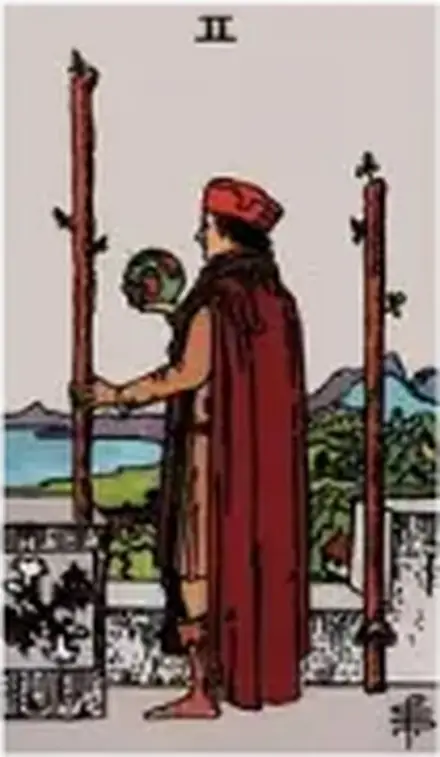
The Two of Wands is dominion already won and the restlessness of someone who holds the world in one hand and wonders where to go next.
Draw this card · Its correspondences
- Arcana: Minor, number 2
- Suit and element: Wands, Fire
- Golden Dawn title: Lord of Dominion
- Sephirah: Chokmah
- Decan: Aries I, Mars (0° to 10° Aries)
- Keywords: Future planning, progress, decisions, discovery
- Yes or no?: It depends
- Archetype: The Lord on the Battlements
What the card shows
In the deck Pamela Colman Smith drew for Arthur Edward Waite in 1909, the Two of Wands shows a tall man standing on the battlements of a castle. He is dressed in red and wears a red cap. In his right hand he holds a small globe; with his left he grips a wand propped against the parapet. The second wand is fixed to the stone behind him by an iron ring. From up high he looks out over a wide landscape: cultivated fields, a shoreline and open sea under a grey sky. On the wall to the left is a device of red roses and white lilies crossed in a saltire.
Every detail has a reading. The castle is what has already been conquered, a safe territory of one’s own. The globe is the whole world held in one hand: ambition, the map, the plan. The two wands read as two paths or two forces. The one fastened to the wall is what you already have, and it stays put. The one in his hand is what he can still do. The roses and lilies join desire with purity of intention, two impulses that live side by side in anyone making plans.
In The Pictorial Key to the Tarot (1910), Waite sees a lord surveying his dominion and gazing at the globe at the same time, and he compares his mood to the sadness of Alexander amid the grandeur of the world. The Golden Dawn named the card the Lord of Dominion and gave it the first decan of Aries, ruled by Mars, and Chokmah, the second sefirah of the Tree of Life.
Two of Wands upright
Upright, the Two of Wands reads as the moment after the first success. The Ace of Wands was the spark. The Two is the spark turned into territory. Something has been achieved, a castle of your own, and from that height you look further out and begin to plan. The words tradition attaches to the card are planning, decision, progress and discovery.
In a spread it often points to a choice between keeping what is safe and setting out after something bigger. The card has a foot on each side: the wand fixed to the wall and the wand in the hand. It speaks of ambition with a base under it, of someone who has proved their strength and now wants to test it against the world. It also speaks of the unease that comes with that moment. Waite holds both faces at once: riches and power, and alongside them a certain gloom, the sense that what has been won tastes thin.
The decan sets the tone. Mars in Aries is the most direct energy in the zodiac, all ignition and initiative. That is why the Two of Wands rarely stays in contemplation for long. It asks you to draw up a plan, study the map and choose a direction. Next to travel cards, such as the Six of Swords or the Knight of Wands, it reads as a departure being prepared. Next to cards of stagnation, such as the Four of Cups, the stress falls on dissatisfaction.
As advice, the card invites a cool-headed decision. The world fits in your hand while you look at it from above. To actually reach it you have to come down from the castle, and that means choosing one road and giving up the other.
Two of Wands reversed
Not every school reads reversals. Many readers work with upright cards only and let the surrounding cards add nuance. Those who do read the Two of Wands reversed usually take it in one of two ways.
The first is fear of leaving. You have the plan, the map and the means, and you still stay on the roof. Dominion turns into confinement. What is safe weighs more than what is possible, and the decision gets postponed again and again.
The second is surprise. For the reversed card Waite gives meanings such as wonder, enchantment and emotion, along with trouble and fear. Something unexpected changes the plans: an offer that arrives unsought, news that forces a rethink of the whole direction.
In both cases the advice is to look at what you are protecting and ask whether it is still worth it. Sometimes the right plan is the smallest one. Sometimes the best move is to let the surprise open the door.
In love
In love, the Two of Wands reads as a relationship looking to the future. For couples it can point to shared plans: moving, travelling, taking the next step. It can also mark an imbalance, when one partner has their eyes on the horizon and the other feels like part of the castle, something already acquired. The card asks for an honest talk about where each of you is heading.
If you are single, it speaks of independence and choice. You feel strong on your own and are asking what you really want. It may be time to step outside the familiar circle, or to choose between two people or two ways of living love. The Two of Wands as feelings is interested and ambitious, still deciding.
Reversed, in love
Reversed in love, the Two of Wands speaks of indecision and fear of change: plans that never take shape, a comfortable relationship that no longer excites, someone who makes promises and never moves. As advice, it suggests asking what you truly expect before you keep on waiting.
Career and money
For career and money, the Two of Wands reads as long-range planning. There is a solid base, a job or a business that works, and the card points to the wish to grow: a new market, a new employer, a venture of your own, work abroad. It is a good card for weighing options, running the numbers and mapping a strategy before you make a move. With money, it speaks of enough resources and the temptation to risk them on something bigger.
Reversed, in career
Reversed, it points to a plan stalled by too much caution or missing information. The advice is to get concrete: set a deadline, ask for the data you lack and choose, even if the step is small.
Health and mood
For health and mood, the Two of Wands is linked with high energy and the restlessness of someone always planning, and also with the flatness that comes when achievement fails to satisfy. It reads as an invitation to balance ambition with rest. No card can diagnose anything. For any symptom or worry, speak to a health professional.
Yes or no? It depends
The Two of Wands reads as “it depends.” The card shows someone with the means and the strength to get what they are asking about, still standing on the battlements with two roads ahead. The answer hangs on the decision you make and on taking the first step. If the question is whether to plan before acting, the answer is yes.
Ask the card: a yes or no tarot reading with one card or three.
The archetype: The Lord on the Battlements
As an archetype, the Two of Wands is the person who has already won something and finds it is not enough. They have taken their castle, they have a name or an estate, and they look at the horizon with a mix of ambition and melancholy. This is the conqueror before the great campaign, the heir who dreams of leaving the family land, the scientist who has solved one problem and is already thinking about a larger one.
In story structure, the card sits at the end of the setup, just before the protagonist crosses the threshold. The ordinary world has been built and it is comfortable. The call is right there, in the globe in their hand. The card’s dramatic force comes from the tension between two wands: what you have and what you want. While the character holds off choosing, the story hums with suspense. Once they choose, the journey begins.
The archetype has an intriguing shadow, the one Waite hints at with Alexander: the sadness of someone who has everything and feels the world is too small. A character like that can be admirable or frightening. They can use their dominion to explore or to conquer, and the reader keeps turning pages to find out which.
In fiction, the card works when the battlements can be seen and felt: a specific place to look out from, an object that embodies the desire, a clear sacrifice the decision will demand.
In literature
- The Great Gatsby (F. Scott Fitzgerald, 1925). Gatsby has the mansion, the parties and the fortune, and he still spends his nights staring at a green light across the bay. It is the Two of Wands at its saddest: dominion won and used as a platform for a desire that lies far away and may never be reached.
- Faust, Part One (Johann Wolfgang von Goethe, 1808). Faust has studied everything and feels walled up in his study. He commands the learning of his age and finds it small. His pact grows out of the Lord of Dominion’s dissatisfaction: to have much, to look beyond it and to decide to go out into the world at any price.
- Don Quixote (Miguel de Cervantes, 1605). Alonso Quijano has his estate, his library and a quiet life in a village of La Mancha. From there he dreams of the world in his books until he decides to ride out and find it. The chapter of his departure is a Two of Wands: the inner map is drawn, and only the gate is left to cross.
For writers
The conflict
The Two of Wands sets up a conflict between security already won and the desire for something greater. It works when the character has a lot to lose: a home, a post, a reputation. The more concrete the castle, the heavier the decision to come down from it. To prepare the card, show the character in their seat of power and let us see an object that embodies what they want: a map, a letter, a window.
The twist
As a plot twist, the Two of Wands is the choice that splits the story in two. The character stops looking and decides. The most interesting moment comes when they realise that taking one wand means letting go of the other: someone is left behind, a plan is dropped, a promise is broken. The reverse twist works too, when the character decides to stay and the story follows the one who leaves.
Prompts
- Write your protagonist’s last night in the place they have conquered, as they decide whether to leave at dawn.
- Describe a map, a globe or a window your character looks at every day, and let the object reveal what they want without naming it.
- Tell the same decision from the point of view of the person who stays in the castle while the other sets off to see the world.
Its correspondences
- Element: Fire. Source: Golden Dawn (tradition).
- Sephirah: Chokmah. Source: Golden Dawn (tradition).
- Decan: Aries I. Source: Golden Dawn (tradition).
Combinations
Two of Wands and Ace of Wands
The Ace and Two of Wands together describe an idea that has already taken shape. The Ace is the spark; the Two is the first territory won and the plan to go further.
Two of Wands and Three of Wands
With the Three of Wands, the Two’s plan gets moving. Together they read as a sequence of looking, deciding and waiting for the ships: a project that has already left the castle.
Two of Wands and The Fool
The Fool beside the Two of Wands pushes you to jump. Planning has gone as far as it can, and the pair asks you to go and see the world with less calculation and more trust.
Two of Wands and The Emperor
With The Emperor, dominion grows stronger. The pair reads as authority, structure and control of the territory, with the risk that security smothers the wish to explore.
Two of Wands and Four of Cups
The Four of Cups underlines the Two of Wands’ dissatisfaction: you have a lot and nothing excites you. The pairing invites you to look for the specific desire hiding behind the gloom.
Two of Wands and Two of Swords
With the Two of Swords, the decision locks up. Two roads, two arguments and someone who will not dare to choose. It reads as a need for more information or more courage.
Two of Wands and The Chariot
The Chariot beside the Two of Wands turns the plan into forward motion. The decision is made, and the energy of Aries moves out with direction and discipline.
Frequently asked questions
What does the Two of Wands mean in tarot?
The Two of Wands stands for dominion already achieved and eyes set on something bigger. Tradition reads it as planning, decision and discovery: someone with a firm base who is asking which road to take in order to keep growing.
What does the Two of Wands mean in love?
In love it reads as future plans and as choice. In a relationship it can describe shared projects, or an imbalance between the partner looking far ahead and the one who stays. For singles, it points to independence and the question of what you really want.
Is the Two of Wands a yes or no card?
It reads as “it depends.” The means to get there are in place; what is missing is the decision and the first step. The answer leans toward yes once you choose a road and follow it.
What does the Two of Wands reversed mean?
Readers who use reversals usually see it as fear of leaving safety, plans that keep being postponed, or dominion that becomes a cage. Waite also gives it a sense of surprise: something unexpected that changes the planned course.
What is the Two of Wands’ decan and Golden Dawn title?
In the Golden Dawn’s Book T, the Two of Wands is called the Lord of Dominion. It corresponds to the first decan of Aries, 0° to 10°, ruled by Mars, and to Chokmah, the second sefirah of the Tree of Life.
What does the globe in the Two of Wands represent?
The globe is the world held in one hand: ambition, the plan and the big picture. Set beside the castle, which is what has already been won, it reads as the wish to carry that dominion further, together with doubt about where to begin.
Do your readingPrevious: Ace of Wands · Next: Three of Wands
The 14 cards of Wands
- Ace of Wands
- Two of Wands
- Three of Wands
- Four of Wands
- Five of Wands
- Six of Wands
- Seven of Wands
- Eight of Wands
- Nine of Wands
- Ten of Wands
- Page of Wands
- Knight of Wands
- Queen of Wands
- King of Wands
By Style Optimizer · published November 22, 2026.