Tarot / The 78 cards / Wands / Five of Wands
Five of Wands (5 of Wands): tarot card meaning, upright and reversed
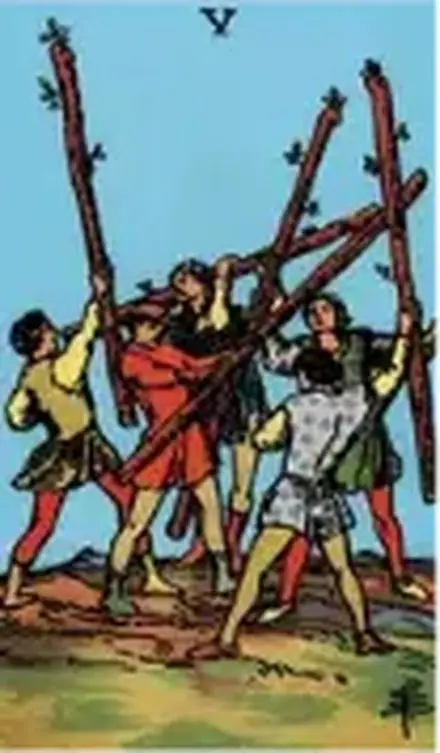
The Five of Wands is a contest between equals: many wills clashing at once, with more noise than wounds and plenty of energy waiting for order.
Draw this card · Its correspondences
- Arcana: Minor, number 5
- Suit and element: Wands, Fire
- Golden Dawn title: Lord of Strife
- Sephirah: Geburah
- Decan: Leo I, Saturn (0° to 10° Leo)
- Keywords: Conflict, disagreement, competition, tension, diversity
- Yes or no?: It depends
- Archetype: The Squabbling Gang
What the card shows
In the deck Pamela Colman Smith drew for Arthur Edward Waite in 1909, the Five of Wands shows five young men on open ground against a clean blue sky. Each holds a long wand and lifts it, crosses it or pushes it against the others. They wear clothes of different colours, and no two look alike. In the centre the wands form a tangle of lines cutting across one another with no clear pattern. Nobody is bleeding, nobody is on the ground, and nobody seems to be winning.
That last detail matters most: the fight has neither victor nor victim. Waite describes the scene as mimic warfare, a scuffle that could be sport or quarrel, and draws the card’s meaning from it: hard competition, the struggle to get ahead, the everyday battle for fortune. The different colours read as a variety of interests and temperaments. The wands, which in this suit are living branches with buds, remind us that what is clashing is creative energy, appetite and initiative. The clear sky suggests the storm is small and will pass.
The Golden Dawn called this card the Lord of Strife and placed it in Geburah, the sefirah of severity and of the force that cuts. Its decan is the first of Leo, ruled by Saturn: the proudest fire in the zodiac held back by the planet of limits. From that mix comes the picture of abundant energy that has not yet found its channel and keeps tripping over itself.
Five of Wands upright
Upright, the Five of Wands reads as a moment when many wills collide. There are arguments, friction, opinions talking over each other, a competitive atmosphere where everyone wants to speak at once. Tradition links it with rivalry between equals: colleagues, siblings, partners or friends each pulling their own way with the same force. That is why the conflict drags on. Nobody has enough authority to settle it.
What sets this card apart from harsher ones is its playful tone. It looks more like training, a heated debate or a brainstorm than a war. The five young men are sizing each other up, testing themselves and learning from one another. Handled well, this tension brings out the best in everyone. It forces people to defend their ideas, sharpen their arguments and measure themselves against someone who can match them.
It can also point to scattered effort. When the energy goes off in a thousand directions, the work stalls even though everyone is trying hard. In a spread, the Five of Wands often turns up when too many people are making decisions, too many projects are running at once, or a group has no clear rules.
As advice, the card suggests putting the noise in order. Choose which battles are worth fighting, set a turn for speaking, separate healthy competition from personal feuds. With a little structure, the contest turns into collaboration.
Five of Wands reversed
Not every school reads reversals. Many readers use only upright cards and let the neighbouring cards add nuance. Those who do read the Five of Wands reversed tend to take it in one of two ways.
The first is a conflict burning out. The sides grow tired, reach an agreement or discover they were fighting over very little. Read this way, the reversed card brings relief, a truce and the chance to work as a team after a stretch of friction.
The second is a conflict gone underground. The tension is still there, and nobody says it out loud: digs, silences, manoeuvres behind people’s backs and a rivalry dressed up as politeness. Among the reversed meanings Waite lists litigation and intricacy, and that tone of buried dispute fits this reading well.
In both cases the advice is to name the disagreement so it can be resolved, before it has time to fester.
In love
In love, the Five of Wands reads as a season of friction. For couples it can point to frequent arguments over small things, clashing temperaments, or third parties with opinions about the relationship: family, friends, exes. Often these are fights with a spark in them, the kind that keep attraction alive, as long as they stay off personal ground.
If you are single, the card speaks of competition: several people interested in the same person, dates that go nowhere, or a testing phase where it is hard to know what you want. The Five of Wands as feelings is charged and restless. It invites you to play the game and treat each rejection lightly.
Reversed, in love
Reversed in love, the Five of Wands points to a truce after a tense stretch or, the other way round, to complaints swallowed and piling up. The advice is to talk about what bothers you while it is still small.
Career and money
For career and money, the Five of Wands reads as competition. It may be a hiring process with many candidates, a market full of rivals, a meeting where nobody gives ground, or a team with crossed goals. Tradition sees it as a spur: it pushes you to stand out and improve. The risk is the wear of fighting on every front, so pick the ground where you can really win.
Reversed, in career
Reversed, it points to internal conflicts being dodged, unfair competition or an agreement reached out of sheer exhaustion. The advice is to clarify roles and rules before going on.
Health and mood
For health and mood, the Five of Wands is linked with built-up tension and the restlessness of living on high alert. It reads as an invitation to release energy in healthy ways, through movement, sport or rest. No card can diagnose anything. For any symptom or worry, speak to a health professional.
Yes or no? It depends
The Five of Wands reads as “it depends.” The situation is contested and the outcome is still open: there are other people, other interests or too many fronts at once. If you are willing to compete and bring order to the chaos, the answer leans toward yes. If you are hoping things will sort themselves out, it leans toward no.
Ask the card: a yes or no tarot reading with one card or three.
The archetype: The Squabbling Gang
As an archetype, the Five of Wands is the group before it becomes a team. It embodies a dynamic more than a character: the school playground, the newsroom, the band arguing in the rehearsal room, the freshly assembled crew. Everyone has strength and talent, and that is exactly why they collide. When it takes human form, it is the rival who is your equal, the colleague you fight with and learn the most from.
In story structure, the card covers the stretch of tests and minor confrontations: the moment the protagonist arrives in a new world and has to earn a place among peers. It is a great way to introduce a group of characters dynamically, because nothing reveals character as fast as an argument. Each wand is a point of view, and the reader learns who is who by watching how each one fights.
Its dramatic force lies in the ambiguity between play and threat. A Five of Wands scene can begin as a joke and end in a rupture, or begin as a duel and end in friendship. A writer who uses it well keeps the reader guessing. Is this training, or the first crack in the group? That doubt is the engine.
In literature
- The Three Musketeers (Alexandre Dumas, 1844). D’Artagnan arrives in Paris and, in a single morning, books duels with Athos, Porthos and Aramis. When the Cardinal’s guards turn up, the four rivals cross swords on the same side. The novel turns a scuffle between equals into friendship, which is the best way out of the Five of Wands.
- Lord of the Flies (William Golding, 1954). A group of shipwrecked boys play at organising themselves on the island, using the conch shell to decide who may speak. The disputes between Ralph and Jack start as playground rivalry and slowly lose their sense of play. Golding shows the card’s dark side: a contest without rules that stops being make-believe.
- 12 Angry Men (Reginald Rose, 1954). Twelve jurors locked in a room, each with his own prejudice and temperament, argue over a verdict. The whole drama is a verbal Five of Wands: voices crossing, alliances shifting and a debate that, through sheer friction, finally brings reasonable doubt into the light.
For writers
The conflict
The Five of Wands sets up a horizontal conflict between characters of equal strength, none of whom has authority over the rest. It works best when each one has a legitimate reason: nobody is the villain and everyone wants something different from the same project. To build it, give each character their own way of arguing, a favourite argument and one thing they refuse to give up. The clash will follow on its own.
The twist
As a plot twist, the card serves the moment when the game stops being a game. A mock fight ends with a real blow, or a friendly debate uncovers an old grudge. It also works the other way: a fierce dispute is cut short by an outside threat that forces the rivals onto the same side, and the scene changes direction in a single line.
Prompts
- Write an argument between five characters, each defending a different position, so that the reader can tell them apart without dialogue tags.
- Tell a fight that everyone treats as a game except one participant, and let the reader find out before the others do.
- Make two rivals who cannot stand each other work together for a single scene to survive a bigger problem.
Its correspondences
- Element: Fire. Source: Golden Dawn (tradition).
- Sephirah: Geburah. Source: Golden Dawn (tradition).
- Decan: Leo I. Source: Golden Dawn (tradition).
Combinations
Five of Wands and Page of Wands
With the Page of Wands, a beginner’s enthusiasm scatters into arguments and competition. The pair reads as a new idea everyone wants to steer; pick your battles carefully and focus the energy on one front.
Five of Wands and Six of Wands
The Five followed by the Six of Wands is the suit’s classic sequence: after the contest comes victory. The pair reads as a competition won through effort that ends in recognition.
Five of Wands and Five of Swords
Next to the Five of Swords, the friction loses its playful tone. The pair reads as a dispute where someone wants to win at any cost, with wounding words and a victory that leaves a bad taste.
Five of Wands and Temperance
Temperance beside the Five of Wands brings the missing mediation. It reads as the arrival of a person or a method able to blend opposing energies and turn the clash into balance.
Five of Wands and Justice
With Justice, the conflict looks for a referee. Tradition links the pair with disputes settled through formal channels: rules, contracts, mediation or an impartial decision.
Five of Wands and Three of Cups
The Three of Cups softens the Five of Wands and brings it close to a party. The pair reads as friendly rivalry, a competition between friends that ends in celebration.
Five of Wands and The Chariot
The Chariot beside the Five of Wands reads as the ability to prevail amid chaos: a clear will that gathers scattered forces and drives them in a single direction.
Frequently asked questions
What does the Five of Wands mean in tarot?
The Five of Wands stands for a contest between equals: arguments, competition and many wills clashing at once. Tradition reads it as conflict with more noise than harm, almost a game, which can become a spur once it is given order and rules.
What does the Five of Wands mean in love?
In love it reads as a season of friction: arguments over small things, clashing temperaments or the opinions of others. For singles, it speaks of competition and a testing phase. The advice is to keep the tone playful and stop fights from turning personal.
Is the Five of Wands a yes or no card?
It reads as “it depends.” The situation is contested and the result is still open. It leans toward yes if you are ready to compete and organise your fronts, and toward no if you are waiting for the conflict to resolve itself.
What does the Five of Wands reversed mean?
Readers who use reversals usually see it in one of two ways: as a conflict burning out and giving way to a truce, or as tension hiding behind politeness. Either way, naming the disagreement is the first step to resolving it.
What are the Five of Wands’ decan and Golden Dawn title?
In the Golden Dawn system, the Five of Wands is called the Lord of Strife. It corresponds to the first decan of Leo, 0° to 10°, ruled by Saturn, and to Geburah, the sefirah of severity. Hence its image of abundant fire running into a limit.
Is the Five of Wands a negative card?
Tradition treats it as a card of tension, though a light one. Waite’s scene has no wounded and no winners, so it also reads as healthy competition, debate and learning between equals. Its meaning depends heavily on the cards around it.
Do your readingPrevious: Four of Wands · Next: Six of Wands
The 14 cards of Wands
- Ace of Wands
- Two of Wands
- Three of Wands
- Four of Wands
- Five of Wands
- Six of Wands
- Seven of Wands
- Eight of Wands
- Nine of Wands
- Ten of Wands
- Page of Wands
- Knight of Wands
- Queen of Wands
- King of Wands
By Style Optimizer · published November 22, 2026.