Tarot / The 78 cards / Wands / Four of Wands
Four of Wands (4 of Wands): tarot card meaning, upright and reversed
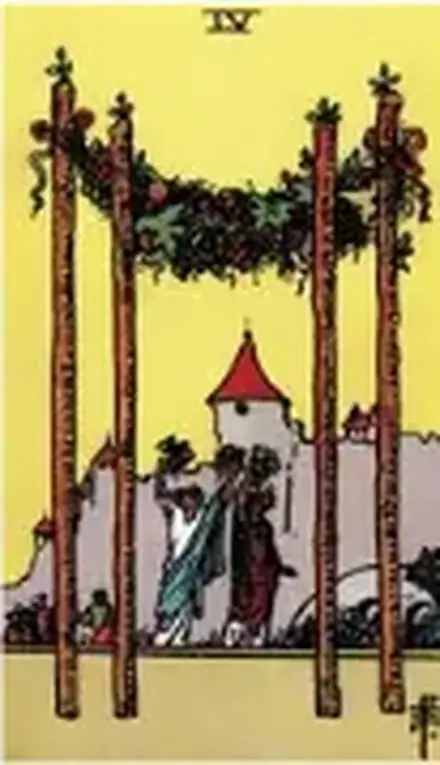
The Four of Wands is the party that crowns finished work: the homecoming, the wedding or the harvest that gathers everyone under the garland.
Draw this card · Its correspondences
- Arcana: Minor, number 4
- Suit and element: Wands, Fire
- Golden Dawn title: Lord of Perfected Work
- Sephirah: Chesed
- Decan: Aries III, Venus (20° to 30° Aries)
- Keywords: Celebration, joy, harmony, relaxation, homecoming
- Yes or no?: Yes
- Archetype: The Feast at the Threshold
What the card shows
In the deck Pamela Colman Smith drew for Arthur Edward Waite in 1909, the Four of Wands shows four tall wands planted in the foreground. A broad garland of flowers, leaves and fruit hangs between them, like an arch over a doorway or a wedding canopy. Behind it two women wearing flower crowns lift bouquets above their heads in a gesture of welcome. Further back stands a group of people, a bridge over a moat and an old castle or manor house. The sky is a bright, warm yellow.
Each piece has a reading. The four wands make a square, the figure of stability: the suit’s fire has found a firm structure and, for a moment, it rests. The garland turns that structure into a threshold, and passing beneath it means entering the celebration. The two women greet whoever arrives, which is why the card is tied to homecomings and hospitality. The bridge and the castle speak of home, community and a safe place behind whatever is being celebrated. The yellow sky is the joy and clarity of the day.
In The Pictorial Key to the Tarot (1910), Waite describes country life, a haven of refuge and a kind of domestic harvest festival, with repose, concord, harmony and prosperity. He adds something rare in his book: reversed, the card keeps the same meaning. The Golden Dawn named it the Lord of Perfected Work and gave it the third decan of Aries, ruled by Venus, and Chesed, the fourth sefirah of the Tree of Life.
Four of Wands upright
Upright, the Four of Wands reads as celebration. Something has come to a good end and deserves a party: a finished project, a move, a wedding, a reunion, a chapter that closes in success. Tradition links the card with joy, harmony, rest, community and coming home.
In a spread it often marks a time of happy stability. After the Ace’s impulse, the Two’s decision and the Three’s wait, the Four is the pause in which you gather what you sowed. It is one of the brightest cards in the suit of Wands, because the fire that elsewhere pushes and burns here gives warmth. It speaks of people gathered together, of a shared table, of feeling that you belong where you are.
The decan sets the tone. Venus in Aries softens the sign’s force and turns it into enthusiasm, affection and a taste for festivity. The Golden Dawn title, Lord of Perfected Work, underlines that what is being celebrated is the fruit of labour: a completed building, a goal reached. Next to Cups cards, such as the Three or the Ten, the stress falls on family and friends. Next to Pentacles cards, it falls on a new home or a material achievement.
As advice, the card invites you to stop and celebrate. Give thanks for what you have achieved, gather the people who helped and enjoy the moment before you throw yourself into the next project. Shared joy is also a way of strengthening the foundations.
Four of Wands reversed
Not every school reads reversals. Many readers work with upright cards only and let the surrounding cards add nuance. With the Four of Wands, Waite himself barely shifts the meaning: reversed, he says, the card still speaks of prosperity, increase, felicity and beauty.
Modern readings usually add two shades. The first is a celebration postponed or left incomplete: a party called off, a move delayed, an achievement that never gets the recognition it deserves.
The second is tension at home. The harmony is real, and still there is friction in the family or the group, someone who feels unwelcome, a gathering attended more from duty than joy.
In both cases the advice is to care for the bond before the form. The celebration can be smaller or come later and still keep its sense of gathering and of work well done.
In love
In love, the Four of Wands is one of the most favourable cards in the deck. For couples it can point to commitment, a wedding, moving in together, or a season of harmony and stability. The garland has long been seen as a bridal canopy, and tradition links it with a union celebrated in front of others. It can also mean introducing your partner to the family or building a home together.
If you are single, it speaks of meeting people at gatherings, parties and celebrations, and of feeling at ease in your own world. The Four of Wands as feelings is warm, proud and ready to make things official. It is a good moment to say yes to your social life.
Reversed, in love
Reversed in love, the Four of Wands speaks of commitment plans that are delayed, friction with family, or a stable relationship that needs its spark rekindled. As advice, it suggests celebrating the small things while the big ones are on their way.
Career and money
For career and money, the Four of Wands reads as a milestone reached: a project completed successfully, a launch, an opening, a team working in harmony. It can also point to a move into new offices or a pleasant working atmosphere. With money, it speaks of stability and enough resources to enjoy what you have achieved. It is a good card for recognising the team’s work.
Reversed, in career
Reversed, it points to an achievement that goes uncelebrated, a lack of recognition or tension in the group. The advice is to close the chapter properly and thank people for their effort before starting the next.
Health and mood
For health and mood, the Four of Wands is linked with well-earned rest, recovery after effort and the well-being that comes from company and home. It reads as an invitation to celebrate improvements and look after your relationships. No card can diagnose anything. For any symptom or worry, speak to a health professional.
Yes or no? Yes
The Four of Wands reads as a clear yes. The card shows work completed and celebrated, with home in the background and the community gathered. What you are asking about has good prospects, especially if it concerns commitments, moves, gatherings or projects coming to a close. Even reversed, Waite’s tradition keeps its favourable sense.
Ask the card: a yes or no tarot reading with one card or three.
The archetype: The Feast at the Threshold
As an archetype, the Four of Wands is more a scene than a character: the gathering that celebrates something accomplished. When it takes human form, it is the host greeting guests at the door, the traveller coming home, the bride under the garland, the old man who sees the whole family together for once. It is the figure who says welcome.
In story structure, the card has two natural places. It can be the happy ending, the wedding or banquet that closes a comedy and confirms that order has been restored. It can also be a scene in the middle, the party that brings every character into one room. The second is especially useful. A celebration forces people who would never otherwise meet to share a space, and it lets tensions rise beneath the joy.
The archetype has a shadow that literature knows well. The perfect party can paper over cracks, and the threshold under the garland can also be the place where something breaks. The more dazzling the celebration, the louder a silence, an absence or a misplaced remark will sound.
In fiction, the card works when the joy has been earned. The reader needs to feel the road travelled in order to enjoy the feast. It also works when the scene is rich in concrete detail: the food, the music, who sits next to whom, and who is missing.
In literature
- Blood Wedding (Federico García Lorca, 1933). Lorca builds the whole play toward a country wedding, with its songs, its orange blossom and a house made ready for the feast. In the middle of the celebration, the bride runs off with Leonardo. It is the Four of Wands turned to tragedy: the threshold of the party as the place where everything left unsaid explodes.
- The Dead (James Joyce, 1914). The story that closes *Dubliners* takes place at the Morkan sisters’ annual party: dancing, supper, speeches and songs in a crowded house. The celebration is warm and drawn in loving detail. At the end, a song wakes a memory in Gretta that transforms the night for her husband, Gabriel.
- Much Ado About Nothing (William Shakespeare, 1600). The comedy turns on feasts, masked dances and weddings. The first wedding collapses at the altar because of a slander, and only once the truth comes out does the final celebration arrive. Shakespeare shows both faces of the Four of Wands: the feast under threat and the feast restored.
For writers
The conflict
The Four of Wands sets up a conflict that grows inside harmony. The celebration brings together characters with unfinished business and makes them share the same garland for a few hours. It works when everyone wants the party to go well and each of them is hiding something. To prepare the card, decide what is being celebrated, who worked to make the day happen and who would rather be somewhere else.
The twist
As a plot twist, the Four of Wands is the arrival at the threshold. It may be the return of someone nobody expected at the party, news that transforms the celebration, or a toast that says too much. It also works the other way round: a long conflict that suddenly resolves because the characters meet at a wedding or a harvest and discover they are still family.
Prompts
- Write a family party from the point of view of the person who arrives late and crosses the threshold when everyone is already seated.
- Let a celebration go perfectly until someone raises a glass for a toast nobody asked them to give.
- Tell a character’s homecoming after years away through the small changes they notice at the table laid out for them.
Its correspondences
- Element: Fire. Source: Golden Dawn (tradition).
- Sephirah: Chesed. Source: Golden Dawn (tradition).
- Decan: Aries III. Source: Golden Dawn (tradition).
Combinations
Four of Wands and Three of Cups
The Three of Cups beside the Four of Wands multiplies the party. Together they read as celebration with friends, reunions and shared joy, one of the most festive pairings in the deck.
Four of Wands and Ten of Cups
With the Ten of Cups, the celebration centres on family. The pair reads as a happy home, a wedding or a moment of fulfilment shared with those closest to you.
Four of Wands and The Lovers
The Lovers beside the Four of Wands strengthen the sense of commitment. They read as a union that is chosen and celebrated, often a wedding or a decision to live together.
Four of Wands and Ten of Pentacles
The Ten of Pentacles adds inheritance and family wealth. The pair reads as a family home, a celebration across generations or material stability enjoyed in good company.
Four of Wands and Three of Wands
With the Three of Wands, the waiting ends in celebration. The ships are home and what was set in motion reaches harbour. It reads as a venture abroad that gets celebrated at home.
Four of Wands and The Sun
The Sun beside the Four of Wands is pure light. The pair reads as joy without shadows, visible success and a celebration where everyone feels included.
Four of Wands and Five of Swords
The Five of Swords brings conflict to the party. It reads as tension at a family gathering or in a group, a victory that not everyone celebrates in the same way.
Frequently asked questions
What does the Four of Wands mean in tarot?
The Four of Wands stands for the celebration of finished work. Tradition reads it as joy, harmony, homecoming and community: a project that reaches a good end, a wedding, a move or a reunion celebrated with others.
What does the Four of Wands mean in love?
In love it is one of the most favourable cards. For couples it is linked with commitment, weddings, moving in together and happy stability. For singles, it speaks of meeting people at gatherings and celebrations and of a social life opening up.
Is the Four of Wands a yes or no card?
It reads as a clear yes, especially for questions about commitments, moves, gatherings or projects coming to a close. Waite kept its favourable meaning even when the card is reversed.
What does the Four of Wands reversed mean?
Waite said the reversed card keeps its sense of prosperity and happiness. Modern readings add shades: a postponed celebration, an achievement that goes unrecognised, or friction in the family or group that needs attention.
What is the Four of Wands’ decan and Golden Dawn title?
In the Golden Dawn’s Book T, the Four of Wands is called the Lord of Perfected Work. It corresponds to the third decan of Aries, 20° to 30°, ruled by Venus, and to Chesed, the fourth sefirah of the Tree of Life.
Does the Four of Wands mean marriage?
It is one of the cards tradition most links with weddings, because the garland forms a canopy over the four wands. It can also speak of other celebrations: a new home, an anniversary, a harvest or the return of someone you love.
Do your readingPrevious: Three of Wands · Next: Five of Wands
The 14 cards of Wands
- Ace of Wands
- Two of Wands
- Three of Wands
- Four of Wands
- Five of Wands
- Six of Wands
- Seven of Wands
- Eight of Wands
- Nine of Wands
- Ten of Wands
- Page of Wands
- Knight of Wands
- Queen of Wands
- King of Wands
By Style Optimizer · published November 22, 2026.