Tarot / The 78 cards / Wands / Page of Wands
Page of Wands: tarot card meaning, upright and reversed
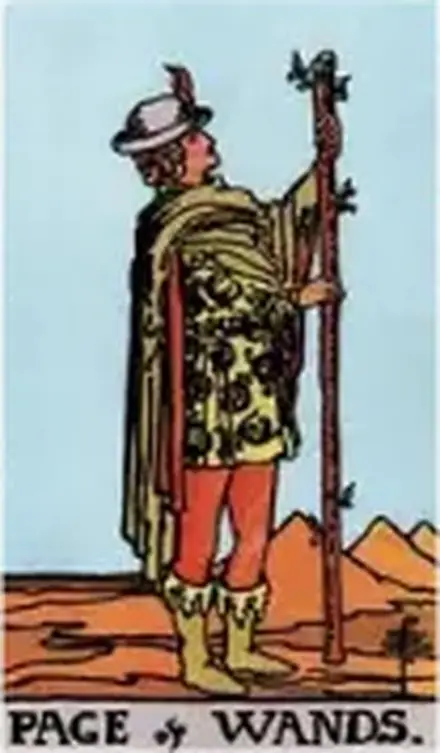
The Page of Wands is enthusiasm setting out to explore: news that sparks, a fresh curiosity and the urge to learn by doing.
Draw this card · Its correspondences
- Arcana: Minor, court card (Page)
- Suit and element: Wands, Fire
- Golden Dawn title: Princess of the Shining Flame
- Nature: Earth of Fire
- Sephirah: Malkuth
- Signs: Cancer, Leo, Virgo
- Keywords: Enthusiasm, exploration, discovery, a free spirit
- Yes or no?: Yes
- Archetype: The Eager Apprentice
What the card shows
In the deck Pamela Colman Smith drew for Arthur Edward Waite in 1909, the Page of Wands is a young man standing in a desert landscape. He holds a tall, sprouting wand with both hands and looks up at it intently, as if he expects something from it. He wears a yellow tunic printed with black salamanders, a short cloak and a cap with a red plume that flickers like a flame. In the background, three pyramids or mounds rise from the sand under a clear sky.
Each piece carries a traditional reading. His fixed gaze on the wand is the beginner’s curiosity: he is still studying the tool before he uses it. For alchemists and occultists, salamanders were the spirits of fire, creatures that live in the flame without burning, and on the tunic they mark the Page as wholly of that element. The red plume is enthusiasm you can see from a long way off. The desert and the pyramids suggest distant lands, possible journeys and ancient knowledge waiting to be found.
In The Pictorial Key to the Tarot (1910), Waite describes a young man “in the act of proclamation,” faithful though unknown, who brings strange news. That is why the card is linked with the messenger. In the Golden Dawn the Pages are Princesses: this one is the Princess of the Shining Flame, the earthy part of fire, placed in Malkuth and tied to the quadrant of Cancer, Leo and Virgo. That system arranges the court differently. Its Knight is the fire of the suit and its King is the air.
Page of Wands upright
Upright, the Page of Wands reads as enthusiasm, exploration and discovery. It is the stage when something new wakes your curiosity and you want to try it, learn it and make mistakes along the way. Modern tradition reads the Pages as messages and learning, and in Wands that learning has the energy of fire: you learn by doing, eagerly and with a little daring.
In a spread it often points to news that lights you up. It might be a proposal, an invitation, an idea passed on by someone else, or a discovery that opens a door. Waite links the card with the messenger and with favourable testimony, so it can also speak of someone who brings good references or backs a project.
The Page of Wands as a person reads as someone young at heart, whatever their age: curious, restless, expressive, with more ideas than experience. They love travel, challenges and the unknown. They are generous with their enthusiasm, spread it to everyone nearby and sometimes get bored before finishing what they start. At work this might be the intern who says what nobody else dared, or the student who has just found their calling.
The card is closely tied to the Ace of the same suit. The Ace is the spark, and the Page is the first person to pick it up and carry it somewhere. Next to cards of persistence, such as the Eight of Pentacles, curiosity becomes a craft. Next to unstable cards, such as the Five of Wands, the risk is scattering.
As advice, the card asks you to explore without worrying about looking like a beginner. Asking, trying and announcing what you want to do are all part of the road.
Page of Wands reversed
Not every school reads reversals. Many readers use only upright cards and let the neighbouring cards add nuance. Those who do read the Page of Wands reversed tend to take it in one of two ways.
The first is enthusiasm that burns out fast. Plenty of ideas, plenty of beginnings and little follow-through: the project that thrilled you on Monday is dropped by Friday. For the reversed card Waite speaks of anecdotes, announcements and bad news, and adds indecision, which fits this reading.
The second is news that is delayed or arrives differently from what you hoped. A slow reply, a muddled message, an opportunity announced only halfway.
Either way, the advice points to the same place. Choose one thing to learn and give it time before you jump to the next.
In love
In love, the Page of Wands reads as flirtation, excitement and messages that brighten the day. For couples it can point to a playful season full of novelty, spontaneous plans or the wish to rediscover each other. Waite goes as far as calling the Page a lover, which strengthens its romantic side.
If you are single, the Page of Wands often describes a new interest, someone who piques your curiosity, or a message that arrives out of the blue. The Page of Wands as feelings is excited, flirty and eager to find out more. The card is all about beginnings: the thrill is there, and it remains to be seen whether commitment will follow.
Reversed, in love
Reversed in love, the Page of Wands speaks of messages that never come, interest that cools quickly, or someone who plays along with no wish to get involved. As advice, it invites you to ask clearly what each of you is looking for.
Career and money
For career and money, the Page of Wands reads as a new apprenticeship, an internship, a course or a project with much still to discover. It favours initiative, communication and creative work. It can also point to career news that opens possibilities. Financially it speaks of modest beginnings with real potential.
Reversed, in career
Reversed, it points to a lack of follow-through, ideas that never take shape, or delayed news at work. The advice is to finish what you started before opening another front.
Health and mood
For health and mood, the Page of Wands is linked with youthful energy and the urge to move and try new activities. It reads as a good moment to take up a sport or a habit without forcing the pace. No card can diagnose anything. For any symptom or worry, speak to a health professional.
Yes or no? Yes
The Page of Wands reads as a yes, especially when the question is about learning, travelling, trying something new or receiving news. It brings enthusiasm and encourages you to dive in. The nuance is its youth: this yes is a beginning and needs persistence to bear fruit, because the card speaks more of exploration than of finished results.
Ask the card: a yes or no tarot reading with one card or three.
The archetype: The Eager Apprentice
As an archetype, the Page of Wands is the young character who throws themselves into discovering the world. They have more curiosity than experience and more appetite than method. They may be the apprentice, the student, the messenger or the newcomer who does not yet know the local rules and so dares to break them.
In story structure, the Page of Wands usually takes one of two places. The first is the protagonist at the start of the journey, when the reader shares their first mistakes and their first wonder. The second is the messenger: the secondary figure who arrives with news, a letter or a map and sets everyone else in motion. In both cases the Page brings energy and movement.
Its dramatic force lies in naivety. The Page sees what adults have stopped noticing and says what others keep quiet. That freshness can save a situation and can also land the whole group in trouble. The archetype’s natural arc is learning. The Page begins by looking at the wand as a toy and ends by understanding its weight.
For it to work in fiction, the character’s enthusiasm has to collide with reality. If everything goes their way, the Page falls flat. When their curiosity costs them something and they keep going anyway, the reader loves them.
In literature
- Treasure Island (Robert Louis Stevenson, 1883). Jim Hawkins is an innkeeper’s boy who finds a map and sails off into the unknown. He has the Page of Wands’ curiosity and nerve: he slips in where he should not, overhears what he was never meant to hear and learns through risk. The whole novel is his apprenticeship.
- Little Women (Louisa May Alcott, 1868). Jo March writes plays in the attic, publishes her first stories and argues with anyone who needs arguing with. She is the Page of Wands as a writer’s vocation: enthusiasm, impatience and a great deal to learn. Alcott shows how that youthful fire turns, over the years, into a craft.
- Adventures of Huckleberry Finn (Mark Twain, 1884). Huck runs away and drifts down the Mississippi on a raft, learning the world one bend of the river at a time. His quick wits and improvised schemes are the Page of Wands’ roguish face: he learns by doing, often the hard way, and each episode teaches him something about himself and about Jim.
For writers
The conflict
The Page of Wands sets up a conflict between a beginner’s enthusiasm and a world that demands experience. It works best when the character has a clear passion and nobody around them takes it seriously: family, a teacher, a closed profession. To prepare the card, let the reader see their clumsiness first and their talent afterwards, so the clash between the two creates tension.
The twist
As a plot twist, the Page of Wands is the message that arrives out of nowhere and changes the story’s direction: a letter, a rumour, a map, an invitation. It also works the other way, when the apprentice discovers something the experts overlooked. The most interesting moment comes when everyone else has to decide whether to believe the youngest member of the group.
Prompts
- Write your character’s first day in a trade they know nothing about, and let them make a mistake that ends up revealing a talent.
- Tell the arrival of a young messenger who brings strange news and has no idea how important it is.
- Have your protagonist announce a project out loud before they know how to do it, forcing everyone else to take it seriously.
Its correspondences
- Element: Fire. Source: Golden Dawn (tradition).
- Sephirah: Malkuth. Source: Golden Dawn (tradition).
- Sign: Cancer. Source: Golden Dawn (tradition).
- Sign: Leo. Source: Golden Dawn (tradition).
- Sign: Virgo. Source: Golden Dawn (tradition).
- Hexagram: 27 · Providing Nourishment. Source: Crowley, The Book of Thoth (modern system).
In the Golden Dawn the Knight is the fire of the suit and the King its air. Many modern readings of the Rider deck swap the two.
Combinations
Page of Wands and Ace of Wands
With the Ace of Wands, the spark finds someone to pick it up. The pair reads as a new idea that a young person or a beginner decides to explore, a start full of energy with everything still to learn.
Page of Wands and Eight of Pentacles
The Page of Wands with the Eight of Pentacles speaks of enthusiasm turning into a craft. The pair reads as hands-on learning, an internship or a course pursued with persistence.
Page of Wands and The Fool
With The Fool, exploration becomes an adventure without a safety net. The pair reads as a trip, a move or a change taken on with excitement and very little planning.
Page of Wands and Page of Cups
Waite warned that the Page of Wands followed by the Page of Cups could signal a rival. In modern reading, the two Pages together speak of news and new feelings arriving at the same time.
Page of Wands and Five of Wands
Next to the Five of Wands, enthusiasm scatters into arguments and competition. Pick your battles carefully and avoid spending your energy on every front.
Page of Wands and The Empress
With The Empress, curiosity becomes fertile. The pair reads as a creative project that grows, an idea that bears fruit or, in traditional readings, family news.
Page of Wands and Page of Swords
The Pages of Wands and Swords together speak of messages, questions and fast learning. They read as a period of study, crossing news and a great deal of conversation.
Frequently asked questions
What does the Page of Wands mean in tarot?
The Page of Wands stands for enthusiasm setting out to explore: news that sparks, a new curiosity and the urge to learn by doing. Tradition links it with the messenger and with the energetic beginner. It belongs to the suit of Wands, which corresponds to fire.
What does the Page of Wands mean in love?
In love it reads as flirtation, excitement and cheerful messages. For couples it speaks of play and novelty; for singles, of a new interest or someone who appears out of the blue. It is a card of beginnings, so commitment remains to be seen.
What is the Page of Wands like as a person?
It reads as someone young at heart, curious, restless and expressive, with more ideas than experience. They are drawn to travel and challenges, spread enthusiasm and sometimes struggle to finish what they start. It may be a student, an apprentice or the bearer of news.
Is the Page of Wands a yes or no card?
It reads as a yes, especially for questions about learning, travelling or trying something new. The nuance is that this yes opens a beginning and needs persistence to produce results.
What does the Page of Wands reversed mean?
Readers who use reversals usually see it as enthusiasm that fades quickly, abandoned projects or delayed news. Waite adds indecision. The advice is to focus on one thing and give it time.
What are the Page of Wands’ Golden Dawn correspondences?
In the Golden Dawn the Page is the Princess of the Shining Flame, earth of fire, placed in Malkuth and tied to Cancer, Leo and Virgo. That system swaps King and Knight: its Knight is the fire of the suit and its King is the air.
Do your readingPrevious: Ten of Wands · Next: Knight of Wands
The 14 cards of Wands
- Ace of Wands
- Two of Wands
- Three of Wands
- Four of Wands
- Five of Wands
- Six of Wands
- Seven of Wands
- Eight of Wands
- Nine of Wands
- Ten of Wands
- Page of Wands
- Knight of Wands
- Queen of Wands
- King of Wands
By Style Optimizer · published November 22, 2026.