Tarot / The 78 cards / Wands / Seven of Wands
Seven of Wands (7 of Wands): tarot card meaning, upright and reversed
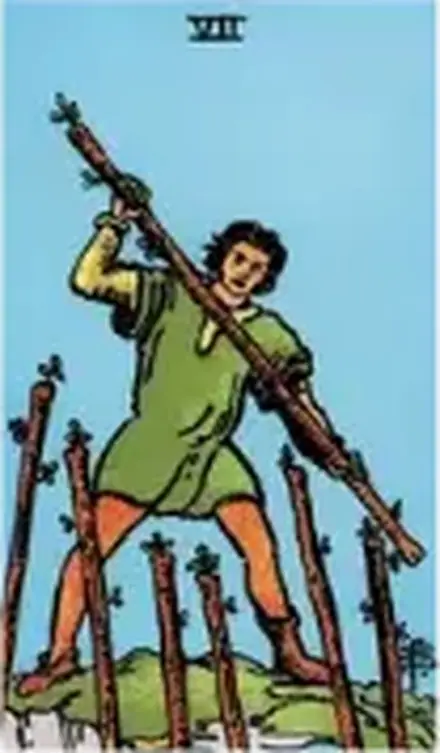
The Seven of Wands is the courage to hold your ground: a hard-won position that many challenge and that you keep with firmness and nerve.
Draw this card · Its correspondences
- Arcana: Minor, number 7
- Suit and element: Wands, Fire
- Golden Dawn title: Lord of Valour
- Sephirah: Netzach
- Decan: Leo III, Mars (20° to 30° Leo)
- Keywords: Challenge, competition, protection, perseverance
- Yes or no?: Yes, with conditions
- Archetype: The Defender on the Hill
What the card shows
In the deck Pamela Colman Smith drew for Arthur Edward Waite in 1909, the Seven of Wands shows a young man standing on top of a rise. He wears a green tunic and holds a wand with both hands in a defensive stance, like someone blocking a blow. From below, from the bottom edge of the card, six wands rise toward him. We never see the people holding them. Only the staves appear, climbing like the spears of an enemy hidden behind the slope. In the background lie a clear sky and open country.
One detail many people miss is his footwear: the young man wears a different shoe on each foot. It is usually read as a sign that he has had to defend himself with no time to prepare, using whatever was at hand, and also as the shaky balance of someone fighting on uneven ground. The rise is his advantage, since he stands above his opponents. Waite stresses this and reads the card as valour and vantage, because the one on high can hold off many even when alone. He adds meanings of discussion, negotiation and competition in trade, the battle of words and of the market.
The Golden Dawn called this card the Lord of Valour and placed it in Netzach, the sefirah of victory and of desire that endures. Its decan is the third of Leo, ruled by Mars: the sign’s proud fire joined to the planet of combat. It is the courage that rises when what you have is under threat.
Seven of Wands upright
Upright, the Seven of Wands reads as defending a position. Something has been won, a job, an idea, a project, a place in the group, and now others are contesting it. Criticism arrives, or competitors, pressure, people who want the same thing. Tradition links the card with the courage to stand firm and with the advantage of holding the high ground: you are outnumbered, and you are fighting from a better spot.
In a spread it often appears when you need to hold a conviction against the majority or protect something you worked hard to earn. It differs from the Five of Wands because the clash is no longer between equals: one person defends and many attack. It differs from the Six too, which celebrates victory. The Seven is the day you have to prove that victory was deserved.
The card asks for firmness and for judgement as well. The young man on the rise holds out because he knows why he is there. When the cause is clear, pressure makes you stronger. When it is unclear, the wear becomes enormous and it is worth asking whether this hill is worth it.
As advice, the Seven of Wands invites you to keep your place calmly, to avoid being dragged into a fight on your opponent’s terms and to use the advantage that clear ideas give you. In this card, perseverance is rewarded.
Seven of Wands reversed
Not every school reads reversals. Many readers use only upright cards and let the neighbouring cards add nuance. Those who do read the Seven of Wands reversed tend to take it in one of two ways.
The first is the defender’s exhaustion. You feel you cannot go on, you doubt your position and you think about giving up. Waite links the reversed card with perplexity, embarrassment and anxiety, and warns against indecision: the greatest danger is wavering in the middle of the defence.
The second is defensiveness without cause. Someone takes every comment as an attack and raises the wand against people who only wanted to talk, or clings to a position out of pride.
In both cases the advice is to look again at what you are defending and why, and to decide calmly whether to hold on or let go.
In love
In love, the Seven of Wands reads as a relationship that needs protecting. For couples it can point to outside pressure, criticism from family, a third person getting in the way, or the need to defend a shared decision against everyone else. It also speaks of defending your own boundaries within the relationship.
If you are single, the card points to keeping your standards in the face of pressure to find someone, or to competing for a person several others are interested in. The Seven of Wands as feelings is protective and a little guarded. It invites you to know what you want before you fight for it.
Reversed, in love
Reversed in love, the Seven of Wands points to excessive defensiveness, jealousy, or the exhaustion of holding a relationship together alone. The advice is to lower the wand and ask before assuming you are under attack.
Career and money
For career and money, the Seven of Wands reads as competition that tests a position you have earned: market rivals, colleagues after the same job, criticism of your project, or tough negotiations. Tradition sees it as favourable for those who are prepared, because the defender has the advantage. Lean on data, experience and the quality of the work you have done.
Reversed, in career
Reversed, it points to burnout, doubts about your own ability, or a battle lost to indecision. The advice is to choose what to defend and to delegate or release the rest.
Health and mood
For health and mood, the Seven of Wands is linked with long periods on high alert and the fatigue of living defensively. It reads as an invitation to protect your rest and set limits on whatever drains you. No card can diagnose anything. For any symptom or worry, speak to a health professional.
Yes or no? Yes, with conditions
The Seven of Wands reads as “yes, with conditions.” Your position is strong and the outcome can be favourable, though it will take effort: expect opposition, criticism or competition. The answer is yes for anyone willing to defend what they want with persistence and without wavering halfway.
Ask the card: a yes or no tarot reading with one card or three.
The archetype: The Defender on the Hill
As an archetype, the Seven of Wands is the character left standing alone against many. It embodies the one who upholds an uncomfortable truth, the guardian of a mountain pass, the scientist defending her discovery against the establishment, the lawyer who takes the case nobody wants. Its essential trait is being outnumbered, balanced by conviction and better ground. On the card the enemy does not even have a face. It is staves rising from below, the anonymous pressure of the crowd.
In story structure, the card covers the stretch where the protagonist has already won something and must show they can keep it. It is the siege, the last stand, the courtroom scene where everyone turns against the accused. It fits very well in the second half of the second act, when pressure is mounting and the character must decide whether the cause is worth the price.
The mismatched shoes are a lesson for writers. The Seven’s defender is almost never ready. They are caught half-dressed, without allies and without time. That improvisation makes them human and vulnerable. A hero who holds out with everything in their favour moves us very little. One who holds out in odd shoes, because there was no time to find the pair, wins the reader over.
In literature
- Antigone (Sophocles, 441 BC). Antigone buries her brother against King Creon’s decree and refuses to back down while the whole city stays silent. She holds her position alone, with the law of the gods as her high ground. It is the Seven of Wands in tragic form: the courage to keep a conviction in the face of power.
- An Enemy of the People (Henrik Ibsen, 1882). Dr Stockmann discovers that the spa town’s water is contaminated and refuses to keep quiet. The townspeople, the press and his own brother turn on him at a ferocious public meeting. Ibsen leaves him isolated and unbowed at the end, convinced that the strongest man is the one who stands most alone.
- To Kill a Mockingbird (Harper Lee, 1960). Atticus Finch agrees to defend Tom Robinson in a town that has already condemned him. The scene where he sits alone outside the jail as a mob arrives at night is an exact image of the card: one man in his place, facing many who climb toward him.
For writers
The conflict
The Seven of Wands sets up a conflict of one against many. The character has something others want or reject: a post, an idea, a piece of land, a secret. It works best when the opposition is varied, with attackers driven by different motives, and when the protagonist has some concrete advantage to make up for being alone. To build it, decide exactly what your character’s hill is and what they would lose by taking a step back.
The twist
As a plot twist, the card serves the moment the defender realises that one of the wands rising against them is held by someone they love. The opposite revelation works too: the protagonist, sure they are alone, discovers that someone has been quietly guarding their flank. Either one shifts the weight of the resistance in a single scene.
Prompts
- Write a scene where your protagonist defends an idea before a group, and do not let them win the argument, only stay on their feet.
- Make your character face an attack with no time to prepare, and let one detail of how they look give them away.
- Tell a siege from the point of view of one of the attackers, who slowly begins to admire the person holding out.
Its correspondences
- Element: Fire. Source: Golden Dawn (tradition).
- Sephirah: Netzach. Source: Golden Dawn (tradition).
- Decan: Leo III. Source: Golden Dawn (tradition).
Combinations
Seven of Wands and Six of Wands
The Six followed by the Seven of Wands warns that victory must be defended. After recognition come the rivals, and tradition reads this as the test that proves the triumph was deserved.
Seven of Wands and Strength
With Strength, the Seven’s courage becomes calm. The pair reads as resistance sustained without violence, through patience and self-command under pressure.
Seven of Wands and Nine of Wands
The Seven and Nine of Wands together speak of a long defence. They read as someone who has been holding out for a while, wounded but standing, and close to the end of the ordeal.
Seven of Wands and Seven of Swords
Next to the Seven of Swords, the defence gets complicated by strategy and deceit. Watch who attacks from the front and who does it from behind, and do not trust every alliance.
Seven of Wands and The Emperor
The Emperor beside the Seven of Wands reinforces the defender’s authority. The pair reads as a position held through clear rules, structure and a firm will to protect what is yours.
Seven of Wands and The Hanged Man
With The Hanged Man, the card invites a change of perspective. The pair reads as resistance worth pausing so you can see the situation from another angle before fighting on.
Seven of Wands and Four of Pentacles
The Four of Pentacles beside the Seven of Wands points to defending possessions or material security. It can be sensible protection or a clinging that keeps you from moving.
Frequently asked questions
What does the Seven of Wands mean in tarot?
The Seven of Wands stands for defending a hard-won position against those who challenge it. Tradition reads it as courage, perseverance and the advantage of the high ground: someone outnumbered who stands firm because they know why they are there.
What does the Seven of Wands mean in love?
In love it reads as a relationship that needs protecting from outside pressure, criticism or third parties, and as defending your own boundaries. Reversed, it points to excessive defensiveness or the fatigue of holding the relationship together alone.
Is the Seven of Wands a yes or no card?
It reads as “yes, with conditions.” The position is favourable, and the result demands effort and persistence against opposition. It is a yes for anyone ready to defend what they want without wavering halfway.
What does the Seven of Wands reversed mean?
Readers who use reversals usually see it as the defender’s exhaustion, doubt and the temptation to give up, or as defensiveness with no real cause. Waite warns against indecision. The advice is to review what you are defending and why.
What are the Seven of Wands’ decan and Golden Dawn title?
In the Golden Dawn system, the Seven of Wands is called the Lord of Valour. It corresponds to the third decan of Leo, 20° to 30°, ruled by Mars, and to Netzach, the sefirah of victory and endurance. Mars in Leo gives the image of courage defending its own.
Why does the man in the Seven of Wands wear mismatched shoes?
In Pamela Colman Smith’s drawing, the defender wears a different shoe on each foot. It is usually read as a sign that he was attacked with no time to prepare and is fighting on unstable ground with whatever he had to hand.
Do your readingPrevious: Six of Wands · Next: Eight of Wands
The 14 cards of Wands
- Ace of Wands
- Two of Wands
- Three of Wands
- Four of Wands
- Five of Wands
- Six of Wands
- Seven of Wands
- Eight of Wands
- Nine of Wands
- Ten of Wands
- Page of Wands
- Knight of Wands
- Queen of Wands
- King of Wands
By Style Optimizer · published November 22, 2026.