Tarot / The 78 cards / Wands / Nine of Wands
Nine of Wands (9 of Wands): tarot card meaning, upright and reversed
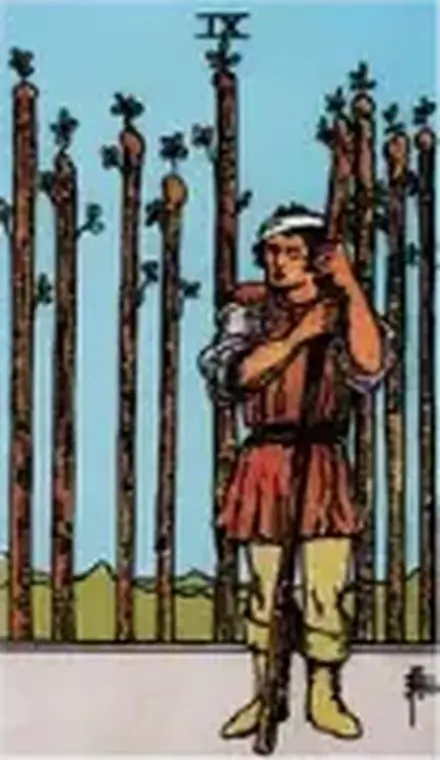
The Nine of Wands is the resilience of someone who has already fought hard: wounded and weary, still standing, guarding the last line.
Draw this card · Its correspondences
- Arcana: Minor, number 9
- Suit and element: Wands, Fire
- Golden Dawn title: Lord of Great Strength
- Sephirah: Yesod
- Decan: Sagittarius II, Moon (10° to 20° Sagittarius)
- Keywords: Resilience, courage, persistence, a last stand
- Yes or no?: Yes, with conditions
- Archetype: The Wounded Sentinel
What the card shows
In the deck Pamela Colman Smith drew for Arthur Edward Waite in 1909, the Nine of Wands shows a man standing on grey stone ground. He leans on a long staff with both hands, and his head is bandaged, the sign of a recent wound. He looks off to one side with a wary expression, like someone expecting the enemy to appear at any moment. Behind him, eight staves rise from the ground, straight and in a row, forming a kind of fence. In the distance are green hills and a clear sky.
In The Pictorial Key to the Tarot (1910), Waite describes the scene in few words: the figure has an air of expectation, as if awaiting a foe, and the eight staves behind him stand in orderly array like a palisade. Each element carries a reading. The bandage says the battle has already begun and left its mark. The staff he leans on is both crutch and weapon, fatigue and defence in a single gesture. The eight staves are everything built so far, the accumulated experience that guards his back. The sidelong glance is the learned mistrust of someone who has been attacked before.
In Book T, the Golden Dawn named this card the Lord of Great Strength and placed it in Yesod, the foundation. Its decan is the second of Sagittarius, ruled by the Moon. The Moon brings out the card’s instinctive side: the intuition that warns of danger before it is visible, and the strength that rises from deep inside once the body is already spent.
Nine of Wands upright
Upright, the Nine of Wands reads as resilience. It is the card of someone who has been through many trials, is tired and still stands firm. Tradition links it with strength in opposition: Waite writes that if the person is attacked they will meet the onslaught boldly, and that their build marks them out as a formidable opponent. The wound is there, and so is the resolve.
In a spread it often appears when the end is close. It is the ninth step of ten, the last leg of a long road. Strength falters just when it is needed most, and the card reminds you that everything achieved so far serves as protection. That is why it reads as a call to keep going at the final moment.
The Nine of Wands meaning also has a cautious side. The figure is watchful, and that watchfulness can be healthy or excessive. Sometimes the card points to someone grown suspicious from past wounds who sees enemies where there are none any more. Waite adds another, less familiar sense: delay, suspension, adjournment. The battle pauses for a moment, and nobody knows when it will resume.
As advice, it asks you to hold your position, conserve your strength and set clear boundaries. It also invites you to tell apart the caution that protects from the suspicion that isolates.
Nine of Wands reversed
Not every school reads reversals. Many readers use only upright cards and let the neighbouring cards add nuance. Those who do read the Nine of Wands reversed tend to take it in one of two ways.
The first is a defence giving way. Waite gives the reversed card obstacles, adversity and calamity: the palisade falls, and the person is too tired to keep holding the line. It can point to exhaustion, the urge to quit, or a struggle that no longer pays.
The second is mistrust turned inward. The defensive stance hardens so much that it blocks help and closes you off to anything new. The person stays on guard even though the battle is over.
In both cases the advice is to review what is worth defending, ask for support and accept that giving up a position can also be a form of strength.
In love
In love, the Nine of Wands reads as a heart that guards itself. For couples it can point to a relationship that has weathered many crises and is still standing, scarred and held together by the persistence of both partners. It can also suggest that one of you is on the defensive because of old wounds and finds trust hard.
If you are single, the card often describes someone hurt in past relationships who has built a palisade. The Nine of Wands as feelings is cautious and protective, interested but slow to lower its guard. Tradition reads it as a time to look after yourself while leaving the gate open a crack.
Reversed, in love
Reversed in love, the Nine of Wands speaks of emotional exhaustion, the urge to give up on a difficult relationship, or mistrust that is now doing harm. As advice, it invites you to talk about the wounds instead of defending yourself against them.
Career and money
For career and money, the Nine of Wands reads as the final push before a goal. A long project is close to finishing, and last-minute obstacles appear. The card advises persistence, protecting what you have achieved and keeping an eye on the competition. Financially, it is linked with guarding your savings and planning for the unexpected.
Reversed, in career
Reversed, it points to burnout, a sense of constant struggle without reward, or problems piling up. Ask for help and share the load before you burn out completely.
Health and mood
For health and mood, the Nine of Wands is linked with recovery after a difficult period and the fortitude to keep going. It can also point to accumulated tiredness and the need to avoid pushing too hard. Tradition reads it as a call to rebuild strength patiently. No card can diagnose anything. For any symptom or worry, speak to a health professional.
Yes or no? Yes, with conditions
The Nine of Wands reads as a yes with conditions. The goal is close and within reach, and it demands persistence and one last obstacle overcome. Tradition takes it as favourable for anyone willing to hold out a little longer. Give up now, and what you have built may be lost.
Ask the card: a yes or no tarot reading with one card or three.
The archetype: The Wounded Sentinel
As an archetype, the Nine of Wands is the wounded sentinel: the veteran guarding the last gate, the defender of a besieged fortress, the mother holding the family together after a disaster. This is someone who has already fought a great deal and knows the cost of every battle. Their only task now is to endure. Their strength comes from experience and from the memory of what it took to get this far.
In story structure, the Nine of Wands sits at the final ordeal before the climax, the moment when the protagonist seems beaten and finds strength where there was none. It is the night before the last assault, the chapter where everything urges surrender. Its tension grows out of fatigue. The reader knows the character is at the limit and fears they will not hold. That is why the bandage matters so much. Without a wound, endurance has no merit.
The archetype has a shadow that fiction can use well. A sentinel who has suffered too much can turn paranoid, unable to tell friend from foe. The palisade protects, and it also imprisons. A good Nine of Wands character carries that contradiction inside: they need their defences to survive and will have to lower them to reach the end of the road. The richest arc belongs to the one who learns when to resist and when to open the gate. The Moon of its decan reminds us that such decisions are usually made by instinct.
In literature
- Robinson Crusoe (Daniel Defoe, 1719). Crusoe raises a palisade of stakes around his shelter and spends years watching the beach. The novel turns the card’s image into a method of survival: every stake driven in is a day won from the island. His alarm at the footprint in the sand is the sidelong glance in its purest form.
- The Old Man and the Sea (Ernest Hemingway, 1952). Santiago battles an enormous marlin for days, his hands torn and without sleep. When he finally lands it, he has to defend it from the sharks. It is the Nine of Wands distilled: a wounded man who refuses to give up even when he has almost nothing left to protect.
- The Two Towers (J. R. R. Tolkien, 1954). The defence of Helm’s Deep is a whole night of resistance behind a wall. The defenders, exhausted and outnumbered, hold until dawn. Tolkien writes the card’s exact moment: the last wall, the last effort, the wait for help that may never come.
For writers
The conflict
The Nine of Wands sets up a conflict between exhaustion and the need to go on. The character has already paid a high price, and the reader knows it. One last stretch remains, the hardest of all, and every ounce of missing strength shows on the page. For it to work, the wound must be visible: an aching body, a recent loss, a broken trust. The more concrete the fatigue, the more the decision to endure weighs.
The twist
As a plot twist, the Nine of Wands opens two paths. In the first, the expected attack comes and the character withstands it against all odds. In the second, the enemy never shows up, and the twist lies in discovering that the guard was no longer needed: the palisade had become a prison. The card’s sidelong glance suggests a third twist, in which the danger comes from the side nobody was watching.
Prompts
- Write the night before a final battle from inside the head of someone too tired to sleep.
- Have your protagonist spend days waiting for an enemy who never arrives, and tell what they learn about themselves while they wait.
- Describe a house, a relationship or a job as if it were a palisade, and let the reader guess what lies behind each stake.
Its correspondences
- Element: Fire. Source: Golden Dawn (tradition).
- Sephirah: Yesod. Source: Golden Dawn (tradition).
- Decan: Sagittarius II. Source: Golden Dawn (tradition).
Combinations
Nine of Wands and Strength
With Strength, resilience comes from within. The pair reads as quiet courage and a patience able to bear any trial without losing calm or gentleness.
Nine of Wands and Seven of Wands
The Seven of Wands is active defence and the Nine is defence with scars. Together they read as a long struggle that requires holding your position on several fronts at once.
Nine of Wands and Ten of Wands
With the Ten of Wands, endurance starts turning into a burden. The pair reads as someone who has held on so long they no longer know how to let go, and as a warning of exhaustion ahead.
Nine of Wands and The Emperor
With The Emperor, defence becomes structure. The pair reads as firm boundaries, protection of what is yours and an authority that knows how to hold its ground.
Nine of Wands and The Star
The Star after the Nine of Wands reads as relief. After the long vigil come calm and the hope that the worst is over.
Nine of Wands and Two of Cups
With the Two of Cups, the palisade opens. The pair reads as someone who has been hurt finally allowing themselves to trust another person.
Nine of Wands and The Hermit
With The Hermit, defence turns into retreat. The pair reads as a time of chosen solitude to recover strength, with the risk of isolating yourself too much.
Frequently asked questions
What does the Nine of Wands mean in tarot?
The Nine of Wands stands for resilience, persistence and the last line of defence. Tradition reads it as the strength of someone wounded and tired who stays firm because the goal is close. It also speaks of caution and vigilance.
What does the Nine of Wands mean in love?
In love it reads as a heart that guards itself. It can describe a couple who have survived many crises, or someone mistrustful because of old wounds. For singles, it invites self-care while leaving the door slightly open.
Is the Nine of Wands a yes or no card?
It reads as a yes with conditions. The goal is within reach, and it demands one last effort and a final obstacle overcome. Tradition takes it as favourable for anyone who decides to keep going.
What does the Nine of Wands reversed mean?
Readers who use reversals link it with exhaustion, the urge to quit, or a defensive stance that has gone too far. Waite gave it obstacles, adversity and calamity. The advice is to ask for help and choose what is truly worth defending.
What is the Nine of Wands’ decan and Golden Dawn title?
In the Golden Dawn’s Book T, the Nine of Wands is called the Lord of Great Strength. It corresponds to the second decan of Sagittarius, 10° to 20°, ruled by the Moon, and to Yesod, the foundation of the Tree of Life.
Why is the figure’s head bandaged in the Nine of Wands?
The bandage shows that the person has already fought and been hurt. That gives the card its meaning: endurance counts because it comes after the damage. The figure stays on his feet despite his wounds, with the experience of his eight staves behind him.
Do your readingPrevious: Eight of Wands · Next: Ten of Wands
The 14 cards of Wands
- Ace of Wands
- Two of Wands
- Three of Wands
- Four of Wands
- Five of Wands
- Six of Wands
- Seven of Wands
- Eight of Wands
- Nine of Wands
- Ten of Wands
- Page of Wands
- Knight of Wands
- Queen of Wands
- King of Wands
By Style Optimizer · published November 22, 2026.