Tarot / The 78 cards / Wands / Ten of Wands
Ten of Wands (10 of Wands): tarot card meaning, upright and reversed
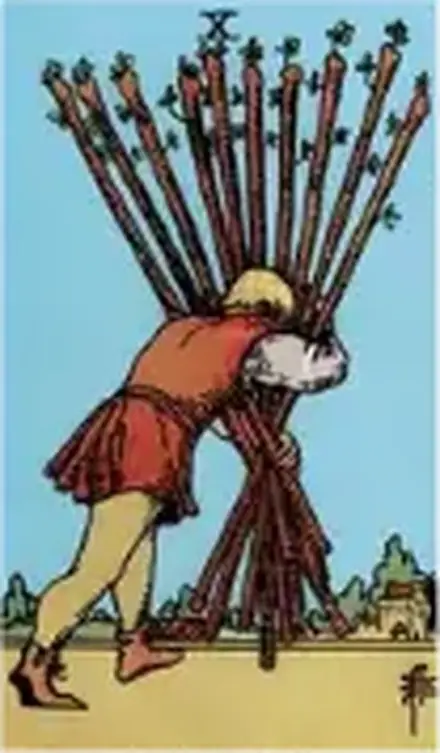
The Ten of Wands is the load that weighs at the end of the road: success and duty piled so high that it gets hard to see where you are going.
Draw this card · Its correspondences
- Arcana: Minor, number 10
- Suit and element: Wands, Fire
- Golden Dawn title: Lord of Oppression
- Sephirah: Malkuth
- Decan: Sagittarius III, Saturn (20° to 30° Sagittarius)
- Keywords: Burden, extra responsibility, hard work, stress, completion
- Yes or no?: Not for now
- Archetype: The Burden-Bearer
What the card shows
In the deck Pamela Colman Smith drew for Arthur Edward Waite in 1909, the Ten of Wands shows a man walking forward, bent over. He hugs a bundle of ten staves, all gathered together, holding them against his chest with both arms. There are so many, and they are so long, that they cover his head and block his view: he walks without being able to see clearly where he is going. Ahead, in the distance, a house stands among trees, the destination he is heading for. The ground is a ploughed field and the sky is clear.
In The Pictorial Key to the Tarot (1910), Waite sums up the card in one idea: a man oppressed by the weight of the ten staves he carries. Every detail of the image strengthens that reading. The stooped posture is physical effort, the body bending under its load. The staves in front of his face are responsibilities that block the horizon: whoever carries this much stops seeing the landscape. The house in the background is the goal, close and still to be reached. That he carries the staves in his arms, instead of tying them to his back or sharing them out, suggests he could carry them another way and does not.
In Book T, the Golden Dawn named this card the Lord of Oppression and placed it in Malkuth, the last sefirah, the kingdom of matter. Its decan is the third of Sagittarius, ruled by Saturn. Here the fire of Wands reaches its densest form, as Saturn, the planet of weight and limits, turns energy into burden.
Ten of Wands upright
Upright, the Ten of Wands reads as the weight of too many responsibilities. It is the last number in the suit and closes the cycle of fire: the Ace’s spark has become a mountain of tasks, commitments and obligations. Waite simply calls it oppression. He adds an important nuance: it can also signify fortune, gain or any kind of success, and then the oppression comes from those very things. Triumph has weight.
In a spread it often appears when someone has taken on more than they can carry. It may be work, family, a project that has grown too big, or the role of the person who always handles everything. They keep moving and keep delivering, at the cost of exhaustion and of losing sight of why they do it.
The Ten of Wands meaning also has a sense of closure. The man is near the house: the end of the effort is in view. Tradition reads it as the last stretch of a long job, best finished without adding more weight. Waite also notes that the card can speak of false appearances and disguise, and that in a lawsuit it is linked with loss.
As advice, it asks you to look at what you are holding in your arms. Delegating, dropping a staff or sharing the load is usually the wisest move. It also invites you to lift your head and remember where you are walking to.
Ten of Wands reversed
Not every school reads reversals. Many readers use only upright cards and let the neighbouring cards add nuance. Those who do read the Ten of Wands reversed tend to take it in one of two ways.
The first is the load being set down. The staves fall to the ground and the person is finally free of responsibilities that were never theirs. It may be a chosen relief, such as delegating or stepping away from a commitment, or a collapse forced by exhaustion.
The second is complication. Waite gives the reversed card contrarieties, difficulties and intrigues. The weight turns into a tangle: obligations that cross, people loading their problems onto others, effort that leads nowhere.
In both cases the advice is to look honestly at which staves are yours and which you took on out of habit or fear of saying no.
In love
In love, the Ten of Wands reads as a relationship that has become heavy. For couples it can point to one partner carrying almost everything: the home, the decisions, the other person’s problems. It can also suggest that work and obligations leave little room for affection. The card asks you to share the chores and win back time together.
If you are single, it often describes someone so busy there is no space for love, or someone still dragging the weight of a past relationship. The Ten of Wands as feelings is committed and loyal, and very tired. Lighten the load before opening the door to someone new.
Reversed, in love
Reversed in love, the Ten of Wands speaks of putting down a weight: ending a draining relationship or redistributing responsibilities within the couple. It can also point to tensions over an unfair division of labour finally coming into the open.
Career and money
For career and money, the Ten of Wands reads as an excess of tasks: overtime, projects piling up and the sense that everything depends on you. It can come alongside success, because a growing business brings more work. Tradition advises delegating, setting priorities and finishing what is pending before taking on anything more.
Reversed, in career
Reversed, it points to exhaustion, the risk of burnout, or a decision to drop responsibilities that are not worth it. Review contracts and commitments calmly.
Health and mood
For health and mood, the Ten of Wands is linked with stress, built-up tension and the fatigue that comes from carrying too much for too long. Tradition reads it as an invitation to rest, delegate and listen to the body, especially the back and shoulders, where the weight shows. No card can diagnose anything. For any symptom or worry, speak to a health professional.
Yes or no? Not for now
The Ten of Wands reads as “not for now.” What you are asking about may well succeed, and your current load is too heavy to take on anything else. Tradition advises finishing what is pending and setting part of the weight down before taking a new step. If the question is whether something will cost a great deal of effort, the answer is yes.
Ask the card: a yes or no tarot reading with one card or three.
The archetype: The Burden-Bearer
As an archetype, the Ten of Wands is the burden-bearer: the one who carries everything. It is the eldest daughter caring for her parents and siblings, the employee doing the work of three, the hero everyone turns to and nobody relieves. It is also the achiever who has got what they wanted and discovers that success brings a mountain of obligations with it. Their most visible trait is that they move forward without seeing, because the staves cover their face.
In story structure, the Ten of Wands occupies the final stretch of a long arc, when the protagonist has won almost everything and the price is starting to show. It is the moment the character is about to reach the house and, at the same time, about to fall. It works very well for the climax of a story of ambition, where the reader understands before the character does that so much weight cannot be sustained.
The archetype’s dramatic interest lies in the question of why they carry it. It may be duty, pride, guilt, fear of letting people down, or an inability to ask for help. Each answer gives a different character. Waite also points to an unsettling shade: the card is linked with disguise and false appearances. Some bearers carry so that nobody looks at what is hidden inside the bundle. The richest arc belongs to the one who learns to drop staves and discovers the house was still in the same place. Saturn, ruler of its decan, reminds us that every load has a limit.
In literature
- Death of a Salesman (Arthur Miller, 1949). Willy Loman enters carrying his heavy sample cases, and that image sums up the play. For decades he has held up his family and a dream of success that never arrives. The weight keeps him from seeing reality. Miller writes the Ten of Wands as a tragedy of work and pride.
- The Metamorphosis (Franz Kafka, 1915). Gregor Samsa supports his parents and sister single-handed with a job he loathes. When he wakes up transformed into an insect, his first worry is being late for work. Kafka pushes the card’s burden into the absurd: the bearer has lost even his human shape.
- Les Misérables (Victor Hugo, 1862). Jean Valjean spends his life carrying other people: he lifts a cart off a trapped man, takes on Cosette’s fate and hauls the wounded Marius through the sewers of Paris. Hugo makes the Ten of Wands literal and moral at once, a man who keeps shouldering weight that was never his.
For writers
The conflict
The Ten of Wands sets up a conflict between duty and limits. The character carries something they chose or had imposed on them, and every new staff brings them closer to breaking point. It works best when the burden has concrete names: a sick father, a family business, a promise. The reader needs to see the weight in the body and the gestures, and also understand why the character refuses to put it down.
The twist
As a plot twist, the Ten of Wands offers the moment the load falls. It may fall from exhaustion, in a scene of collapse, or because someone suddenly takes it away and the character discovers they could live without it. Another option follows Waite’s hint about disguise: the bundle of staves hides something, and the twist is revealing what the bearer had concealed beneath all that weight.
Prompts
- Write a whole day in the life of someone who takes care of everything and everyone, without a single person thanking them.
- Have your protagonist drop, one by one, the ten obligations they carry, with each renunciation costing more than the last.
- Tell the arrival at the house in the card’s background: what the bearer finds when they finally set the load down at the door.
Its correspondences
- Element: Fire. Source: Golden Dawn (tradition).
- Sephirah: Malkuth. Source: Golden Dawn (tradition).
- Decan: Sagittarius III. Source: Golden Dawn (tradition).
Combinations
Ten of Wands and Nine of Swords
Waite says it outright: followed by the Nine of Swords, success is thwarted. Together they read as a burden that keeps you up at night and anxiety born of too many responsibilities.
Ten of Wands and Nine of Wands
With the Nine of Wands, endurance turns into burden. The pair reads as someone who has held on so long they no longer know how to let go, and as a warning that exhaustion is near.
Ten of Wands and Eight of Wands
With the Eight of Wands, everything arrives at once. The pair reads as an avalanche of tasks, messages and requests that end up weighing more than expected.
Ten of Wands and Temperance
Temperance beside the Ten of Wands calls for balance. The pair reads as the moment to share the load, pace your strength and find a rhythm you can sustain.
Ten of Wands and The World
With The World, the effort reaches its end. The pair reads as a long job completed: the bearer reaches the house and can finally set the staves down.
Ten of Wands and Four of Pentacles
With the Four of Pentacles, the burden becomes attachment. The pair reads as someone who will not release responsibilities or possessions for fear of losing control.
Ten of Wands and Justice
With Justice, the question is whether the division is fair. The pair reads as the need to balance obligations so that everyone takes on their proper share.
Frequently asked questions
What does the Ten of Wands mean in tarot?
The Ten of Wands stands for burden, excessive responsibility and the effort of the final stretch. Tradition reads it as the weight of work and also of success, which brings new obligations. It invites you to delegate and set down part of what you carry.
What does the Ten of Wands mean in love?
In love it reads as a relationship grown heavy: one partner carries almost everything, or obligations leave little room for affection. For singles, it suggests lightening the load before opening up to someone. The card asks you to share tasks and protect time together.
Is the Ten of Wands a yes or no card?
It reads as “not for now.” What you are asking about could succeed, and your current load is too heavy to take on more. Tradition advises finishing what is pending before starting something new.
What does the Ten of Wands reversed mean?
Readers who use reversals usually see it as a burden being set down, out of relief or exhaustion. Waite gave it contrarieties, difficulties and intrigues. The advice is to tell apart the responsibilities that are truly yours from those taken on out of habit.
What is the Ten of Wands’ decan and Golden Dawn title?
In the Golden Dawn’s Book T, the Ten of Wands is called the Lord of Oppression. It corresponds to the third decan of Sagittarius, 20° to 30°, ruled by Saturn, and to Malkuth, the last sefirah of the Tree of Life, the kingdom of matter.
Is the Ten of Wands a negative card?
It is a demanding card, and tradition grants it a positive side. Waite also linked it with fortune and success, and the house in the background shows the goal is near. Its message is to learn to carry the weight differently.
Do your readingPrevious: Nine of Wands · Next: Page of Wands
The 14 cards of Wands
- Ace of Wands
- Two of Wands
- Three of Wands
- Four of Wands
- Five of Wands
- Six of Wands
- Seven of Wands
- Eight of Wands
- Nine of Wands
- Ten of Wands
- Page of Wands
- Knight of Wands
- Queen of Wands
- King of Wands
By Style Optimizer · published November 22, 2026.