Tarot / The 78 cards / Swords / Six of Swords
Six of Swords (6 of Swords): tarot card meaning, upright and reversed
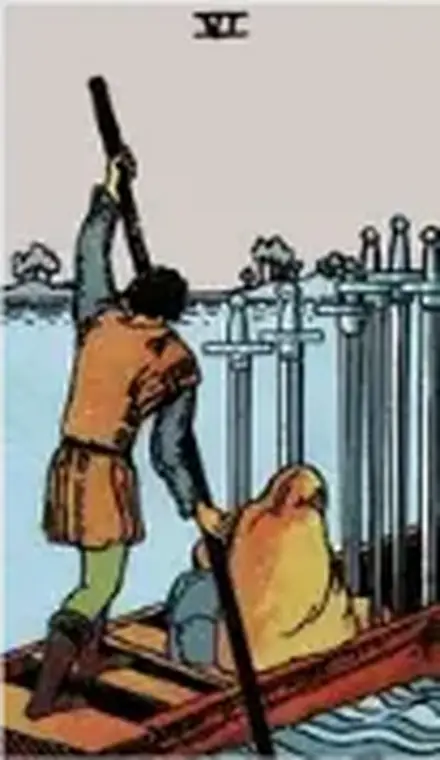
The Six of Swords is the passage to calmer waters: leaving a hard chapter behind and moving slowly towards a better shore.
Draw this card · Its correspondences
- Arcana: Minor, number 6
- Suit and element: Swords, Air
- Golden Dawn title: Lord of Earned Success
- Sephirah: Tiphareth
- Decan: Aquarius II, Mercury (10° to 20° Aquarius)
- Keywords: Transition, leaving behind, moving on, a journey
- Yes or no?: Yes, with conditions
- Archetype: The Traveller Leaving the Shore
What the card shows
In the deck Pamela Colman Smith drew for Arthur Edward Waite in 1909, the Six of Swords shows a boat crossing a river or an inlet of the sea. Standing at the stern, a ferryman pushes it along with a long pole. In front of him sit two passengers: a woman wrapped in a cloak and hood, huddled, and a small child beside her. Six swords stand upright in the front of the boat. The water nearest the ferryman is choppy, while the water stretching ahead on the other side is smooth. In the distance lies the far shore, with trees and hills under a still, grey sky.
Each detail has its reading. The boat is the passage from one situation to another, and the ferryman is the help that makes the crossing possible when you cannot row alone. The hooded woman is the grief that travels with whoever leaves: she does not look back, and she cannot yet look ahead. The child is what is being protected and carried to the new place. The swords standing in the boat are the thoughts and memories that travel with them. Nobody pulls them out, and still the boat floats. The contrast between rough and calm water sums up the whole card: the storm is left behind and the journey moves towards stillness.
In The Pictorial Key to the Tarot (1910), Waite describes a ferryman carrying passengers to the farther shore on a quiet course, the freight light and within his strength, and gives the card meanings of journey by water, route, way, envoy and expedient. Reversed, he gives declaration, confession and publicity. The Golden Dawn named it the Lord of Earned Success, placed it in Tiphareth and gave it the second decan of Aquarius, ruled by Mercury, from 10° to 20°.
Six of Swords upright
Upright, the Six of Swords reads as a transition. Something difficult is left behind and a journey begins towards a better place, even if you have yet to arrive. The tradition stresses the card’s tone: steady progress, a little melancholy, with no celebration. Whoever sits in the boat carries their wounds along, and moves all the same.
In a spread it often marks a change of chapter: a move, a trip, leaving a job or a relationship, the end of a period of conflict. Waite gave it the literal sense of a journey by water, and many readings keep it. On an inner level, the card speaks of distancing yourself mentally from a problem, gaining perspective and letting time settle what was stirred up. It can also say you need to accept help. That is what the ferryman is there for.
The Golden Dawn title, Lord of Earned Success, is one of the kindest in the suit of Swords. Tiphareth, the sephirah of balance and harmony, explains why the Six brings some relief after the harshness of the Five. The decan, Mercury in Aquarius, adds mental clarity and movement: the mind sorts itself out, finds a way through and sets off. It is success won through effort, without any triumphalism.
As advice, the Six of Swords invites you to leave what can no longer be fixed and to trust the slow rhythm of recovery. Take what is essential, accept the company on offer and keep your eyes on the shore that awaits you.
Six of Swords reversed
Many readers never read reversals and let the surrounding cards supply the nuance instead. Those who do usually read the Six of Swords reversed in one of two ways.
The first is the stalled crossing. Someone knows they need to leave and stays, or leaves and keeps coming back to the same place. The boat sits in mid-water, or drifts back to the rough shore. The reversed card then speaks of resistance to change and of unfinished business that blocks the way forward.
The second follows Waite, who gave the reversed card declaration, confession and publicity, and even mentioned a proposal of love. Read this way, the card points to something that had been travelling in silence coming to light: a truth spoken aloud, news made public. In both cases, the advice is to look at what you are carrying in the boat and decide what deserves to reach the other side.
In love
In love, the Six of Swords describes a relationship coming out of a hard patch. With a partner it can mean the worst is over: after a crisis, the two of you are moving towards a calmer time, sometimes with a move to a new home or city. It can also describe a peaceful separation, where each person leaves without further harm.
If you are single, the card speaks of recovering from a break-up and leaving a painful story behind. It reads as a needed stretch of calm before you open up to someone new, and sometimes as a meeting that happens while travelling.
Reversed, in love
Reversed in love, it reads as difficulty moving on: getting back with an ex, staying in a relationship that has ended on the inside, or carrying the pain of the last one into the next. It can also signal a declaration of feeling that comes as a surprise.
Career and money
For career and money, the Six of Swords reads as a change that improves things gradually: a transfer, a new job, leaving a tense environment or a project past its worst moment. Financially, it shows difficulties starting to recede, though abundance has yet to arrive. It favours business travel and the help of a mentor.
Reversed, in career
Reversed, it points to a change that keeps being delayed, or to problems that follow you into a new job. Settle what is pending before you leave, so you do not carry the same load to the new place.
Health and mood
For health and mood, the Six of Swords is linked with convalescence and slow recovery after a draining period. It reads as an invitation to rest, to get a change of scene if you can and to let others keep you company. No card can diagnose anything: for any symptom or doubt, the right person to see is a health professional.
Yes or no? Yes, with conditions
The Six of Swords reads as a conditional yes. The situation is heading somewhere better, though progress will be slow and will ask you to leave behind something that weighs on you today. If the question is whether to leave, make a change or take a trip, the answer leans towards yes, provided you accept that arriving takes time.
Ask the card: a yes or no tarot reading with one card or three.
The archetype: The Traveller Leaving the Shore
As an archetype, the Six of Swords is the exile, the refugee, the survivor who leaves with only the clothes on their back. It is also the ferryman, the figure who helps people cross: the silent guide, the stranger who offers a way out, the friend who comes along without asking questions. The card places both characters in the same boat, and its dramatic power lies in the bond between the one who flees and the one who makes the escape possible.
In the structure of a story, the card holds the place of the crossing. It tends to appear after the hardest blow, when the protagonist abandons the scene of defeat and sets out. It is a transitional chapter, full of passing landscapes and low-voiced conversations, where the character begins to understand what has happened to them. Many versions of the hero’s journey include this crossing of water, the border between the known world and the other one.
The most fertile part of the archetype is the swords that travel in the boat. The character leaves, and their memories, guilt and questions leave with them. The new shore will only be different if they can decide what to do with that cargo. So stories of the Six of Swords are less about arriving than about crossing. The change happens on the water, in the suspended time between one life and the next, with the far shore still in the distance.
In literature
- The Aeneid (Virgil, 19 BC). Aeneas flees burning Troy with his father on his shoulders and his son by the hand, and takes to the sea in search of a new land. In Book VI he also crosses the waters of the dead in Charon’s boat. The whole poem is a Six of Swords: a journey by water with the wounds on board.
- Adventures of Huckleberry Finn (Mark Twain, 1884). Huck escapes a violent father and Jim escapes slavery, and the two drift down the Mississippi on a raft. The river is their crossing: a time between two lives, with danger on every bank and a friendship that grows on the water. Twain turns flight into a slow education.
- Brooklyn (Colm Tóibín, 2009). Eilis Lacey leaves her mother and sister in a small Irish town and crosses the Atlantic to a new life in New York. The voyage is miserable, the arrival lonely, and the homesickness travels with her like the swords in the boat. Tóibín writes the card’s quiet, melancholy passage to a better shore.
For writers
The conflict
The Six of Swords sets up a conflict between what the character leaves behind and what they bring along. It works best when the departure is necessary and still painful: a house that must be abandoned, a city that is no longer safe, a relationship that ends with nobody to blame. The journey is the setting, and the real conflict happens inside the boat, between the passengers and their memories.
The twist
As a plot twist, the card offers a crossing that changes the meaning of the escape. Halfway over, the character discovers something about the ferryman, about their companion or about the shore they are heading for. Or one of the swords in the boat, a secret or a guilt, comes to light before they arrive and forces a choice between pressing on and turning back.
Prompts
- Write a boat crossing told only through what a child sees and hears, without anyone explaining why they are leaving.
- Have the ferryman in your story speak for the first time in the middle of the water, and let what he says change where the journey ends.
- Tell a house move through the six objects the character decides to take, and what they remember as they pack each one.
Its correspondences
- Element: Air. Source: Golden Dawn (tradition).
- Sephirah: Tiphareth. Source: Golden Dawn (tradition).
- Decan: Aquarius II. Source: Golden Dawn (tradition).
Combinations
Six of Swords and Queen of Swords
The Six of Swords beside the Queen of Swords speaks of leaving a painful situation with your head held high. Together they read as closing a chapter by your own choice and reaching calmer waters.
Six of Swords and The Star
With The Star, the crossing fills with hope. Together they read as a recovery moving in the right direction, with the sense that the new shore will bring calm and meaning.
Six of Swords and Eight of Cups
The Eight of Cups beside the Six of Swords strengthens the idea of leaving. Together they read as walking away from something that no longer fulfils you, sadly and with the certainty that the time has come.
Six of Swords and Three of Swords
With the Three of Swords, the boat carries a fresh sorrow. Together they read as moving away from a wound, a break-up or a loss, and slowly starting the road to recovery.
Six of Swords and Three of Wands
Beside the Three of Wands, the journey looks towards new opportunities. Together they read as a relocation or expansion that opens horizons, often far from home or across the sea.
Six of Swords and The Chariot
With The Chariot, the transition gains drive and direction. Together they read as a change taken on decisively, moving faster than the Six of Swords usually does on its own.
Six of Swords and Death
Death beside the Six of Swords speaks of one chapter ending and the passage into the next. Together they read as a deep change lived calmly, like crossing a river without looking back.
Frequently asked questions
What does the Six of Swords mean in tarot?
The Six of Swords stands for transition: leaving a hard chapter behind and moving towards calmer waters. The tradition reads it as a journey, outer or inner, made slowly and with the wounds on board, that leads to a better situation.
What does the Six of Swords mean in love?
In love it reads as a relationship coming out of a crisis and moving towards calm, or as a peaceful separation. If you are single, it speaks of recovering from a break-up and taking time before opening up to someone new.
Is the Six of Swords a yes or no card?
It reads as a conditional yes. Things are improving, if slowly, and you will need to leave behind something heavy. If your question is about leaving, changing or travelling, the answer leans towards yes.
What does the Six of Swords mean reversed?
Readers who use reversals usually see it as a stalled crossing: being unable to leave, returning to the same place or dragging unresolved problems along. Following Waite, it can also point to a declaration or confession made public.
Does the Six of Swords mean travel?
Waite gave it the sense of a journey by water, and many readings keep that. The tradition also reads it as an inner journey: stepping back from a problem, gaining perspective and letting time calm what was stirred up.
What decan corresponds to the Six of Swords?
In the Golden Dawn system, the Six of Swords is the Lord of Earned Success. It corresponds to the second decan of Aquarius, ruled by Mercury, 10° to 20°, and sits in Tiphareth, the sephirah of balance on the Tree of Life.
Do your readingPrevious: Five of Swords · Next: Seven of Swords
The 14 cards of Swords
- Ace of Swords
- Two of Swords
- Three of Swords
- Four of Swords
- Five of Swords
- Six of Swords
- Seven of Swords
- Eight of Swords
- Nine of Swords
- Ten of Swords
- Page of Swords
- Knight of Swords
- Queen of Swords
- King of Swords
By Style Optimizer · published November 22, 2026.