Tarot / The 78 cards / Swords / Seven of Swords
Seven of Swords (7 of Swords): tarot card meaning, upright and reversed
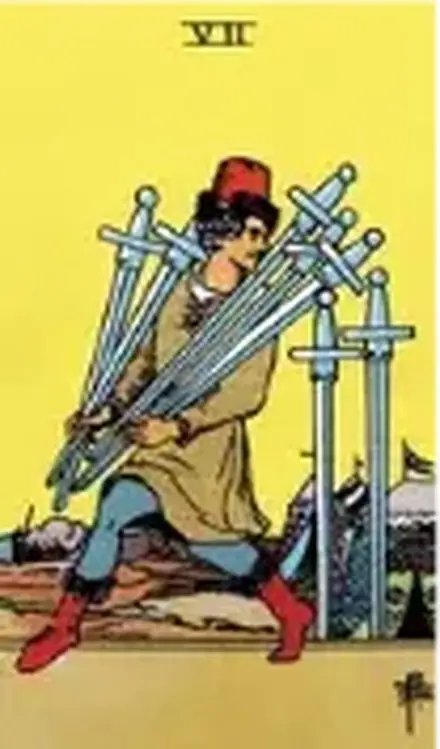
The Seven of Swords is strategy moving in secret: the cunning plan, the kept secret and the temptation to get away with something.
Draw this card · Its correspondences
- Arcana: Minor, number 7
- Suit and element: Swords, Air
- Golden Dawn title: Lord of Unstable Effort
- Sephirah: Netzach
- Decan: Aquarius III, Moon (20° to 30° Aquarius)
- Keywords: Deception, strategy, stealth, betrayal
- Yes or no?: Not for now
- Archetype: The Clever Thief
What the card shows
In the deck Pamela Colman Smith drew for Arthur Edward Waite in 1909, the Seven of Swords shows a man slipping away from a military camp. He walks on tiptoe, body leaning forward, head turned to look behind him. He wears a red cap, red boots and a short tunic, and clutches five swords to his chest, gripping them by the blades. Two swords stay behind, planted in the earth. On the left stand the camp’s tents with their pennants, and in the distance a small group of soldiers has noticed nothing. The sky is yellow and the ground is pale sand.
Every detail counts. The tiptoe step is stealth: an action that depends on going unseen. The backward glance is doubt and watchfulness, the fear of being caught. The five swords he carries off are ideas, plans or advantages taken from others. The two he leaves are what he cannot manage, the loose end that may give him away later. Holding a sword by the blade is risky, and whoever takes what belongs to others this way gets cut too. Many readers see satisfaction on his face, almost a grin.
In The Pictorial Key to the Tarot (1910), Waite sums up the scene as a man carrying off five swords in haste beside a camp, and gives the card meanings broader than theft: design, attempt, wish, hope, confidence, and also quarrelling and a plan that may fail. The Golden Dawn named it the Lord of Unstable Effort, placed it in Netzach and gave it the third decan of Aquarius, ruled by the Moon, from 20° to 30°.
Seven of Swords upright
Upright, the Seven of Swords reads as the card of going it alone. Someone acts on their own, keeping their plans quiet, seeking an advantage they could never win head-on. It can be legitimate cunning, such as negotiating discreetly, preparing an exit without warning anyone or protecting an idea until it is ready. It can also be deception: a lie, a betrayal, something taken without permission. The tradition insists that the card describes the method more than the morality. What we see is a covert manoeuvre, and the context tells us whether it is mischief or abuse.
In a reading it usually points to one of three situations. First, you may be tempted to take a shortcut and get away with it. Second, someone else may be playing both sides or holding back information. Third, the moment calls for tactical intelligence: choosing which battles to fight and which to sidestep. The Golden Dawn title, Unstable Effort, names the weak spot in all three. The plan half works, depends on nobody looking and leaves two swords behind.
The card’s decan, the Moon in Aquarius, fits that reading. The Moon brings changeability and the night; Aquarius brings the mind that goes its own way. Together they describe a brilliant intelligence that moves in the shadows and changes course with ease.
As advice, the Seven of Swords asks you to check two things: what is being kept quiet, and who benefits from the silence. If the manoeuvre is yours, think about the swords left on the ground. If it belongs to someone else, verify before you trust, without falling into suspecting everything.
Seven of Swords reversed
Many readers never read reversals and let the surrounding cards supply the nuance instead. Those who do usually read the Seven of Swords reversed as the moment the secret comes out.
It can be a deception uncovered, a lie that no longer holds, or someone confessing what they did. It also reads as remorse: the one who took the swords decides to give them back, apologise or come clean. Waite gives the reversal some curious meanings, such as good advice, counsel, instruction, slander and babbling, and from these comes another possible reading: words in circulation, rumour, a confidence that slips out.
On an inner level, the reversed card speaks of no longer fooling yourself. The excuses run out, the numbers that never added up get looked at squarely and the solo strategy gives way to asking for help. The advice is to use that moment to sort out what was left pending.
In love
In love, the meaning of the Seven of Swords fits in one word: secrecy. In a relationship it can point to something one partner is hiding: an affair, a debt, a doubt or an unspoken plan to leave. Sometimes the secret is smaller, a part of life kept for oneself, and the card invites you to ask whether that silence protects or divides. The tradition advises talking before spying.
If you are single, the card speaks of seduction games played close to the chest: someone who shows only half of themselves, who has another story on the go or who says what you want to hear. It can also describe you, guarding yourself so carefully that you never show what you feel.
Reversed, in love
Reversed in love, it reads as the truth surfacing: a confession, a deception discovered or an honest conversation after a long time of dodging it. It hurts, and it also clears the ground so you can decide with real information.
Career and money
For career and money, the Seven of Swords reads as competition with dirty tricks: a colleague taking credit for someone else’s work, a copied idea, a deal with fine print. It can also ask you for discretion, such as keeping a project under wraps or quietly preparing a job change. Financially, review contracts and accounts, and be wary of easy money.
Reversed, in career
Reversed, it shows an irregularity coming to light, or the need to return what is not yours. It is also a good moment to seek advice and drop a strategy that has run its course.
Health and mood
For health and mood, the Seven of Swords is linked with the strain of carrying secrets and the habit of playing down what worries you. It reads as an invitation to tell someone you trust what is going on and to stop hiding symptoms. No card can diagnose anything: for any discomfort or doubt, the right person to see is a health professional.
Yes or no? Not for now
The Seven of Swords reads as “not yet”. Information is missing, someone is hiding their hand or the plan depends on nobody looking, and that makes it unstable. While something stays hidden, the answer leans towards no. Once everything is on the table, the question deserves asking again with real information.
Ask the card: a yes or no tarot reading with one card or three.
The archetype: The Clever Thief
As an archetype, the Seven of Swords is the rogue, the trickster, the gentleman thief. This is the character who wins by wit what he cannot win by force, which is why readers tend to feel a mix of sympathy and suspicion towards him. Hermes, Odysseus, Lazarillo and the con artists of crime fiction all belong to this family. The weapon is intelligence and the territory is shadow.
In the structure of a story, the card marks the secret move. It can be the second-act job in a heist story, the betrayal the reader senses and the protagonist misses, or the plan the hero hatches without telling even his allies. Its dramatic tension comes from the figure’s backward glance: someone could spot him at any moment. Every scene with this card has a hidden clock.
The most fertile feature of the archetype is the two swords left on the ground. No deception is perfect, and a good story of deceit plants early the loose end that will later undo it: a witness, a forgotten object, one lie contradicting another. The Seven of Swords also raises the most interesting moral question of the picaresque: when is cunning survival, and when does it become abuse? A character who steals to eat and one who steals for pleasure carry the same card and call for very different scenes.
In literature
- Lazarillo de Tormes (Anonymous, 1554). Lázaro learns early that in his world only the best deceiver survives. He steals wine from the blind man with a straw, opens the priest’s chest with a copied key and always looks back in case he is caught. It is the founding text of the picaresque: cunning born of need, and a punishment that comes in the end.
- Oliver Twist (Charles Dickens, 1838). Fagin trains a gang of boys to pick pockets on the streets of London, and the Artful Dodger is his star pupil: quick fingers, quick tongue, eyes always over his shoulder. Dickens gives the card its charm and its menace, since the same skill that keeps the boys fed leads straight to the gallows.
- The Talented Mr Ripley (Patricia Highsmith, 1955). Tom Ripley takes over another man’s life, money and name, and Highsmith makes the reader hope he is never caught. The whole novel unfolds with the card’s backward glance: each lie forces another, and the tension lies in the loose ends left behind.
For writers
The conflict
The Seven of Swords sets up a conflict between what a character does and what others believe they are doing. It works best when the manoeuvre has an understandable motive: saving someone, recovering something stolen from them, escaping an unfair situation. That traps the reader between wanting it to succeed and dreading what it will cost. Plant the detail that could give them away from the start.
The twist
As a plot twist, the card offers two routes. In the first, the reader discovers that a trusted character has been playing both sides for a long time. In the second, the protagonist’s deception comes out through one of the swords left on the ground, the loose end that seemed trivial. Both twists work best when the clues were in plain sight and nobody looked at them.
Prompts
- Write a theft scene from the thief’s point of view, in the present tense and in short sentences, so the reader always knows exactly where the danger is.
- Have your protagonist lie to protect someone, and make that same person the one who uncovers the lie.
- Tell the same night twice: once from the man carrying off five swords, once from the soldier who finds the two left behind the next morning.
Its correspondences
- Element: Air. Source: Golden Dawn (tradition).
- Sephirah: Netzach. Source: Golden Dawn (tradition).
- Decan: Aquarius III. Source: Golden Dawn (tradition).
Combinations
Seven of Swords and Knight of Cups
The Seven of Swords beside the Knight of Cups casts doubt on a promise that sounds too lovely. Together they read as charm covering another motive, and advise checking the facts before you hand over your trust.
Seven of Swords and Page of Swords
With the Page of Swords, the secret turns into spying: someone watches, takes notes and stores information. The tradition reads the pair as a reminder to be careful what you share, and with whom.
Seven of Swords and The Magician
With The Magician, cunning reaches its most skilful. Together they read as a talent for persuading and manoeuvring that can serve honest ingenuity or slide into manipulation, depending on the rest of the spread.
Seven of Swords and The Moon
The Moon beside the Seven of Swords deepens the shadows: confusion, half-truths and deceptions that are hard to spot. The pair asks for patience and for caution with first impressions.
Seven of Swords and Judgement
With Judgement, what was hidden comes to light and accounts must be settled. Together they read as the moment of truth for a secret manoeuvre, yours or someone else’s, and a chance to make amends.
Seven of Swords and Justice
Justice beside the Seven of Swords speaks of a deception discovered, with consequences. In legal or contractual matters, the pair advises getting everything in writing and dealing straight.
Seven of Swords and Five of Swords
With the Five of Swords, the advantage is won by foul means and breeds resentment. Together they read as a victory gained by cheating that isolates the one who claims it.
Frequently asked questions
What does the Seven of Swords mean in tarot?
The Seven of Swords stands for secret strategy: cunning, stealth and, on its darker side, deception and betrayal. The tradition reads it as a covert manoeuvre that only half succeeds, because it depends on nobody looking and always leaves loose ends.
What does the Seven of Swords mean in love?
In love it reads as a secret in the relationship: something one partner keeps quiet, a parallel story or a self-protection that blocks intimacy. If you are single, it warns of seduction games played close to the chest. The advice is to talk openly before you start spying.
Is the Seven of Swords a yes or no card?
It reads as “not yet”. While information stays hidden or the plan depends on nobody finding out, the answer leans towards no. Once everything is on the table, you can ask the question again.
What does the Seven of Swords mean reversed?
Readers who use reversals usually see it as a secret uncovered: a lie that no longer holds, a confession or the remorse of whoever took the swords. It also reads as no longer fooling yourself, and as a time to ask for advice.
Does the Seven of Swords always mean betrayal?
Betrayal is one of its readings, and the tradition opens wider. Waite gave it meanings such as design, attempt, hope and confidence. The card describes a discreet manoeuvre, and the surrounding cards show whether it is fair cunning or deceit.
What decan corresponds to the Seven of Swords?
In the Golden Dawn system, the Seven of Swords is the Lord of Unstable Effort. It corresponds to the third decan of Aquarius, ruled by the Moon, 20° to 30°, and sits in Netzach, the seventh sephirah of the Tree of Life.
Do your readingPrevious: Six of Swords · Next: Eight of Swords
The 14 cards of Swords
- Ace of Swords
- Two of Swords
- Three of Swords
- Four of Swords
- Five of Swords
- Six of Swords
- Seven of Swords
- Eight of Swords
- Nine of Swords
- Ten of Swords
- Page of Swords
- Knight of Swords
- Queen of Swords
- King of Swords
By Style Optimizer · published November 22, 2026.