Tarot / The 78 cards / Swords / Knight of Swords
Knight of Swords: tarot card meaning, upright and reversed
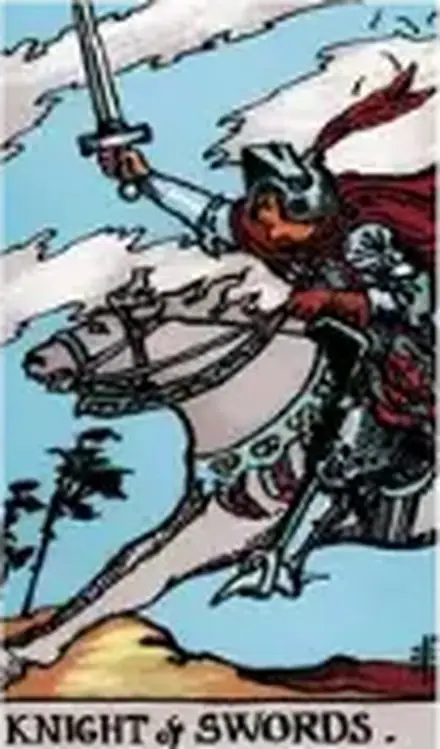
The Knight of Swords is an idea launched at full gallop: courage, speed and candour that clear a path and flatten whatever stands in it.
Draw this card · Its correspondences
- Arcana: Minor, court card (Knight)
- Suit and element: Swords, Air
- Golden Dawn title: Lord of the Winds and the Breezes
- Nature: Fire of Air
- Sephirah: Chokmah
- Signs: Taurus, Gemini
- Keywords: Swift action, ambition, impulsiveness
- Yes or no?: Yes
- Archetype: The Headlong Champion
What the card shows
In the deck Pamela Colman Smith drew for Arthur Edward Waite in 1909, the Knight of Swords is the fastest figure in the whole tarot. A knight in full armour and a red cloak charges at full tilt, leaning forward, sword raised above his head. The white horse stretches out mid-stride, mane and tail streaming in the wind. Butterflies and birds decorate its harness. In the background the clouds are torn to shreds and small trees bend under a strong wind.
Each element has its reading. The raised sword is the decision already made, the idea turned into an attack. The gallop shows that thought has stopped deliberating and is on the move. The white horse is often read as purity of intention: the knight believes in his cause. The butterflies and birds on the harness, like the stormy sky, belong to air, the suit’s element, which in tarot governs mind, speech and conflict. The red cloak adds the fire that drives him on.
In The Pictorial Key to the Tarot (1910), Waite describes a rider charging at full speed as if to scatter his enemies, and compares him with the hero of chivalric romance, almost a Galahad, whose sword is swift and sure because he is clean of heart. In the Golden Dawn he is the Lord of the Winds and Breezes, fire of air, in Chokmah, and he rules the stretch of the zodiac between Taurus and Gemini. That system also swaps two court figures: its Knight is the fire of the suit and its King the air.
Knight of Swords upright
Upright, the Knight of Swords reads as swift action guided by a clear idea. In the modern Rider reading, Knights are movement, and in the suit of air that movement is mental and verbal: saying what needs saying, deciding without hedging, defending a cause with argument and courage. The card tends to appear when a situation has stalled and someone arrives to break the deadlock.
Waite gives it skill, bravery, capacity and defence, and also enmity, wrath and war. That double edge sits at the heart of the card. The same speed that lets you seize an opportunity can trample anyone who cannot keep pace. The candour that cuts through confusion can also wound. In a spread, the Knight of Swords says things are about to move fast, and asks whether you are heading in the right direction.
As advice, the tradition reads it two ways depending on the neighbouring cards. Beside cards of deadlock or fear, it urges you to act now, with determination. Beside cards of conflict, it asks you to rein in the horse for a moment, weigh your words and choose your battle.
As a person, the Knight of Swords is brilliant, direct, ambitious and impatient. They think and talk fast, get bored by details and fire up over causes. A great ally in a crisis and hard company for anyone who needs calm. Usually young, or living with youthful energy: the combative lawyer, the reporter chasing the story, the founder who bets everything on one idea. Their loyalty to the truth is real. Their tact is in short supply.
Knight of Swords reversed
Many readers never read reversals and let the surrounding cards supply the nuance instead. Those who do usually read the Knight of Swords reversed as speed with no direction.
Waite gives the reversed card imprudence, incapacity and extravagance. The card then speaks of rash decisions, arguments that flare up over nothing and words spoken without thought. It can describe someone who bulldozes conversations, interrupts, imposes their view and leaves a trail of wounds without noticing.
Another common reading is energy held back: the knight wants to charge and something stops him, or he charges so often in so many directions that he never arrives anywhere. Projects started in a rush and dropped, plans that change every week. The reversed card’s advice is to pick one goal, lower the sword in petty fights and save your strength for the one that matters.
In love
In love, the Knight of Swords reads as intellectual passion and a fast pace. With a partner it can point to a frank conversation that puts things straight, a sudden decision or a phase of intense verbal energy, with lively arguments and equally quick reconciliations. The card asks you to make sure honesty never hardens into harshness.
If you are single, it can herald someone who arrives fast, seduces with words and offers a great deal in a short time. The tradition advises enjoying the momentum while watching whether that person keeps up over time what they promise in the first charge.
Reversed, in love
Reversed in love, the Knight of Swords speaks of wounding arguments, coldness, impatience or someone who drifts in and out of the relationship without warning. The advice is to lower the tone and listen before you reply.
Career and money
For career and money, the Knight of Swords reads as a phase of initiative and competition. It favours tough negotiations, presentations, debates and projects that need someone to push them forward. It can also show a quick change of role or strategy. With finances, the tradition advises seizing the opportunity without skipping the analysis.
Reversed, in career
Reversed, it points to clashes with colleagues, impulsive decisions and spending done in the heat of the moment. The advice is to check the numbers before signing and stop turning every meeting into a battle.
Health and mood
For health and mood, the Knight of Swords is linked with the stress of always rushing, built-up tension and the slips that come from never stopping. It reads as an invitation to slow down and give your body the rest your mind keeps denying it. No card can diagnose anything: for any symptom, the right person to see is a health professional.
Yes or no? Yes
The Knight of Swords reads as a quick yes. Things are moving, and the card favours acting decisively, speaking your mind and seizing the moment. The nuance lies in the speed: it is a yes that asks you to make sure you are charging in the right direction. If the question calls for patience or diplomacy, the yes grows shakier.
Ask the card: a yes or no tarot reading with one card or three.
The archetype: The Headlong Champion
As an archetype, the Knight of Swords is the hero who believes he is right and waits for nobody to prove it. He is the defender of causes, the avenger, the young man who hurls himself at the established order with the sword of ideas. He has a purity that inspires admiration and a lack of restraint that inspires alarm. In the story, everyone needs him when a siege must be broken, and almost nobody can stand him in peacetime.
In the structure of a story, the Knight of Swords is the engine of the second act. He arrives when the plot has stalled and speeds it up: he provokes the duel, publishes the article, says the accusation out loud. He can also be the antagonist who forces the protagonist to move, or the ally whose haste puts everyone at risk. His presence turns latent conflict into open conflict.
The richness of the archetype lies in its arc. The knight can learn to measure his strength and grow into the King of the same suit, a clear and fair authority. Or he can crash against his own speed: the heroic charge that ends in disaster because nobody stopped to look at the terrain. Waite compares him with Galahad, the pure knight, and fiction has explored a thousand times how close that purity lives to fanaticism. A good Knight of Swords on the page makes the reader want him to win and fear what he will do if he does.
In literature
- Don Quixote (Miguel de Cervantes, 1605). Don Quixote charges windmills, flocks of sheep and puppet shows, convinced he is defending justice. He is the Knight of Swords carried into comedy and melancholy: the pure idea galloping off without a glance at reality. Cervantes lets the reader laugh at his haste and admire his faith.
- Henry IV, Part 1 (William Shakespeare, 1597). Hotspur, the young Percy, talks fast, flares up fast and rebels fast. His honour is genuine and his impatience undoes him: he rides into the Battle of Shrewsbury without waiting for reinforcements. Shakespeare sets him against Prince Hal, who learns to wait, and lets both edges of the card show.
- The Three Musketeers (Alexandre Dumas, 1844). D’Artagnan arrives in Paris and on his very first day books a duel with each of the three musketeers. Brave, impulsive and brilliant, he embodies the bright side of the Knight of Swords: swift action that wins him allies. The novel also makes him pay for his haste.
For writers
The conflict
The Knight of Swords sets up a conflict between conviction and prudence. The character knows what they want and will do anything to get it, while the world asks for patience, alliances and nuance. It works best when they are right in substance and wrong in manner, so the reader is torn. Put someone slower and wiser beside them, trying to hold them back.
The twist
As a plot twist, the Knight of Swords is the reckless charge: the character acts before having all the information and sets off a reaction nobody expected. The most fertile version comes when the charge succeeds and the success brings worse consequences than defeat would have. The bent trees on the card suggest that the wind the knight stirs up also sweeps away people who had nothing to do with it.
Prompts
- Write a scene where your protagonist interrupts a meeting to say a truth everyone knows and nobody dared to name.
- Have a character win an argument brilliantly, and narrate what they lose in the same scene.
- Tell a high-speed chase from the horse’s point of view, or from someone forced to follow the hero without understanding where he is going.
Its correspondences
- Element: Air. Source: Golden Dawn (tradition).
- Sephirah: Chokmah. Source: Golden Dawn (tradition).
- Sign: Taurus. Source: Golden Dawn (tradition).
- Sign: Gemini. Source: Golden Dawn (tradition).
- Hexagram: 32 · Duration. Source: Crowley, The Book of Thoth (modern system).
In the Golden Dawn the Knight is the fire of the suit and the King its air. Many modern readings of the Rider deck swap the two.
Combinations
Knight of Swords and Page of Swords
The Knight and Page of Swords together read as news turning into immediate action. Someone receives information and rushes off without waiting; the tradition advises confirming the facts before the charge.
Knight of Swords and King of Swords
With the King of Swords, the knight’s energy meets an authority that gives it order. Together they read as an apprenticeship: the quick idea passes through the judgement of someone experienced and gains precision.
Knight of Swords and The Chariot
The Chariot beside the Knight of Swords doubles the speed and the determination. Together they read as victory through sheer drive, clear progress and the risk of never looking to the sides.
Knight of Swords and Five of Swords
With the Five of Swords, the charge ends in a bitter victory: the argument is won and the people are lost. The tradition reads the pair as a warning against needless fights.
Knight of Swords and Temperance
Temperance beside the Knight of Swords asks for moderation. Together they read as the moment to rein in the horse, blend reason with patience and move at a pace you can sustain.
Knight of Swords and Knight of Wands
With the Knight of Wands, fire joins air and everything speeds up: travel, abrupt changes, decisions made overnight. A great deal of energy in need of direction.
Knight of Swords and The Tower
The Tower with the Knight of Swords reads as a rupture caused by hasty words or actions. The truth comes out all at once, and whatever was badly built comes down.
Frequently asked questions
What does the Knight of Swords mean in tarot?
The Knight of Swords stands for swift action guided by an idea: courage, candour, ambition and determination. The tradition reads it as the movement that breaks a deadlock, with a warning that its speed can turn into recklessness and its honesty into harshness.
What does the Knight of Swords mean in love?
In love it reads as intellectual passion, frank conversations and fast decisions. It can herald someone who arrives with great momentum. Reversed, it warns of wounding arguments and impatience, and advises listening before you answer.
What is the Knight of Swords like as a person?
It describes someone brilliant, direct, ambitious and impatient, who thinks and talks fast and fires up over causes. A great ally in a crisis, they can be overwhelming in daily life. Their loyalty to the truth runs deep; their tact runs short.
Is the Knight of Swords a yes or no card?
It reads as a quick yes: the card favours acting decisively and seizing the moment. It does ask you to check your direction before you charge. In matters that call for patience or diplomacy, the answer becomes less certain.
What does the Knight of Swords mean reversed?
Readers who use reversals usually see it as speed without direction: recklessness, rash decisions, arguments that flare up over nothing or projects started and abandoned. The advice is to choose one goal and save your strength for it.
What are the Golden Dawn title and zodiac signs of the Knight of Swords?
In the Golden Dawn he is the Lord of the Winds and Breezes, fire of air, placed in Chokmah, and he rules the stretch between Taurus and Gemini. That system swaps King and Knight: its Knight is the fire of the suit and its King the air.
Do your readingPrevious: Page of Swords · Next: Queen of Swords
The 14 cards of Swords
- Ace of Swords
- Two of Swords
- Three of Swords
- Four of Swords
- Five of Swords
- Six of Swords
- Seven of Swords
- Eight of Swords
- Nine of Swords
- Ten of Swords
- Page of Swords
- Knight of Swords
- Queen of Swords
- King of Swords
By Style Optimizer · published November 22, 2026.