Tarot / The 78 cards / Swords / Queen of Swords
Queen of Swords: tarot card meaning, upright and reversed
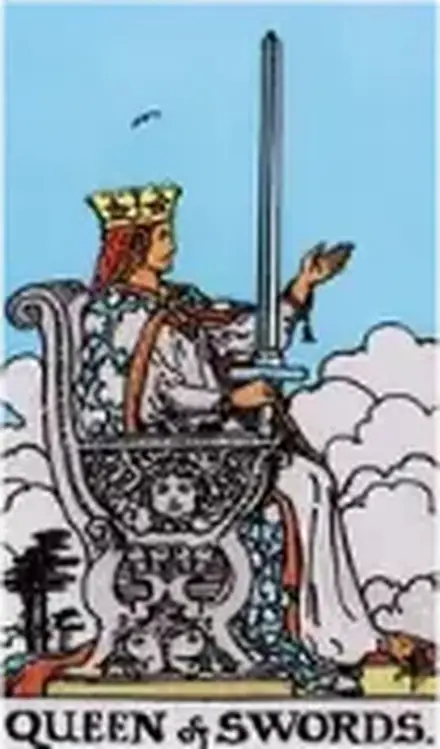
The Queen of Swords is the mind that sees clearly after suffering: independent judgement, plain speech and a self-reliance hard won.
Draw this card · Its correspondences
- Arcana: Minor, court card (Queen)
- Suit and element: Swords, Air
- Golden Dawn title: Queen of the Thrones of Air
- Nature: Water of Air
- Sephirah: Binah
- Signs: Virgo, Libra
- Keywords: Clarity, independence, perception, direct communication
- Yes or no?: It depends
- Archetype: The Clear-Eyed Survivor
What the card shows
In the deck Pamela Colman Smith drew for Arthur Edward Waite in 1909, the Queen of Swords sits in profile, facing the right-hand side of the card. In her right hand she holds the sword upright, its hilt resting on the arm of the throne. Her left hand reaches forward, palm open, like someone giving a direction or welcoming a visitor. She wears a crown of butterflies and a cloak patterned with clouds. A tassel hangs from her left wrist. Her grey stone throne is carved with butterflies, a crescent moon and the head of a winged child. Below, clouds gather on the horizon and treetops peep through. Above, the sky is clear and a single bird flies very high.
Each detail has its reading. The straight sword is judgement that refuses to bend. The open hand balances that edge: the Queen cuts, and she also listens. The butterflies are air and the soul in transformation, and the winged head is a sylph, the spirit of the element. The clouds lie beneath her. She has passed through the confusion and now looks down on it from above. The lone bird speaks of a mind that rises on its own.
Waite describes her face as severe yet chastened, the face of someone familiar with sorrow, and links her with widowhood, absence and female sadness. The Golden Dawn called her the Queen of the Thrones of Air: water of air, the receptive side of the intellect, in the sephirah Binah, between Virgo and Libra. In that system the Queens keep their place, while King and Knight are swapped: the Golden Dawn Knight is the fire of the suit and its King the air.
Queen of Swords upright
Upright, the Queen of Swords reads as mental clarity won the hard way. This is the card of someone who has been through a loss, a disappointment or a stretch of solitude and has come out clear-headed. She sees things as they are, says what she thinks without decoration and makes up her own mind. The modern Rider tradition reads her as the inner mastery of air: the Queen governs her own thoughts, which is why she is hard to fool.
In a spread she often marks the moment to set boundaries, separate facts from impressions and speak frankly. She also appears when you need judgement of your own in the face of other people’s pressure. Her independence has roots. It comes from having learned to be alone and to hold an unpopular opinion.
As a person, the Queen of Swords is mature, sharp and observant, often with a hard story behind her. She is honest to the point of discomfort, with a dry wit and a precise memory for detail. She listens closely and spots contradictions at once. She can seem cold at first, and those who know her know she is fair, loyal to the truth and protective of anyone who genuinely needs it. The tradition connects her with women who are widowed, separated or living alone by choice, and by extension with anyone, of any gender, who has turned independence into a kind of clarity. She makes a good adviser, editor, lawyer, teacher or doctor: the person you go to when you want the truth.
As advice, the card asks you to think before reacting, to say things precisely and to accept that clarity sometimes requires distance.
Queen of Swords reversed
Many readers never read reversals and let the surrounding cards supply the nuance instead. Those who do usually read the Queen of Swords reversed in one of two ways.
The first is the blade turned on others. Sharpness becomes constant criticism, sarcasm or a coldness that wounds. Waite speaks here of malice, bigotry, prudery and deceit: intelligence placed at the service of harsh judgement or manipulation. The person is right about the facts and wrong in how they treat people.
The second is clarity lost. The pain that brought lucidity in the upright card is still clouding things when reversed. You judge from the wound, distrust everyone or withdraw for fear of being hurt again. It can also point to words held back when they ought to be said.
In both cases the advice is similar: recover the card’s open hand, the one that balances the sword. Listen before passing sentence, and keep what you think apart from what hurts.
In love
In love, the Queen of Swords reads as sincerity and high standards. In a relationship she asks for clear conversations, explicit agreements and respect for personal space. She can describe someone who loves with the head as much as the heart and has no patience for half-truths. She also appears when a relationship needs boundaries or needs to look at an old wound.
If you are single, the tradition links her with a time of chosen solitude, often after a break-up. She reads as independence and discernment: you know what you want and what you no longer accept, and you would rather wait than settle.
Reversed, in love
Reversed in love, the Queen of Swords speaks of coldness, reproach or distrust rooted in a wound that never closed. She can point to cutting remarks, jealousy reasoned to extremes or a distance that protects and isolates at once. The advice is to say what hurts without turning it into a weapon.
Career and money
For career and money, the Queen of Swords reads as analysis, rigour and direct communication. She favours work that calls for judgement: reviewing, editing, negotiating, drafting, researching. She can describe a professional respected for her precision, or the moment to defend a position with solid arguments. Financially, she advises looking at the numbers without illusions and deciding with a cool head.
Reversed, in career
Reversed, she points to criticism that sours the atmosphere, decisions driven by resentment or communication so curt it blocks collaboration. The advice is to keep analysis apart from personal judgement.
Health and mood
For health and mood, the Queen of Swords is linked with mental strain, overthinking and grief carried in silence. She reads as an invitation to make room for what you feel and to stop trying to solve everything with your head. No card can diagnose anything: for any symptom or worry, the right person to see is a health professional.
Yes or no? It depends
The Queen of Swords reads as “it depends”: the answer is yes if the situation is faced honestly and talked about clearly, and no if it rests on illusions or on what others expect. The card asks you to separate facts from wishes before you decide. If the question is whether to tell the truth, she leans towards yes.
Ask the card: a yes or no tarot reading with one card or three.
The archetype: The Clear-Eyed Survivor
As an archetype, the Queen of Swords is the character who sees what others refuse to see. She has lost something important, a husband, a child, a faith, a youthful illusion, and from that loss she has drawn an intelligence without anaesthetic. In fiction she plays the uncomfortable adviser, the amateur sleuth, the unmarried aunt who guesses the family secret, the judge who refuses to be impressed. Her power lies in her gaze and in the exact word.
In the structure of a story, the Queen of Swords usually appears as a mentor or as a clear-sighted antagonist. As a mentor, she tells the protagonist what they need to hear in place of what they want to hear, and her signature scene is the conversation that dismantles a self-deception. As an antagonist, she is the woman who understands the game better than anyone and plays it to her advantage. In both roles, the reader trusts her diagnosis even while disliking her tone.
Her shadow is the one Waite already pointed to: mourning that hardens into rigidity, clarity that stiffens into intolerance, the person who imposes on others the solitude she chose. A good Queen of Swords character keeps both faces in view. The reader senses the wound behind the irony, and that makes her human.
As a plot moment, the card marks the instant a character stops feeling and starts understanding: the aftermath of tears, when things are finally seen in their proper place.
In literature
- The Murder at the Vicarage (Agatha Christie, 1930). The first Miss Marple novel gives us a village Queen of Swords: an elderly spinster whom everyone takes for a gossip and who turns out to be the sharpest mind in St Mary Mead. She watches, compares people with cases she already knows and reaches the truth without raising her voice.
- Washington Square (Henry James, 1880). Catherine Sloper begins naive and ends as a quiet Queen of Swords. Her father belittles her and her suitor abandons her for money. Years later, when he returns, she dismisses him with a calm worth more than any reproach: she has understood, and she has chosen to stay alone.
- Great Expectations (Charles Dickens, 1861). Miss Havisham, jilted on her wedding day, stops every clock at that hour and raises Estella to break men’s hearts. She is the Queen of Swords reversed: grief frozen into rigidity, a sharp mind turned to cruelty, and a solitude imposed on the girl in her care.
For writers
The conflict
The Queen of Swords sets up a conflict between truth and affection. The character sees clearly what is going on and must decide whether to say it, to whom and at what cost. It works best when that clarity has cost her a real loss, and when telling the truth endangers a bond she cares about. Tension grows if others call her cold precisely when it hurts her most.
The twist
As a plot twist, the Queen of Swords is the diagnosis nobody saw coming: a quiet woman’s single sentence that demolishes the official version, a letter written by a widow that reveals the dead man’s secret. It can also be the inner turn of a protagonist who stops asking permission and starts judging for herself. The card’s open hand suggests a final beat: after the cut, an offer.
Prompts
- Write a conversation in which a woman dismantles another character’s lie using only questions, without asserting anything.
- Tell the day your protagonist, now widowed or separated, turns down help she once would have accepted, and why.
- Describe someone everyone considers cold through an intimate gesture nobody sees, and let the reader draw their own conclusions.
Its correspondences
- Element: Air. Source: Golden Dawn (tradition).
- Sephirah: Binah. Source: Golden Dawn (tradition).
- Sign: Virgo. Source: Golden Dawn (tradition).
- Sign: Libra. Source: Golden Dawn (tradition).
- Hexagram: 28 · Preponderance of the Great. Source: Crowley, The Book of Thoth (modern system).
In the Golden Dawn the Knight is the fire of the suit and the King its air. Many modern readings of the Rider deck swap the two.
Combinations
Queen of Swords and King of Swords
The Queen and King of Swords together read as the mind’s two faces: the one that perceives and the one that rules. They point to a decision that demands rigorous analysis, or a couple bound by intellectual respect more than passion.
Queen of Swords and Three of Swords
With the Three of Swords, the card shows where her clarity came from: a heartbreak or a loss. Together they read as grief that, worked through well, ends in lucidity and a new independence.
Queen of Swords and Queen of Cups
The Queen of Swords beside the Queen of Cups balances head and heart. The tradition reads them as advice to listen to what you feel while keeping your eyes on the facts, or as two women who complement each other.
Queen of Swords and Justice
With Justice, the Queen’s judgement becomes formal: an agreement, a contract, a ruling. Together they read as impartiality and as the need to speak the truth even when it has consequences.
Queen of Swords and The High Priestess
The High Priestess beside the Queen of Swords adds intuition to intelligence. Together they read as very fine perception, the ability to read between the lines and to keep a secret wisely.
Queen of Swords and Six of Swords
With the Six of Swords, the Queen leaves a painful situation with her head held high. The pair speaks of closing a chapter and reaching calmer waters by your own decision.
Queen of Swords and The Hermit
The Hermit and the Queen of Swords reinforce chosen solitude. Together they read as a retreat that brings perspective, with a warning that distance can harden into isolation.
Queen of Swords and Ace of Swords
With the Ace of Swords, the Queen receives the clear idea she was looking for. Together they read as a truth spoken at the right moment and well put, cutting through confusion and showing the way.
Frequently asked questions
What does the Queen of Swords mean in tarot?
The Queen of Swords stands for mental clarity, independence and the plain speech of someone who has learned from hard experience. In the modern Rider reading she is the inner mastery of air: a mind that governs itself, sees precisely and makes its own decisions.
What does the Queen of Swords mean in love and as feelings?
In love she reads as sincerity, clear boundaries and respect for personal space. As feelings, she describes someone who cares deeply and thinks it all through before showing it. If you are single, she often marks chosen solitude after a break-up. Reversed, she warns of coldness or distrust.
What is the Queen of Swords like as a person?
As a person, the Queen of Swords is mature, observant and independent, honest to the point of discomfort, with a dry wit. Often there is a loss behind her. She can seem distant, yet she is fair and loyal to the truth, and people seek her out when they need advice without sugar-coating.
Is the Queen of Swords a yes or no card?
She reads as “it depends”: yes if the situation is faced with honesty and facts, no if it rests on illusions. If you are asking whether to speak plainly or set a boundary, the card leans towards yes.
What does the Queen of Swords mean reversed?
Readers who use reversals see her as sharpness that wounds: constant criticism, sarcasm, coldness or manipulation. Also as clarity lost to an unhealed wound, leading to distrust of everyone. The advice is to listen before passing sentence.
What sign and sephirah correspond to the Queen of Swords?
In the Golden Dawn, the Queen of Swords is the Queen of the Thrones of Air, water of air, ruling from the end of Virgo to the middle of Libra. Like all the Queens, she sits in Binah, the sephirah of understanding. Crowley assigned her hexagram 28.
Do your readingPrevious: Knight of Swords · Next: King of Swords
The 14 cards of Swords
- Ace of Swords
- Two of Swords
- Three of Swords
- Four of Swords
- Five of Swords
- Six of Swords
- Seven of Swords
- Eight of Swords
- Nine of Swords
- Ten of Swords
- Page of Swords
- Knight of Swords
- Queen of Swords
- King of Swords
By Style Optimizer · published November 22, 2026.