Tarot / The 78 cards / Swords / Page of Swords
Page of Swords: tarot card meaning, upright and reversed
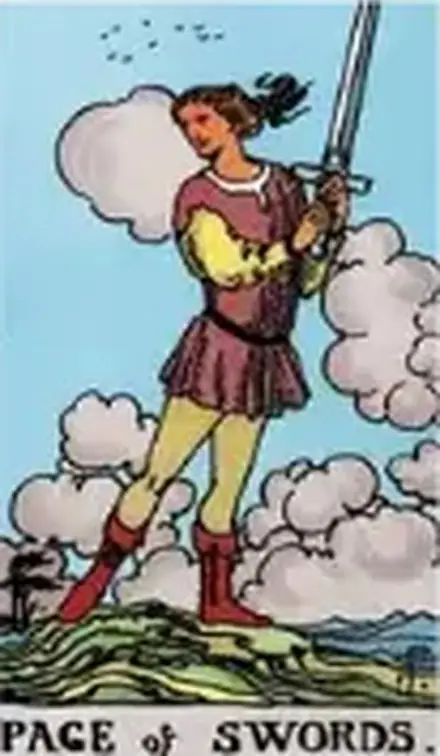
The Page of Swords is the young mind that watches, questions and learns: news that arrives sharp, and a curiosity still learning restraint.
Draw this card · Its correspondences
- Arcana: Minor, court card (Page)
- Suit and element: Swords, Air
- Golden Dawn title: Princess of the Rushing Winds
- Nature: Earth of Air
- Sephirah: Malkuth
- Signs: Capricorn, Aquarius, Pisces
- Keywords: Curiosity, mental agility, a communicator, energy
- Yes or no?: It depends
- Archetype: The Watchful Apprentice
What the card shows
In the deck Pamela Colman Smith drew for Arthur Edward Waite in 1909, the Page of Swords is a slim young man striding across high, uneven ground. He holds the sword in both hands, raised on a diagonal, like someone ready to use it without yet knowing against whom. His body turns one way and his head the other: he is keeping watch. The wind tousles his hair, whips the clouds into swirls and bends the small trees in the background. A flock of birds flies overhead.
Each detail has its reading. The raised sword is the brand-new idea, the word just learned and eager to be tried out. The twisted stance shows divided attention, eyes on where he is going and on where danger might come from. The high, open ground is the observer’s post, a place from which you see a great deal and are also seen. The clouds, the wind and the birds belong to air, the suit’s element, which in tarot governs thought, speech and conflict.
In The Pictorial Key to the Tarot (1910), Waite describes a lithe, active figure walking swiftly over rugged ground and glancing about as if expecting an enemy at any moment. He gives the card vigilance, examination, overseeing authority and secret service. In the Golden Dawn the card is called the Princess of the Rushing Winds, earth of air, and sits in Malkuth: thought at the moment it finally touches the ground and becomes action. The same system also swaps two court figures, making the Knight the fire of the suit and the King its air.
Page of Swords upright
Upright, the Page of Swords reads as an alert mind learning to use its edge. In the modern Rider reading, Pages are messages and learning, and in the suit of air that means news, questions, study and vigilance. The card tends to appear when something needs your attention: a fact worth checking, a conversation to listen to carefully, a situation you have yet to understand fully.
In a spread it can point to information on its way. An email, a rumour, a report, a question someone asks at exactly the right moment. The tradition also links it with patient observation: looking before acting, gathering evidence, learning the rules before arguing with them. It is closely tied to study, exams and the early stages of any craft built on words or reasoning.
Its energy is quick and a little jumpy. The Page raises the sword before knowing whether it will be needed, and that readiness can protect and can also wound by accident. So the card asks you to pair curiosity with tact: say what you think clearly and choose your moment well.
As a person, the Page of Swords is usually someone young or young at heart, curious, observant and very quick-witted. They ask questions, take notes, catch other people’s contradictions and struggle to keep quiet about what they discover. They might be a student, an apprentice, a cub reporter, a researcher or the little sister who sees everything. Loyal to the truth, sometimes more than to people, they learn by bumping up against limits.
Page of Swords reversed
Many readers never read reversals and let the surrounding cards supply the nuance instead. Those who do usually read the Page of Swords reversed as the shadow side of its own gifts, which is also what Waite suggests.
Vigilance turns into spying and curiosity into gossip. The sharp tongue is used to wound, to spread rumours or to win arguments that never mattered. It can point to someone who speaks before thinking, criticises without knowing the subject or uses what they know about others as a weapon.
Another common reading is unpreparedness. Waite speaks of the unforeseen and of being caught unready: news that takes you by surprise, an exam you failed to study for, a conversation you walk into without the facts. The reversed card then advises lowering the sword, getting properly informed and letting your first reaction cool before you reply.
In love
In love, the Page of Swords reads as a relationship where words carry great weight. With a partner it can point to a necessary conversation, a message that clears something up or a phase where two people watch and study each other to understand. It also speaks of intellectual curiosity: attraction born of shared ideas, long debates and wit.
If you are single, the card usually describes a period of observation: getting to know someone slowly, through messages or conversation, before committing your heart. Sometimes it flags a wariness worth examining. The Page watches so closely that it can see enemies where there is only shyness.
Reversed, in love
Reversed in love, the Page of Swords speaks of jealousy, checking the other person’s phone, cutting remarks or rumours that damage trust. Also of misread messages. The advice is to ask instead of spying, and to watch your tone.
Career and money
For career and money, the Page of Swords reads as a phase of learning and attention to detail. It favours study, internships, research, contract review and anything that calls for reading the small print. It can point to professional news or a proposal to examine before you accept. With finances, the tradition advises checking every figure and distrusting whatever looks too easy.
Reversed, in career
Reversed, it points to office gossip, leaked information or decisions made without enough data. The advice is to document everything, speak with care and avoid firing back at an email or a criticism in the heat of the moment.
Health and mood
For health and mood, the Page of Swords is linked with a restless mind: nerves, sleeplessness from overthinking and the fatigue of always being on alert. It reads as an invitation to rest your head and to seek reliable information instead of feeding the worry. No card can diagnose anything: for any symptom, the right person to see is a health professional.
Yes or no? It depends
The Page of Swords reads as “it depends”. Information is missing, and the card asks you to get it before deciding: ask, check, wait for the news that is on its way. If the question concerns a course, an exam or research, it leans towards yes as long as you have prepared. If the question grows out of suspicion, confirm the facts before you act.
Ask the card: a yes or no tarot reading with one card or three.
The archetype: The Watchful Apprentice
As an archetype, the Page of Swords is the young person who discovers that thinking is a weapon. This is the story’s observer: the girl listening at the door, the apprentice who learns the tricks of the trade by watching the master, the rookie investigator who spots the detail the veterans missed. The Page has the clear eyes of the outsider and the impatience of someone desperate to prove their worth.
In the structure of a story, the Page of Swords tends to appear in two places. Early on, as the messenger who brings the news and sets the plot moving: the intercepted letter, the warning, the awkward question. Later, as the witness who knows something the others do not, whose silence or testimony decides the outcome. It is an archetype of initiation. The character learns, sometimes the hard way, that truth has consequences.
Its shadow is as useful to fiction as its light. The Page can be wrong with total conviction, misread what they see and tell a false story that ruins lives. They can also become a spy, a gossip, the one who sells a secret. The richest arc for this character runs from looking to understanding, and from wielding the sword to win to using it to cut away whatever stands in the way of the truth.
In literature
- Kim (Rudyard Kipling, 1901). Kim is an orphan of the Lahore streets with a gift for watching and blending in. Trained to memorise everything on a tray at a glance, he is drawn into the Great Game as a boy spy. Kipling writes the Page of Swords exactly as Waite described him: vigilance, examination and secret service.
- Harriet the Spy (Louise Fitzhugh, 1964). Harriet walks her neighbourhood with a notebook in which she writes down everything, unfiltered. When her classmates read what she has written about them, she discovers the card’s double edge: honest observation can hurt. The whole novel is the education of a gaze that has to learn tact.
- Atonement (Ian McEwan, 2001). Briony is thirteen, with a ravenous imagination and the certainty that she has witnessed a crime. Her testimony, delivered with all the confidence of youth, wrecks two lives. This is the Page’s shadow: a watchful mind that misreads, and will spend the rest of its life writing to make amends.
For writers
The conflict
The Page of Swords sets up a conflict between what a character sees and what they understand. It works very well with young narrators or newcomers to an unfamiliar world: they observe everything precisely and fail to make sense of it. The conflict grows when what they uncover affects someone close and they must decide whether to speak or stay silent. Plant details the reader can interpret better than the character.
The twist
As a plot twist, the Page of Swords is the message that changes everything: a letter found, a conversation half overheard, a report turning up in the wrong drawer. The most interesting twist comes when the message proves incomplete or misread, and the action it triggers creates a bigger problem than the one it meant to solve. The card’s backward glance suggests the threat was coming from the other side.
Prompts
- Write a scene in which your character overhears someone else’s conversation and draws the wrong conclusion, one the reader can see coming.
- Have a young person correct someone in authority in public, and narrate the price they pay for being right.
- Tell the arrival of a decisive message through the eyes of the person delivering it, who has no idea what it says.
Its correspondences
- Element: Air. Source: Golden Dawn (tradition).
- Sephirah: Malkuth. Source: Golden Dawn (tradition).
- Sign: Capricorn. Source: Golden Dawn (tradition).
- Sign: Aquarius. Source: Golden Dawn (tradition).
- Sign: Pisces. Source: Golden Dawn (tradition).
- Hexagram: 18 · Work on What Has Been Spoiled. Source: Crowley, The Book of Thoth (modern system).
In the Golden Dawn the Knight is the fire of the suit and the King its air. Many modern readings of the Rider deck swap the two.
Combinations
Page of Swords and Knight of Swords
The Page and Knight of Swords together read as an idea leaping from observation to action in no time. The news arrives and someone races off to act; check the facts before charging in.
Page of Swords and Ace of Swords
With the Ace of Swords, the Page receives a crystal-clear truth. Together they read as an intellectual discovery, a brilliant idea or a message that suddenly makes sense of a confusing situation.
Page of Swords and Seven of Swords
Beside the Seven of Swords, the emphasis falls on secrecy and cunning: spying, information hidden or stolen, someone playing both sides. The tradition advises caution about what you share.
Page of Swords and The High Priestess
With The High Priestess, the Page’s curiosity meets a knowledge that refuses to give itself up at once. Together they read as deep study, intuition joining logic and secrets that will take time to surface.
Page of Swords and The Moon
The Moon beside the Page of Swords speaks of rumours, misunderstandings and unreliable information. The mind keeps watch in the half-light, so check every fact before believing it.
Page of Swords and Page of Cups
With the Page of Cups, the message mixes head and heart: a written declaration, a love letter or an honest conversation between two young people getting to know each other.
Page of Swords and Strength
Strength beside the Page of Swords tempers the quick blade with patience. Together they read as curiosity guided by calm courage: asking the hard question gently and holding your tongue until the moment is right.
Frequently asked questions
What does the Page of Swords mean in tarot?
The Page of Swords stands for the young, alert mind: curiosity, vigilance, study and incoming messages. The tradition reads it as learning through words and observation, with a reminder that a newly drawn sword can also wound without meaning to.
What does the Page of Swords mean in love?
In love it reads as a phase of conversation and observation: getting to know each other through words, clearing up something pending or receiving an important message. Reversed, it warns of jealousy, rumours and cutting remarks, and advises asking instead of spying.
What is the Page of Swords like as a person?
It describes someone young or young at heart, curious, observant and quick-witted. They ask many questions, spot contradictions and find it hard to keep quiet about what they discover. Loyal to the truth, they learn by bumping into limits, sometimes with little tact.
Is the Page of Swords a yes or no card?
It reads as “it depends”. The card shows that information is missing and asks you to get it before deciding. For questions about study or research, it leans towards yes if you have prepared.
What does the Page of Swords mean reversed?
Readers who use reversals usually see it as the shadow of its gifts: spying, gossip, hurtful words and news that catches you unprepared. The advice is to get properly informed and avoid replying in the heat of the moment.
What is the Golden Dawn title and element of the Page of Swords?
In the Golden Dawn it is the Princess of the Rushing Winds, earth of air, placed in Malkuth. The system assigns it Capricorn, Aquarius and Pisces, and swaps King and Knight: its Knight is the fire of the suit and its King the air.
Do your readingPrevious: Ten of Swords · Next: Knight of Swords
The 14 cards of Swords
- Ace of Swords
- Two of Swords
- Three of Swords
- Four of Swords
- Five of Swords
- Six of Swords
- Seven of Swords
- Eight of Swords
- Nine of Swords
- Ten of Swords
- Page of Swords
- Knight of Swords
- Queen of Swords
- King of Swords
By Style Optimizer · published November 22, 2026.