Tarot / The 78 cards / Pentacles / Nine of Pentacles
Nine of Pentacles (9 of Pentacles): tarot card meaning, upright and reversed
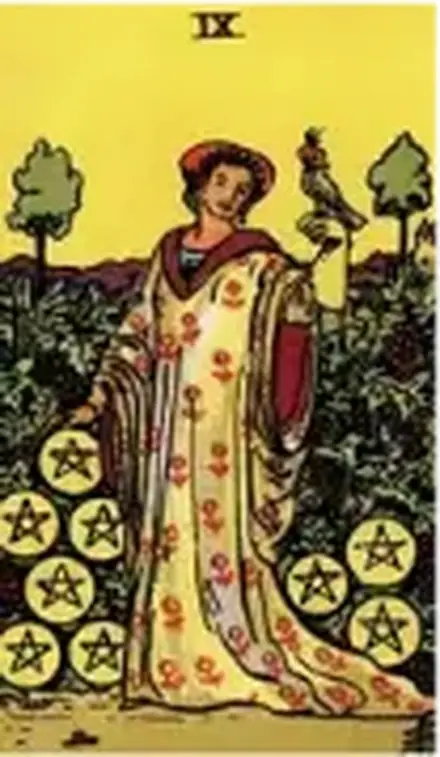
The Nine of Pentacles is wellbeing earned by your own effort: a garden made to measure, independence and the joy of what you built.
Draw this card · Its correspondences
- Arcana: Minor, number 9
- Suit and element: Pentacles, Earth
- Golden Dawn title: Lord of Material Gain
- Sephirah: Yesod
- Decan: Virgo II, Venus (10° to 20° Virgo)
- Keywords: Abundance, luxury, self-sufficiency, financial success
- Yes or no?: Yes
- Archetype: The Mistress of the Garden
What the card shows
In the deck Pamela Colman Smith drew for Arthur Edward Waite in 1909, the Nine of Pentacles shows a woman alone in a garden. She wears a long robe embroidered with red flowers and a headdress. On her left hand, protected by a glove, sits a falcon with its hood on; her right hand rests on the pentacles. Around her grow vines heavy with grapes, and among them the nine pentacles are spread, six on one side and three on the other. In the background, through the trees, a manor house can be glimpsed. Near her feet, almost hidden, a snail is crawling.
Each detail has its reading. The garden and the vines are cultivated abundance: land worked for years that now bears fruit. The hooded falcon is the card’s most discussed symbol. Falconry demands patience and control, and a tamed bird of prey reads as disciplined instinct, a strength that obeys its mistress. The glove protects the hand and reminds us that this calm has skill behind it. The snail, slow and carrying its house on its back, is linked with self-sufficiency and with the unhurried pace of someone who no longer needs to rush.
Waite describes the woman in the garden of a manorial house and suggests that all of it may be hers, proof of complete material wellbeing. He gives the card prudence, safety, success, accomplishment and discernment. The Golden Dawn titled it the Lord of Material Gain and placed it in Yesod, the sefirah of foundation, in the second decan of Virgo, ruled by Venus: pleasure and beauty on solid ground.
Nine of Pentacles upright
Upright, the Nine of Pentacles reads as a time of wellbeing and independence. What has been achieved is real, visible and ready to enjoy. Tradition insists that the achievement is your own. The woman in the garden is waiting for nobody; she has built her place and looks after it. So the card speaks of self-sufficiency, financial security and the confidence of knowing you can live on what you have earned.
In a spread it often marks the fruit of a long effort. After the Eight of Pentacles, at work in the workshop, the Nine steps out into the garden and gathers. It is the card of savings that allow a small luxury, of a home arranged exactly to your taste, of free time well earned. It is also linked with refined taste: the pleasure of things done well, good food, beauty, calm.
Venus in Virgo gives the card a particular character. Enjoyment here is orderly and conscious. There is luxury, and the luxury makes sense: it is chosen, maintained and appreciated. The falcon’s discipline runs through everything.
As advice, the card invites you to recognize what you have achieved and enjoy it without guilt. It also reminds you that independence is sustained through care. The garden still needs tending even when it bears fruit.
Nine of Pentacles reversed
Many readers work only with upright cards and let the neighboring cards shade the meaning. Those who read reversals usually take the Nine of Pentacles reversed in several ways.
The first is fragile security: comfort that depends on someone else, on a salary you do not control, or on appearances kept up on credit. The second is isolation: independence that has turned into loneliness, a walled garden nobody enters anymore. The third comes from Waite, who linked the reversed card with roguery, deception, bad faith and projects that come to nothing.
The advice is to check the foundations of your wellbeing. Is it truly yours, is it sustainable, is it shared? The answers usually show where things need putting in order.
In love
In love, the Nine of Pentacles reads as a relationship between two people who are complete on their own and choose to be together. For couples it speaks of stability, shared comfort and respect for each other’s space. It is the card of the couple who enjoy what they have built without giving up their independence.
If you are single, the Nine of Pentacles often points to a fulfilling time alone: someone at ease with themselves who is looking for nobody to complete them. Tradition reads it as a good starting point for a healthy bond, should one come along.
Reversed, in love
Reversed in love, it speaks of financial or emotional dependence, or of an independence so heavily guarded that it leaves no room for the other person. As advice, it invites you to open the garden gate without giving up the garden.
Career and money
For career and money, the Nine of Pentacles is one of the most prosperous cards in the suit. It reads as financial stability, savings, income of your own and the freedom they bring. It points to projects that stand on their own, freelancers consolidating their business and the reward of prudent management. Tradition advises enjoying success while keeping a close eye on the accounts.
Reversed, in career
Reversed, it warns of spending beyond your means, prosperity that is only on the surface or dependence on a single source of income. The advice is to review the accounts and strengthen your autonomy.
Health and mood
For health and wellbeing, the Nine of Pentacles is associated with the comfort of looking after yourself: rest, good food, time outdoors and an unhurried rhythm. It reads as an invitation to enjoy your body calmly. No card can diagnose anything. For any symptom or concern, the person to see is a health professional.
Yes or no? Yes
The Nine of Pentacles reads as a clear “yes,” especially for questions about money, independence or personal projects. The card speaks of a result that is already ripe and depends mainly on your own effort. If the question involves relying on someone else, the “yes” is qualified: the card favors what you yourself control.
Ask the card: a yes or no tarot reading with one card or three.
The archetype: The Mistress of the Garden
As an archetype, the Nine of Pentacles is the person who has arrived at their place. It embodies someone who has worked hard, chosen well and now enjoys what they have without asking anyone’s permission. The character who lives alone by choice, the widow who runs her estate, the retired artist in a country house, the woman who buys herself the house nobody was ever going to give her.
In story structure, the card usually holds one of two positions. It can be the starting state of a settled character, someone with a great deal to lose when the conflict arrives. Or it can be the goal, the garden the protagonist wins at the end of the journey. Either way, its dramatic force comes from independence. A self-sufficient character is hard to pressure, and when something threatens their garden, the reader feels how much is at stake.
The archetype’s shadow lies in the hooded falcon. So much control can turn into excessive restraint, a life so orderly that it allows no surprises. Many stories begin right there: someone knocks at the garden gate, and its mistress has to decide whether to open it. In fiction, the Nine of Pentacles works best when the reader senses both the character’s fullness and what her calm keeps out.
In literature
- A Room of One’s Own (Virginia Woolf, 1929). Woolf argues that a woman needs money and a room of her own if she is to write. Along the way, the essay tells how a legacy from an aunt gave the narrator an income that set her free. It is the Nine of Pentacles turned into an argument: financial independence as the condition of creative freedom.
- Elizabeth and Her German Garden (Elizabeth von Arnim, 1898). The narrator escapes the duties of society to spend her days in the garden of a remote country estate, planting, reading and delighting in solitude. Her wit keeps the book light, and her pleasure is entirely her own. It is the card’s woman among the vines, content in a world she has shaped to her taste.
- Emma (Jane Austen, 1815). Emma Woodhouse is rich, clever and mistress of her own house, and she declares she has no need to marry. Her independence is real, and so is her blindness: the hooded falcon of the card. Austen builds the novel on that tension between the security of someone who has everything and what she has yet to see.
For writers
The conflict
The Nine of Pentacles sets up a conflict between hard-won independence and whatever might threaten it. The character has a place of their own, and something or someone puts it at risk: a relative with a claim, a tempting offer, a love who asks to share the garden. To set up the card, show the wellbeing in concrete details, the chosen objects, the routines, the order, so the reader feels what is at stake.
The twist
As a plot twist, the Nine of Pentacles is the discovery of what independence costs. What looked like freedom turns out to be a kind of confinement too, or the character’s comfort proves to rest on something they did not want to look at. The reverse twist also works: someone everyone pitied for being alone turns out to be the freest person in the story.
Prompts
- Describe a whole day in the life of a character who lives alone by choice, and let a single visit change everything as evening falls.
- Write the scene in which your protagonist signs for their first house and remembers the person who said they would never manage it.
- Tell the story of the bond between a person and an animal they have patiently tamed, and use it to reveal how they treat other people.
Its correspondences
- Element: Earth. Source: Golden Dawn (tradition).
- Sephirah: Yesod. Source: Golden Dawn (tradition).
- Decan: Virgo II. Source: Golden Dawn (tradition).
Combinations
Nine of Pentacles and Queen of Pentacles
With the Queen of Pentacles, the wellbeing is self-made and also welcoming. It reads as an independent person who looks after home and family and enjoys what they have built with their own hands.
Nine of Pentacles and The Empress
Next to the Empress, the garden comes into full bloom. It reads as abundance, sensual pleasure and a materially fertile life, with the Venusian note both cards share.
Nine of Pentacles and Ten of Pentacles
With the Ten of Pentacles, personal achievement becomes legacy. It reads as wellbeing that begins with one person and reaches the family, the house and the generations to come.
Nine of Pentacles and Nine of Cups
With the Nine of Cups, the satisfaction is both material and emotional. It reads as a wish fulfilled and enjoyed in peace, owing nothing to anyone.
Nine of Pentacles and The Hermit
With the Hermit, independence turns into retreat. It reads as a chosen and fruitful solitude, though it can also warn of isolation that goes on too long.
Nine of Pentacles and Two of Cups
Next to the Two of Cups, two independent people meet. It reads as a bond between equals, where each keeps their own garden and chooses to share it.
Nine of Pentacles and Five of Pentacles
With the Five of Pentacles, the contrast is a warning. It reads as comfort worth protecting, a hard period now behind you or a call to share with those who have less.
Frequently asked questions
What does the Nine of Pentacles mean in tarot?
The Nine of Pentacles represents wellbeing earned through your own effort: independence, financial security and the pleasure of enjoying what you have built. Tradition reads it as prosperity, prudence and self-sufficiency.
What does the Nine of Pentacles mean in love?
In love it reads as a couple of two people who are whole on their own and choose to be together. For singles, it points to a fulfilling time alone and a good starting point for a healthy relationship.
Is the Nine of Pentacles a yes or no card?
It reads as a clear “yes,” especially for questions about money, independence or your own projects. The result is ripe and depends more on the querent’s own effort than on other people.
What does the Nine of Pentacles reversed mean?
Readers who use reversals often see it as fragile or borrowed security, spending beyond your means, or independence that has turned into isolation. The advice is to check the foundations of your wellbeing.
What does the falcon on the Nine of Pentacles mean?
The hooded falcon reads as disciplined instinct: a wild strength tamed with patience. It speaks of the self-control that sustains the card’s wellbeing and, on its shadow side, of control that can become excessive.
What decan and sefirah correspond to the Nine of Pentacles?
In the Golden Dawn system, the Nine of Pentacles is titled the Lord of Material Gain. It corresponds to the second decan of Virgo, ruled by Venus (10° to 20°), and to Yesod, the ninth sefirah of the Tree of Life.
Do your readingPrevious: Eight of Pentacles · Next: Ten of Pentacles
The 14 cards of Pentacles
- Ace of Pentacles
- Two of Pentacles
- Three of Pentacles
- Four of Pentacles
- Five of Pentacles
- Six of Pentacles
- Seven of Pentacles
- Eight of Pentacles
- Nine of Pentacles
- Ten of Pentacles
- Page of Pentacles
- Knight of Pentacles
- Queen of Pentacles
- King of Pentacles
By Style Optimizer · published November 22, 2026.