Tarot / The 78 cards / Pentacles / Five of Pentacles
Five of Pentacles (5 of Pentacles): tarot card meaning, upright and reversed
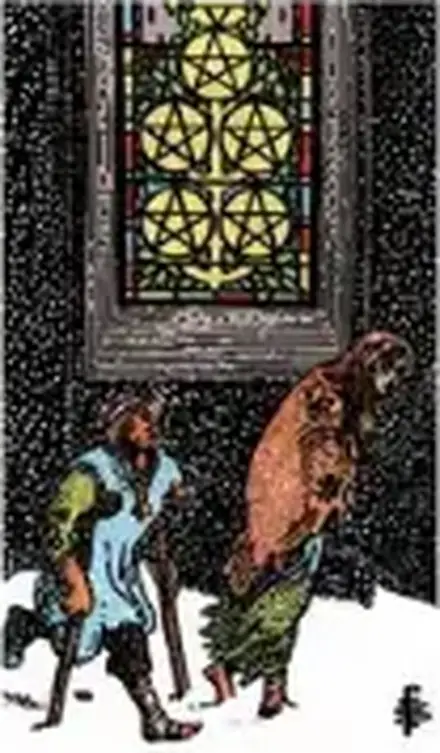
The Five of Pentacles is life out in the cold: two people in hardship and need passing a lit window they have not yet noticed.
Draw this card · Its correspondences
- Arcana: Minor, number 5
- Suit and element: Pentacles, Earth
- Golden Dawn title: Lord of Material Trouble
- Sephirah: Geburah
- Decan: Taurus I, Mercury (0° to 10° Taurus)
- Keywords: Need, poverty, insecurity, financial worry
- Yes or no?: No
- Archetype: The Walker in the Snow
What the card shows
In the deck Pamela Colman Smith drew for Arthur Edward Waite in 1909, the Five of Pentacles is one of the most recognizable scenes in the suit. It is night and snowing. Two figures pass along a wall. The man limps forward on crutches, his head bandaged and one leg injured. A small bell hangs from his neck, the kind the sick were made to wear in the Middle Ages to warn others of their approach. The woman walks ahead, hunched, a torn shawl over her head and her feet bare in the snow. Above them glows a church window with five pentacles arranged like the branches of a tree.
Each detail has its traditional reading. The snow is the lack of resources and warmth, the season when the earth gives nothing. The wounds speak of harm to the body as well as to the purse. The bell adds exclusion: whoever wears it is cut off from ordinary contact with others. The window is the key to the card. There is light, there is shelter, there is a door close by, and the two figures keep walking without looking up.
In The Pictorial Key to the Tarot (1910), Waite sums up the card as two mendicants in a snowstorm passing a lighted casement, and links it above all with material trouble. He adds a curious note: some earlier card readers took it as a card of love and lovers, of concord and affinities, the couple who stay together through misfortune. The Golden Dawn calls it the Lord of Material Trouble, places it in Geburah, the sefirah of severity, and assigns it the first decan of Taurus, ruled by Mercury.
Five of Pentacles upright
Upright, the Five of Pentacles reads as a time of scarcity and of being left out in the cold. Its most direct meaning in tarot is financial: money runs short, a job is lost, an expense throws the budget off, or you live with the constant feeling of not making it to the end of the month. Tradition widens the meaning to any kind of exposure: a run of poor health, loneliness after a move, the sense of having been shut out of a group.
The card belongs to the number five, which in every suit marks a crisis halfway along the road. After the stability of the Four, something breaks and material security wobbles. The Golden Dawn expresses this through Geburah, the force that prunes and cuts back. The decan of Mercury in Taurus adds mental worry about practical matters, a mind going round and round the accounts without finding a way out.
The most valuable nuance lies in the window. Help is right beside the two figures, and the card reads as an invitation to see it. Often the Five of Pentacles speaks of the pride or fear that keeps people from asking for support, of the habit of enduring alone, of assuming nobody will open the door.
As advice, the card asks you to acknowledge need without shame, look for concrete resources and lean on whoever walks beside you. The two figures are cold, and they are also keeping each other company.
Five of Pentacles reversed
Many readers work only with upright cards and let the neighboring cards shade the meaning. Those who read reversals usually take the Five of Pentacles reversed in two ways.
The first is the end of a hard run. The storm eases, income appears, someone holds out a hand, and the person finally steps into the warmth. Read this way, the reversed card speaks of slow recovery, of help accepted and of lessons about the value of the basics.
The second is harsher and matches Waite’s own reading: disorder, chaos, ruin, discord. Scarcity grows worse through bad decisions, or the couple who held together begin to blame each other. In both cases, the advice is to put material matters in order step by step and to ask for help before the problem grows.
In love
In love, the Five of Pentacles has two readings. For couples it can point to a hard stretch faced together: money trouble, illness or a setback that tests the relationship. The older reading Waite records sees two lovers enduring the storm side by side, and that is its bright side. It can also describe feeling alone inside a relationship, an emotional distance that leaves you cold.
If you are single, the card often reflects a season of loneliness or the sense of being left outside the love others seem to share. It invites you to look at the lit window: friends, family and places where warmth is on offer.
Reversed, in love
Reversed in love, it reads as reconciliation after a hard period, or as affection returning after isolation. In a tense spread, it can point to arguments over money. The advice is to talk about practical matters without turning them into blame.
Career and money
For career and money, the Five of Pentacles reads as loss or insecurity: a layoff, a contract not renewed, a debt, a business going through a bad season. Tradition advises reviewing expenses, looking for available support, getting advice and accepting temporary help without shame. The card is a reminder that the way out of a crisis is often close at hand.
Reversed, in career
Reversed, it reads as the start of financial recovery: a new job, income that brings relief or a debt renegotiated. It can also warn of messy accounts that make the situation worse.
Health and mood
For health and wellbeing, the Five of Pentacles is associated with fatigue, with ailments that drag on and with the low mood that money worries bring. It reads as a call to look after the basics: rest, warmth and company. No card can diagnose anything. For any symptom or concern, the person to see is a health professional.
Yes or no? No
The Five of Pentacles reads as a “no” to the question as it stands, especially if it concerns money, a job or a material project. Current conditions are lean, and the card advises against risking what little there is. This “no” leaves a door open: if you ask for help or change your approach, the answer may change with time.
Ask the card: a yes or no tarot reading with one card or three.
The archetype: The Walker in the Snow
As an archetype, the Five of Pentacles is the character who has lost almost everything and keeps walking. The exile, the beggar, the sick person nobody wants near, the widow left with nothing, the laborer turned out onto the street. Their dramatic power comes from exposure. The reader sees them cold, hungry and hurt, and shares the urgency of every step.
The card has two characters, which makes it especially useful in fiction. One leads and the other leans, one limps and the other shivers. Shared misfortune creates a bond that prosperity never would have. Many survival stories work this way: two people with nothing in common discover they need each other.
In story structure, the Five of Pentacles is the fall to the bottom: the moment after the reversal, when the protagonist has lost their place and has not yet found another. It is the crossing of the desert, the longest night. The lit window gives the scene its tension. The reader sees the shelter before the character does and waits, anxiously, for them to look up.
The risk with this archetype is turning poverty into scenery or a moral lesson. It works when the character keeps their dignity, their humor or their anger, and when help, if it comes, carries a cost or a condition. An outstretched hand can also humiliate, and that ambiguity offers a great deal to work with.
In literature
- The Little Match Girl (Hans Christian Andersen, 1845). A barefoot girl sells matches on New Year’s Eve. Through the windows she can see the warmth of other homes, and she can only watch from the snow. Andersen turns the card’s exact image into a fairy tale: the light that is near and out of reach, the cold that seeps into the body and the people who pass without seeing her.
- Misericordia (Benito Pérez Galdós, 1897). Benina, maid to a ruined lady, secretly begs at a Madrid church door to keep her mistress fed. Galdós portrays the city’s beggars with humor and without easy pity. With Almudena, the blind man, Benina forms the couple on the card: two poor people holding each other up.
- The Grapes of Wrath (John Steinbeck, 1939). The Joad family lose their land and cross the country in search of work that barely exists. Every camp is a lit window that closes. The novel ends with an act of help between strangers in the depths of poverty, the deepest side of this Five of Pentacles.
For writers
The conflict
The Five of Pentacles sets up a conflict between need and pride. Your character needs help and finds it hard to ask, or asks and is refused, or receives it and feels they lose something by accepting. It works best when the lack is concrete: a figure, a bill, a pair of broken shoes, a medicine. The cold has to be something the reader can touch. Add a companion so the scarcity becomes a relationship.
The twist
As a plot twist, the card offers the window nobody had noticed. The character has spent chapters looking for a way out, and help was beside them from the start: an old friend, a forgotten skill, a door they never tried. The reverse twist also works: the longed-for shelter demands a price, and the character has to decide whether it is worth going in.
Prompts
- Write a scene in which your protagonist walks past a warm place and decides not to go in; let the reader understand why without being told.
- Make two characters at odds share a freezing night, and let one of them learn something at dawn that changes everything about the other.
- Tell the first time a proud person asks for help, with the whole request in a single line of dialogue.
Its correspondences
- Element: Earth. Source: Golden Dawn (tradition).
- Sephirah: Geburah. Source: Golden Dawn (tradition).
- Decan: Taurus I. Source: Golden Dawn (tradition).
Combinations
Five of Pentacles and Ace of Pentacles
With the Ace of Pentacles, scarcity finds a way out. It reads as income, a job or a material opportunity that lets you step out of the snow and start again more carefully.
Five of Pentacles and Queen of Pentacles
Next to the Queen of Pentacles, the Five reads as help arriving at the right moment: a practical, generous person who offers a roof, a meal or advice. It invites you to accept.
Five of Pentacles and Six of Pentacles
With the Six of Pentacles, the one who was cold now receives. It reads as the move from need to support: aid, a grant, a loan. It also asks you to look at the giver’s conditions.
Five of Pentacles and The Star
The Star beside the Five of Pentacles reads as hope in the middle of hardship. The night is still cold, and yet a light appears that gives direction and encourages you to keep walking.
Five of Pentacles and The Hermit
With the Hermit, the Five’s loneliness runs deeper. It reads as isolation, chosen or imposed, and a call to seek company before the cold becomes a habit.
Five of Pentacles and The Hierophant
The Hierophant beside the Five of Pentacles echoes the card’s church window. It reads as the support of an institution, a community or a tradition you can turn to.
Five of Pentacles and Five of Cups
With the Five of Cups, grief joins material loss. Together they read as a double mourning that calls for time, patience and someone to talk to.
Frequently asked questions
What does the Five of Pentacles mean in tarot?
The Five of Pentacles represents scarcity, material insecurity and the feeling of being left out in the cold. Tradition also reads it as an invitation to ask for help, because a lit window shines right beside the card’s two figures.
What does the Five of Pentacles mean in love?
In love it reads as a hard stretch that tests a couple, often over money or health, or as loneliness for someone single. Its bright side is the old image of lovers who weather the storm together.
Is the Five of Pentacles a yes or no card?
It reads as a “no” to the plan as it stands, especially in money matters. Conditions are lean and it is wise to avoid risk. If you look for support or change your approach, the answer may shift.
What does the Five of Pentacles reversed mean?
Readers who use reversals often see it as the end of a hard run and the start of slow recovery. Following Waite, it can also point to disorder, waste or discord that make scarcity worse.
What decan and Golden Dawn title belong to the Five of Pentacles?
The Golden Dawn calls it the Lord of Material Trouble. It corresponds to the first decan of Taurus, 0° to 10°, ruled by Mercury, and to Geburah, the sefirah of severity, in the element of earth.
Do your readingPrevious: Four of Pentacles · Next: Six of Pentacles
The 14 cards of Pentacles
- Ace of Pentacles
- Two of Pentacles
- Three of Pentacles
- Four of Pentacles
- Five of Pentacles
- Six of Pentacles
- Seven of Pentacles
- Eight of Pentacles
- Nine of Pentacles
- Ten of Pentacles
- Page of Pentacles
- Knight of Pentacles
- Queen of Pentacles
- King of Pentacles
By Style Optimizer · published November 22, 2026.