Tarot / The 78 cards / Pentacles / Knight of Pentacles
Knight of Pentacles: tarot card meaning, upright and reversed
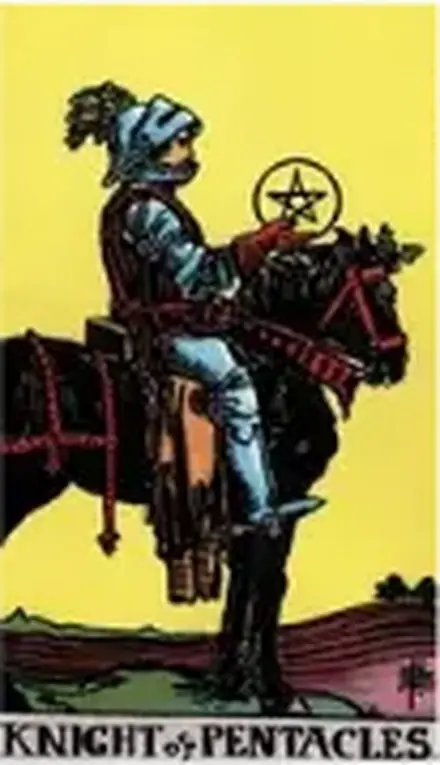
The Knight of Pentacles is the one who moves slowly and arrives: steady work, responsibility and the patience of plowing furrow by furrow.
Draw this card · Its correspondences
- Arcana: Minor, court card (Knight)
- Suit and element: Pentacles, Earth
- Golden Dawn title: Lord of the Wide and Fertile Land
- Nature: Fire of Earth
- Sephirah: Chokmah
- Signs: Leo, Virgo
- Keywords: Efficiency, hard work, responsibility, routine
- Yes or no?: Yes, with conditions
- Archetype: The Plowman in Armor
What the card shows
In the deck Pamela Colman Smith drew for Arthur Edward Waite in 1909, the Knight of Pentacles rides a dark, sturdy, heavy horse with all four hooves on the ground. Of the four knights, he is the only one whose horse stands still. The rider wears armor and a red saddlecloth, with green sprigs on top of his helmet; the horse wears more on its brow. In his hand he holds a pentacle bearing the five-pointed star. Behind him stretches a field plowed into neat furrows, under a yellow sky.
Each detail has its traditional reading. The horse’s stillness is the key to the card: this knight moves at the pace of the earth, never at a gallop. Waite describes him on a slow, enduring horse that matches his own character, and says he exhibits his symbol without looking at it, like someone who knows by heart the worth of what he carries. The green sprigs speak of growth and patience; the plowed field, of work already done and waiting for harvest. The yellow sky gives the scene the light of a calm afternoon.
In the Golden Dawn this card corresponds to the Lord of the Wide and Fertile Land, King of the Spirits of Earth. It helps to know that the Golden Dawn swaps King and Knight relative to the Rider deck: their Knight is the fire of the suit and their King its air. His nature is fire of earth, he sits in Chokmah, and he rules from 20 degrees of Leo to 20 degrees of Virgo. In The Book of Thoth, Aleister Crowley links him with hexagram 62 of the I Ching, Preponderance of the Small.
Knight of Pentacles upright
Upright, the Knight of Pentacles reads as steady work that brings results. In the modern Rider reading, knights are the action of their suit, and in Pentacles that action is slow, methodical and dependable: doing each day what needs doing, meeting deadlines, finishing what you start. It is the card of a routine well kept, of responsibility and of quiet efficiency.
Waite gave him meanings of utility, serviceableness, interest, responsibility and rectitude, all on the practical plane. The Knight of Pentacles meaning comes down to one word: perseverance. Where other knights charge or get distracted, this one advances furrow by furrow and gets there.
As a person, the Knight of Pentacles usually represents someone hardworking, cautious and loyal, whose word holds. The colleague who never misses a deadline, the friend who shows up to help you move, the honest steward. Improvising is hard for him and he distrusts haste; in return, everything he touches is done well. He may seem dull to anyone looking for thrills, and he is the person everyone trusts when something matters.
In a spread he often signals that the road is right and simply needs time. Beside fast cards, such as the Knight of Wands, he invites you to resist being swept along by impatience. Beside the Seven or the Eight of Pentacles, he confirms that the effort will bring its harvest.
As advice, the card asks you to keep working methodically, even when progress looks small.
Knight of Pentacles reversed
Many readers work only with upright cards and let the neighboring cards shade the meaning. Those who read reversals usually take the Knight of Pentacles reversed in two ways.
The first is stagnation. For the reversed card Waite gave inertia, idleness and stagnation: slowness turns into paralysis, routine into empty habit and caution into fear of any change.
The second is his virtue carried too far: work that takes over everything, rigidity, stubbornness or a perfectionism that never lets anything be finished. Read this way, the Knight of Pentacles reversed asks you to get the horse moving: review your routine, delegate something and accept a little risk.
In love
In love, the Knight of Pentacles reads as loyalty and long-term commitment. For couples, he speaks of a stable relationship sustained by everyday gestures and shared plans. The passion may be quiet; the faithfulness is firm.
If you are single, the Knight of Pentacles in love points to someone serious and steady who courts slowly. As feelings, he describes affection that grows quietly and holds: he takes a long time to declare himself and, once he does, keeps his promises. The card asks you to value solidity over instant fire.
Reversed, in love
Reversed in love, he points to a routine that dulls the relationship, a lack of initiative or someone who commits little out of fear of change. The advice is to bring in something new without losing what you have built.
Career and money
For career and money, the Knight of Pentacles is a card of sustained effort and patient saving. He reads as a long project moving forward well, a position of responsibility, a conservative investment or careful work that ends up recognized. Consistency pays better than big bets.
Reversed, in career
Reversed, he speaks of a stalled job, pointless repetitive tasks, too many hours or fear of looking for something better. It is worth asking whether the routine is still leading anywhere.
Health and mood
For health and wellbeing, the Knight of Pentacles is associated with consistency in good habits: regular sleep, moderate exercise and orderly eating. He also reads as a warning against overwork and too much sitting still. No card can diagnose anything. For any symptom or concern, the person to see is a health professional.
Yes or no? Yes, with conditions
The Knight of Pentacles reads as a slow, sure “yes.” The answer is favorable if you accept that it will take time and work. This is a card of results that come through consistency, with no shortcuts. For questions that ask for speed, tradition reads it as “yes, though later than you would like.”
Ask the card: a yes or no tarot reading with one card or three.
The archetype: The Plowman in Armor
As an archetype, the Knight of Pentacles is the character who holds the world steady while others shake it. The squire, the steward, the honest foreman, the faithful friend who is always there. His defining dramatic trait is constancy: he does what he says, finishes what he starts and measures the worth of things by the work they cost.
In story structure, the Knight of Pentacles works beautifully as a counterweight. Beside an impulsive protagonist, he brings firm ground, common sense and the voice that reminds everyone of each adventure’s price. When he is the protagonist, his story is usually one of long effort: raising a farm, keeping a household afloat, fulfilling a duty for years. Tension comes from the temptation to change pace, from what he sacrifices to duty and from what he misses by never looking up.
The card’s motionless horse offers a very useful image for fiction. He is the only knight at a standstill, and that can be read as a virtue or as a limit. The character who never leaves his field may let love, opportunity or the truth go by. Many of the best stories built on this archetype tell of the day the knight finally raises his eyes from the furrow.
The risk in fiction is making him flat. The Knight of Pentacles grows interesting when his loyalty has a cost and his patience hides a desire he never allows himself.
In literature
- Don Quixote (Miguel de Cervantes, 1605). Sancho Panza is the Knight of Pentacles beside his master’s fire. He thinks about his wages, his promised island and his next meal, and he follows Don Quixote with stubborn loyalty. When he governs the isle of Barataria, his practical common sense proves that the earth has its own wisdom.
- The Remains of the Day (Kazuo Ishiguro, 1989). The butler Stevens has served all his life with flawless dedication. The novel shows the card’s dark side: routine and duty worn as armor, and the love that slips away because he never gets the horse moving. His motoring trip across England is, at last, a step forward.
- Middlemarch (George Eliot, 1871). Caleb Garth, a land agent, reveres good work above money. He is honest, slow to judge and firm once he decides. Eliot paints him as the moral ground of the novel, the steadiness that holds up its more brilliant and more fragile characters.
For writers
The conflict
The Knight of Pentacles sets up a conflict between duty and desire, between security and change. It works best when the character has built a life on constancy and something asks him to move: an offer, a love, an injustice. Plant the tension in routine: the same road every day, a task repeated, a letter the character keeps without opening.
The twist
As a plot twist, the Knight of Pentacles is the reliable character who does something unexpected, or the patient work that suddenly bears fruit. The most interesting moment comes when the others discover that the man or woman nobody noticed has been holding everything up. It can also be reversed: the most loyal person stops showing up, and everything wobbles.
Prompts
- Write a full working day for a meticulous character, and let the desire they have never allowed themselves surface in a single detail of the routine.
- Tell a long journey at a slow pace, on horseback, on foot or by car, in which every stage costs something concrete and the reader keeps a running total.
- Make the most reliable character in your story break their word for the first time, and narrate the hours that follow.
Its correspondences
- Element: Earth. Source: Golden Dawn (tradition).
- Sephirah: Chokmah. Source: Golden Dawn (tradition).
- Sign: Leo. Source: Golden Dawn (tradition).
- Sign: Virgo. Source: Golden Dawn (tradition).
- Hexagram: 62 · Preponderance of the Small. Source: Crowley, The Book of Thoth (modern system).
In the Golden Dawn the Knight is the fire of the suit and the King its air. Many modern readings of the Rider deck swap the two.
Combinations
Knight of Pentacles and The Emperor
With the Emperor, constancy becomes structure. Together they read as order, discipline and a solid, well-organized project built to last.
Knight of Pentacles and Knight of Wands
The Knight of Wands and the Knight of Pentacles together set haste against patience. They read as the need to balance impulse with method before moving forward.
Knight of Pentacles and Seven of Pentacles
Next to the Seven of Pentacles, steady work nears the harvest. It reads as a long effort starting to bear fruit that asks for a little more waiting.
Knight of Pentacles and Page of Pentacles
With the Page of Pentacles, what has been learned is put into practice. Together they read as study applied with method, slowly and with good results.
Knight of Pentacles and Temperance
Temperance beside the Knight of Pentacles speaks of the right rhythm. It reads as patience, moderation and calm progress, with neither too much work nor too much rest.
Knight of Pentacles and Four of Pentacles
With the Four of Pentacles, caution hardens into rigidity. Together they read as too much control over money or a fear of change that holds back growth.
Knight of Pentacles and The Chariot
The Chariot beside the Knight of Pentacles sets in motion what was standing still. It reads as decisive progress that keeps its method and consistency.
Frequently asked questions
What does the Knight of Pentacles mean in tarot?
The Knight of Pentacles represents steady work, responsibility and patience. Tradition reads him as slow, sure progress: methodical effort that brings solid results over time, with no shortcuts and no rush.
What does the Knight of Pentacles mean as a person?
As a person, he is hardworking, cautious, loyal and true to his word. He finds improvising hard and distrusts haste, and everything he does is done well. He is the person everyone relies on when something matters.
What does the Knight of Pentacles mean in love and as feelings?
In love he reads as loyalty and long-term commitment: a stable relationship and someone serious who courts slowly and keeps their promises. As feelings, he shows quiet, lasting affection. Reversed, he warns of a routine that dulls the relationship.
Is the Knight of Pentacles a yes or no card?
He reads as a conditional “yes”: slow and sure. The answer is favorable if you accept that it will take time and steady work. For questions that ask for speed, he is interpreted as “yes, but later.”
What does the Knight of Pentacles reversed mean?
Readers who use reversals often see him as stagnation, inertia and empty routine, or as his virtue taken too far: rigidity, stubbornness and work that takes over everything. The advice is to review the routine and accept some change.
What signs correspond to the Knight of Pentacles in the Golden Dawn?
In the Golden Dawn he is the Lord of the Wide and Fertile Land, fire of earth, in Chokmah, ruling from 20 degrees of Leo to 20 degrees of Virgo. That system swaps King and Knight: its Knight is the fire of the suit and its King the air.
Do your readingPrevious: Page of Pentacles · Next: Queen of Pentacles
The 14 cards of Pentacles
- Ace of Pentacles
- Two of Pentacles
- Three of Pentacles
- Four of Pentacles
- Five of Pentacles
- Six of Pentacles
- Seven of Pentacles
- Eight of Pentacles
- Nine of Pentacles
- Ten of Pentacles
- Page of Pentacles
- Knight of Pentacles
- Queen of Pentacles
- King of Pentacles
By Style Optimizer · published November 22, 2026.