How to Turn an Idea into a Story: 15 Story Ideas and Six Steps
November 21, 2026 · Equipo Style Optimizer
An idea is a situation: a lighthouse that casts shadow, a witness who can’t see, a dog two strangers have to share. A story needs more than that: someone who wants something, something in the way and an ending. This guide gives you fifteen ideas to start from and six steps to turn any of them into a story you can write. If you’d rather let chance choose, roll one with our story idea generator.
Start with a roll
The story idea generator combines four pieces: a situation, the person living it, a complication and a writing constraint. Chance takes the first decision off your hands, and the first decision is exactly what blocks you. Set a twenty-minute timer and write without editing.
- Take the first roll. Rolling ten times in search of the perfect idea brings the block right back. If one piece doesn’t work, lock the other three and change that one alone.
- Keep the constraint. “No dialogue” or “in the second person” looks like a nuisance and turns out to be the most useful piece: it makes you solve the scene in a way you wouldn’t have chosen.
- Ask why. Why does this person lie out of habit? What did they expect from a letter that wasn’t meant for them? The answer is usually the beginning of the story.
- Write the scene itself. Twenty minutes of scene are worth more than a page of notes about what might happen.
Story ideas: fifteen starting points
If you’d rather pick from a list, here are fifteen ideas by genre, written for this article. Each one comes with a character, a want and a problem.
| Genre | Idea |
|---|---|
| Literary | A seventy-year-old woman signs up for driving lessons without telling her children. Her road test falls on the morning of her granddaughter’s christening. |
| Literary | Two siblings clearing out their father’s apartment find a second set of keys to a house neither of them has ever heard of. |
| Literary | A substitute teacher is offered a permanent job in the town he left swearing he’d never come back. |
| Mystery | The only witness to a hit-and-run is blind, and what she heard contradicts everyone who saw it. |
| Mystery | At a mountain lodge, a page goes missing from the guest register every morning. |
| Mystery | A painting conservator finds, under a nineteenth-century portrait, the face of a woman who disappeared in 1990. |
| Fantasy | In a city where memories are sold at the market, a girl finds one of her own for sale, from a day she doesn’t remember living. |
| Fantasy | The last translator of the language of trees has to mediate a lawsuit over the felling of a forest. |
| Fantasy | A lighthouse that casts shadow instead of light, and the keeper who has to light it every night without knowing why. |
| Science fiction | On a generation ship, a woman finds the log that proves they reached their destination forty years ago. |
| Science fiction | A company offers to erase one day of your life in exchange for letting you live another one twice. Someone books the same day every year. |
| Romance | Two people who can’t stand each other inherit, half each, an elderly dog that can’t be left alone. |
| Romance | A conference interpreter falls for the voice of the speaker she translates, a man who doesn’t speak a word of her language. |
| Horror | A family moves into a house where every clock shows the time in another time zone, always the same one. |
| Comedy | A burglar breaks into an apartment and finds that the owner has spent three days waiting for someone exactly like him. |
If you’re after practice more than finished stories, there are a hundred more starting points in our creative writing exercises, and seven places to look for ideas in story ideas.
How to turn an idea into a story
An idea becomes a story when someone wants something, something stops them and the situation ends somewhere. These six steps take you from one to the other:
- Turn the idea into a question. “What if the only witness to a crime were blind?” The question opens possibilities; the answer will be the plot.
- Choose who it happens to. The character with the most to lose is usually the best protagonist. Give them a want, a fear and a flaw; if you need help, read how to create characters for a novel or roll some with the character generator.
- Add the obstacle. Someone or something that opposes the want for reasons of its own. A good antagonist believes they’re right.
- Decide what’s at stake. What the protagonist loses if they fail. The more personal it is, the more tension you get.
- Imagine the ending. It may change later, but knowing where you’re headed tells you what to plant at the beginning.
- Write the first scene. Start close to the change, when the situation is about to break. There’s more on this in how to start a story.
For a short piece, that’s enough; the whole process is in how to write a short story. For a novel, you still need a structure.
From idea to plot
The idea gives you a situation; the plot gives you the road. Lay the events over a structure and you’ll see what’s missing. Three acts are the simplest frame: the first sets up the situation and ends when the protagonist commits, the second piles up obstacles until everything seems lost, and the third resolves it. If you want more stops along the way, the Save the Cat beat sheet divides the story into fifteen beats, and our guide to novel structure compares the main models.
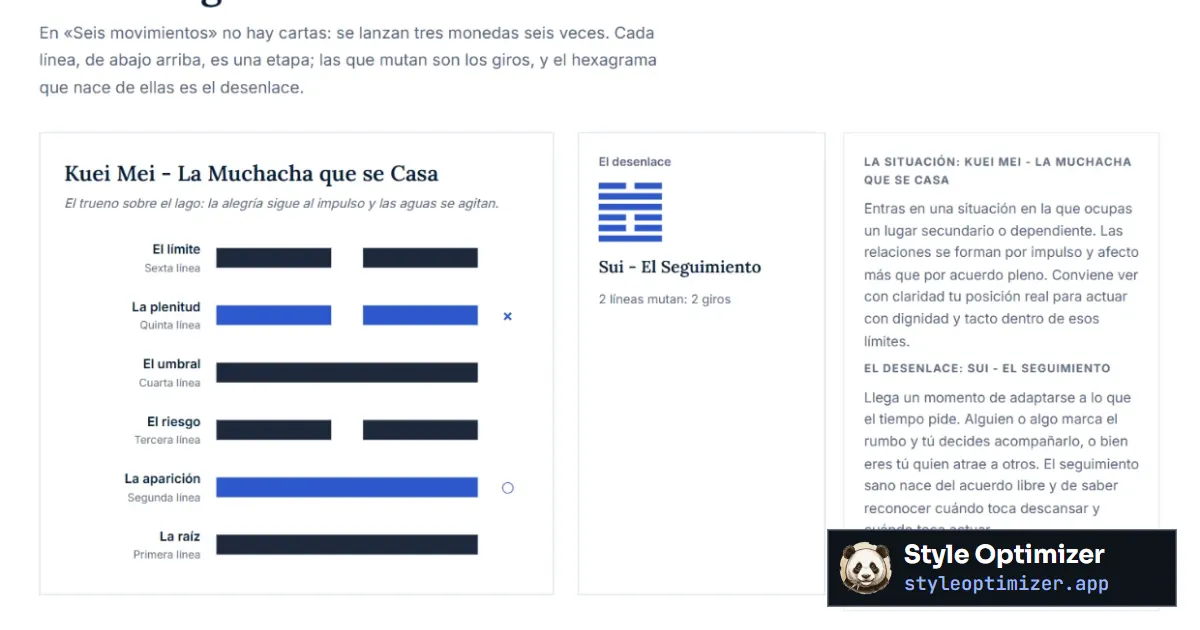
Chance can help here too. Writers have long drawn a tarot card for each act or let a hexagram suggest the turns of a plot: the card or the line doesn’t predict anything, it gives you a constraint to work with. You can try it in our writing oracles.
The last step is the list of scenes. Write each event on a card, put the cards in reading order and check that every scene changes something. We explain how in the scene outline.
Frequently asked questions about story generators
What is a story idea generator and what is it for?
A tool that randomly combines the elements of a story, such as a situation, a character or a conflict, to suggest a starting point. It helps you get unstuck, practice with short exercises and find combinations you’d never have thought of. You write the story; the generator only saves you the first decision.
Does the story idea generator use AI?
Our story idea generator runs in your browser and combines lists written by hand, free and with no sign-up.
How do you create a story from scratch?
Start with a “what if…?” question, choose the character with the most to lose and give them a want and a fear. Add an obstacle with reasons of its own, decide what’s at stake and write a provisional ending. Then lay the events over a structure, such as three acts, and write the first scene.
Where can I find story ideas when nothing comes?
In your own life (an object, a place, a conversation you can’t forget), in the small stories of the local paper, in “what if…?” questions and in generators like ours. A writing constraint helps too: writing with no dialogue or in the second person makes you see the story from another angle.
What’s the difference between a story generator and a plot generator?
A story idea generator suggests a starting point: a situation with a character and a conflict. A plot generator opens that idea into possible paths, scene by scene. The natural order is to use the first to find the idea and the second, or a structure such as three acts, to give it shape.