How to Write a Children’s Story, with Christmas Ideas
November 21, 2026 · Equipo Style Optimizer
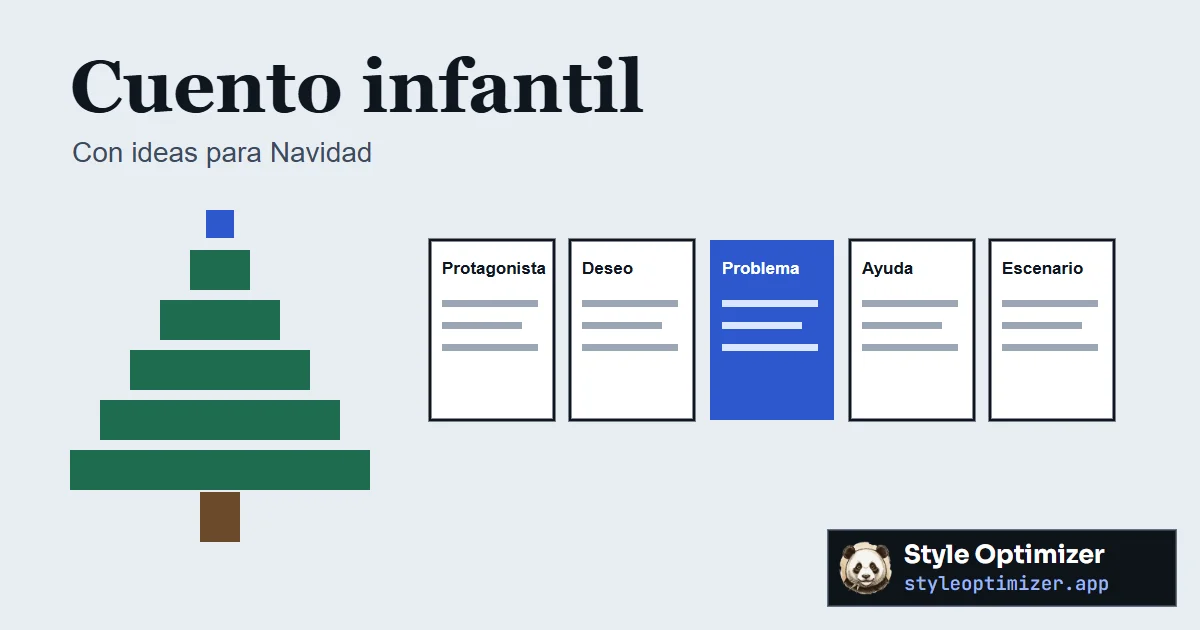
To write a children’s story, start with the age of the child who will read or hear it: length, vocabulary and the kind of story all depend on it. Then you need a protagonist the child can identify with, a clear wish, a problem that grows and an ending that resolves it. Below are the steps, how long it should be for each age, ideas for Christmas stories and a way to check whether your text is easy to read.
How to write a children’s story step by step
1. Decide which age you’re writing for
A story for a three-year-old and one for a ten-year-old are two different crafts. The first is read aloud, repeated a hundred times and lives on its music; the second is read by the child alone and can have chapters and jokes that work on two levels.
2. Choose a protagonist close to the reader
A child, an animal or an object with something childlike about it: fear of the dark, wanting to grow up, jealousy of a sibling. Readers have to see themselves in the character, even if it’s a reindeer.
3. Give them a wish and a problem
As in any short story, without a wish there’s no story. For little ones, a single problem; for older readers, a main one and a few more obstacles.
4. Let the protagonist solve the problem
This is the golden rule: the child protagonist solves their own conflict, even with some help. If an adult or effortless magic fixes it, readers lose their reason to admire the hero.
5. Use repetition
Refrains, structures that repeat three times, lines that come back. Folk tales work this way because children love getting ahead of what’s coming.
6. Write for reading aloud
Read the story aloud before you call it finished. If you stumble, so will the adult reading it at bedtime.
7. Leave room for the pictures
In a picture book, the text doesn’t describe what the illustration already shows. If the picture shows that the dragon is green, the words can spend their time on what the dragon feels.
How long should a children’s story be?
| Category | Reader’s age | Usual length |
|---|---|---|
| Picture book | 3 to 7 | Under 1,000 words, often 300 to 700 |
| Early reader | 5 to 8 | A few hundred to about 2,500 words |
| Chapter book | 6 to 9 | About 6,000 to 15,000 words |
| Middle grade | 8 to 12 | About 30,000 to 55,000 words |
These are the ranges most often cited by agents and publishers in the US and UK; each house sets its own.
Check whether your story is easy to read
Readability formulas measure sentence length and word length. For a story aimed at young readers, the Flesch Reading Ease score should land above 80 and the Flesch–Kincaid grade level should sit near the reader’s school grade. If the score comes out lower, shorten sentences and swap long words for everyday ones. Paste your story into the sentence length checker to see both figures, and read more in our readability test guide.
Ideas for a Christmas story
Christmas works well in children’s stories because it brings together things a child understands deeply: waiting for something, family, cold weather, presents and generosity. A few ideas to get you started:
- A present that gets lost on the way, and a child who decides to go and find it.
- The last ornament for the tree, the one nobody wants to hang because it’s broken.
- A town where it never snows, and a girl who wants to see snow.
- One of Santa’s elves who delivers a present to the wrong house.
- A grandfather spending his first Christmas far from home.
- A snowman who wants to see spring.
- A letter to Santa from someone who asks for nothing for themselves.
- A family of mice living under the nativity scene.
Combine a character from one idea with the problem from another until you find one you like.
Common mistakes when writing for children
- The spelled-out moral. If the story works, children understand the lesson without anyone explaining it at the end.
- Talking down. Children notice when they’re treated as if they couldn’t understand. Write simply without being babyish.
- Too many cute words. One “teeny-weeny” is affectionate; ten are cloying.
- Too many characters. In a story for little ones, three or four are enough.
- An ending that doesn’t close. Open endings work better with older readers; little ones need to know that everything turned out well, or at least that it’s over.
Dialogue in a children’s story
It follows the same rules as in any story, with quotation marks and a new paragraph for each speaker. For the youngest readers, keep each line short and make it clear who is talking every time. If you’re unsure about the punctuation, see how to write dialogue.
And then, getting it published
Children’s stories are mostly published as picture books, and publishers usually choose the illustrator themselves: there’s no need to send drawings with your text. Most large children’s publishers take submissions through literary agents, while some smaller presses accept them directly. Prepare a clean manuscript and a short query letter, as we explain in submitting a manuscript to a publisher, or look at self-publishing if you’d rather work with an illustrator of your own choosing.
Frequently asked questions about writing a children’s story
How many words is a children’s story?
A picture book for ages 3 to 7 usually has under 1,000 words. Early readers and chapter books range from a few hundred words to about 15,000. For ages 8 to 12, it’s middle grade, with tens of thousands of words.
How do I start a story for children?
By introducing the protagonist and their wish in the first lines. “Once upon a time” still works with little ones, because it announces that a story is beginning.
Does a children’s story have to rhyme?
No. Rhyme works very well with the youngest readers, but forced rhyme does more harm than good, and many editors are wary of rhyming manuscripts for that reason. If it’s a struggle, write it in prose with rhythm and repetition.
Do I have to illustrate my story before sending it to a publisher?
No. Unless you’re a professional illustrator, send the text only. The publisher chooses the illustrator.