How to Write an Antagonist: Definition, Types and Examples
November 21, 2026 · Equipo Style Optimizer
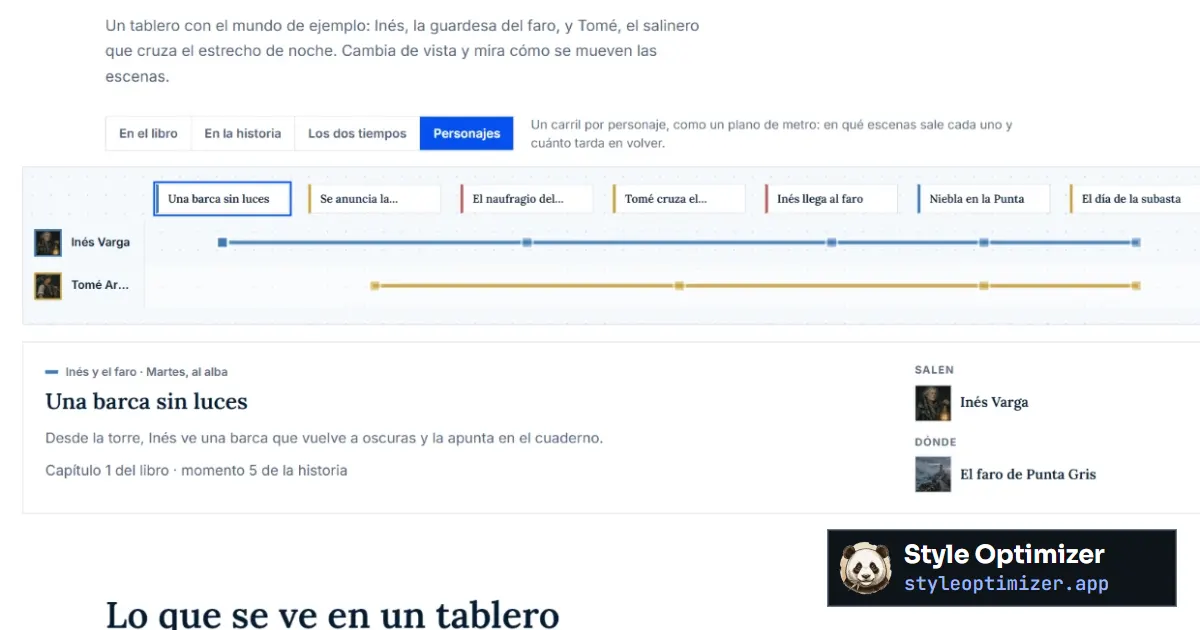
The antagonist is the character or force that opposes the protagonist and keeps them from getting what they want. It can be a person, a society, nature or the protagonist at war with themselves. An antagonist with real weight wants something legitimate, follows their own logic and collides with the protagonist because only one of them can win. Below you’ll find six questions to build yours.
Six questions to build your antagonist
Answer them on paper as if the antagonist were the hero of their own novel:
- Name and occupation: who are they, and what do they do all day?
- What do they want? A concrete goal, the kind the plot can test.
- What do they need? The thing they would have to accept to change.
- What do they fear? What they would do anything to avoid.
- Where do they contradict themselves? Something they do that clashes with what they say.
- What story do they tell themselves? How they explain, in their own head, that they’re in the right.
When you’re done, put their answer to “What do they want?” next to your protagonist’s. If both can come true at the same time, you don’t have an antagonist yet.
What is an antagonist?
The word comes from the Greek antagonistēs, one who competes against another. In a story, the antagonist is the opposition: what turns the protagonist’s desire into conflict. Without one, the protagonist wants something and gets it, and that’s an anecdote.
Along with the protagonist, the antagonist is one of a novel’s main characters. You’ll find the rest of the classification, including the deuteragonist and secondary characters, in types of characters.
Types of antagonist
| Type | What opposes the protagonist | Example |
|---|---|---|
| A person | Another character with an incompatible desire | Javert against Jean Valjean in Les Misérables |
| Society | A system, a law, a community, an era | The Party in George Orwell’s 1984 |
| Nature | The sea, the cold, an illness, an animal | The sea and the sharks in Hemingway’s The Old Man and the Sea |
| The protagonist | A fear, a vice, a part of themselves | Hyde inside Jekyll, in Stevenson’s novel |
Abstract antagonists work best when they have a face. In 1984 the Party is the enemy, and O’Brien is the one who sits across from Winston. In Fahrenheit 451, the book-burning society speaks through Captain Beatty. A face makes room for scenes, dialogue and glances, and readers feel the threat physically.
Many novels combine two types: a flesh-and-blood rival on the outside and one of the protagonist’s fears on the inside. The rival usually attacks exactly that fear.
Antagonist vs. villain: the difference
A villain is one kind of antagonist: one who acts with malice and does harm knowingly. An antagonist, more broadly, is anyone who opposes the protagonist, and they can be a good person.
Javert is the best example. He hunts Jean Valjean through the whole novel, convinced he’s doing his duty, and his pursuit is relentless precisely because he’s honest. When Valjean spares his life, Javert’s whole way of understanding the world collapses. An antagonist like that makes readers think, because both men are partly right.
The villain, by contrast, chooses harm. Iago, in Othello, destroys his general with lies and offers motives that shift so often that Coleridge spoke of his “motiveless malignity.” Both models work; the choice depends on whether your story needs a dilemma or a threat.
Protagonist and antagonist: why they collide
The strongest clash comes when both want the same thing and only one can have it, or when what one wants destroys what the other needs. In Style Optimizer’s sample world, Orsenna, Inés Varga keeps the Punta Gris lighthouse and logs every boat that enters the lagoon. Tomé Arrieta is a salt maker by day, and by night he crosses the strait with smuggled salt, running without lights.
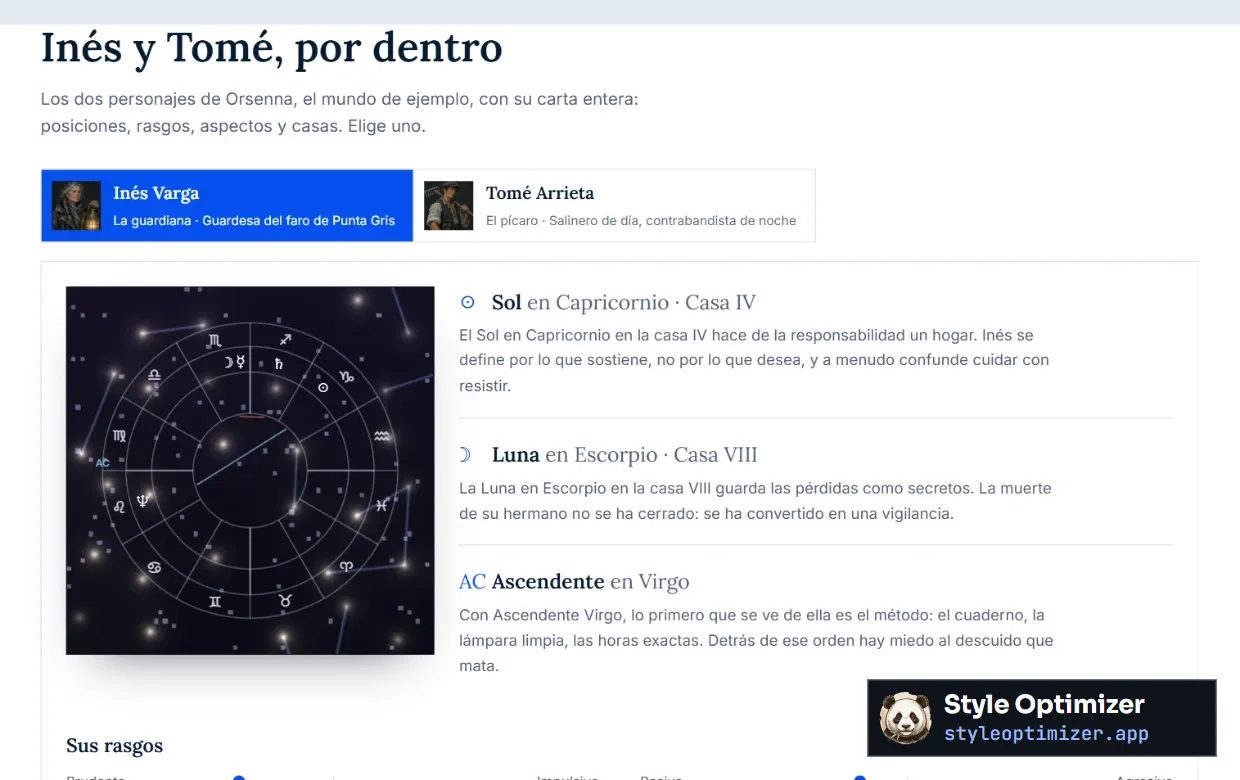
Each of them is right from where they stand. Inés wants no one else lost at sea after losing her brother; to her, a boat running dark is a shipwreck waiting to happen. Her chart in AstroLab, Style Optimizer’s character creator, explains it: Sun in Capricorn, responsibility as home, and Ascendant in Virgo, the logbook and the exact hours.
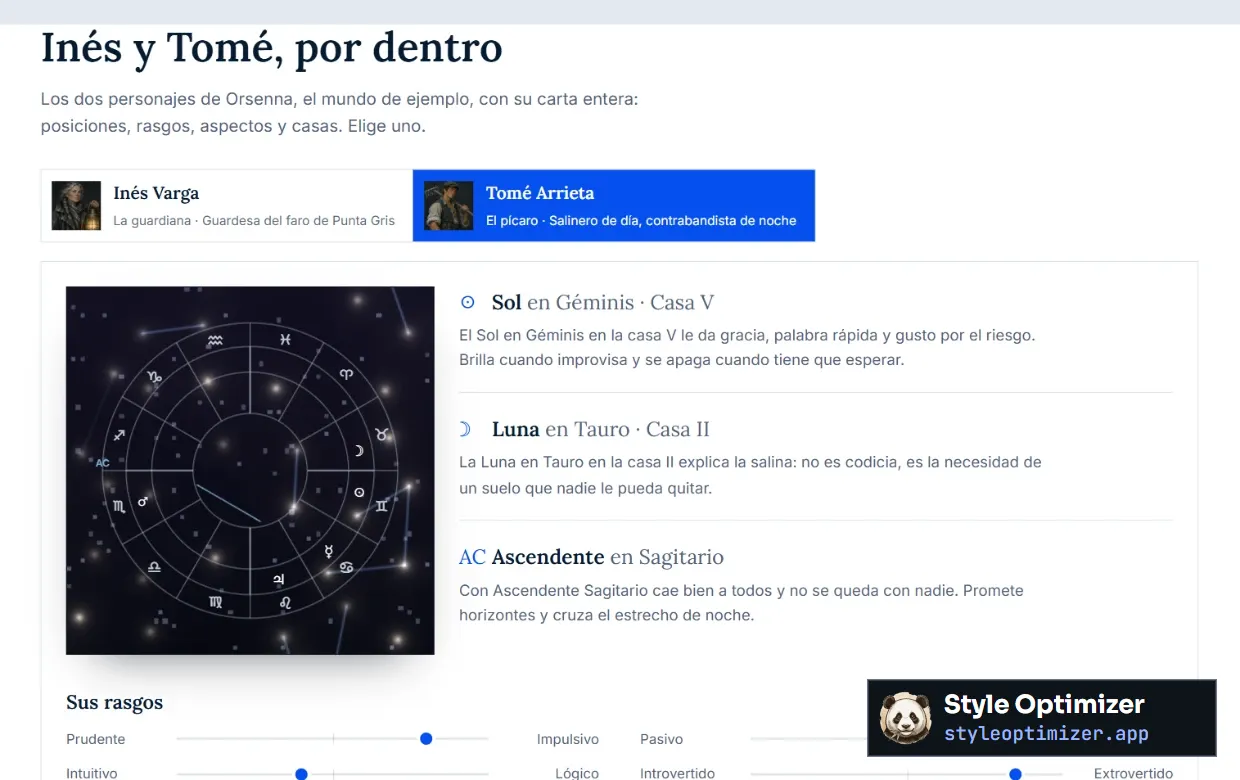
Tomé wants to keep his family’s salt pan, and smuggling is what keeps it afloat. His Moon in Taurus craves ground no one can take from him; his Ascendant in Sagittarius sends him across the strait at night. Each is the other’s antagonist: what she watches for is exactly what he needs to hide. AstroLab’s synastry compares the two charts and shows where they rub against each other.
How to write an antagonist with weight
- Give them a legitimate desire. Something readers would understand wanting: protecting their family, upholding the law, getting back what was taken from them. An antagonist who wants “evil” stays cardboard.
- Give them their own logic. Write a page from their point of view in which they’re right. If you can’t, you don’t know them yet.
- Make the collision inevitable. What one wants has to block what the other wants. If they can strike a deal in chapter two, the novel ends there.
- Make them a match. Stronger, smarter or better resourced than the protagonist, at least at the start. An easy victory moves no one.
- Aim them at the protagonist’s fear. The best antagonist forces the hero through exactly what they dread, and that pushes their character arc.
- Give them presence. Count their scenes. If they appear in four out of sixty, the tension dies between appearances.
For the rest of the work, from desire and fear to wound and voice, follow the seven steps in how to create characters: they apply to the antagonist just as well. And if you see yours as the hero’s shadow, review the character archetypes.
How to write a villain
A villain is an antagonist who has crossed a moral line. To make one frightening and believable, decide three things: why they do harm (a motive readers can understand, even while rejecting it), what they would never do (a limit makes them human, and more unsettling) and what they tell themselves to justify it. Almost no villain sees themselves as a villain. The last of the six questions above, “What story do they tell themselves?”, is the most useful one for writing them.
Keep them from explaining their plan out loud. A villain who frightens acts, and lets readers discover the scope of what they’ve done.
Antagonist FAQ
What is an antagonist in a short story?
The character or force that opposes the protagonist and keeps them from getting what they want. Because a short story is brief, it’s usually a single clear figure: the wolf, the stepmother, a storm or one of the protagonist’s own fears. Its job is to create the conflict that carries the story to its ending.
What’s the difference between an antagonist and a villain?
An antagonist is any character or force that opposes the protagonist, good or bad. A villain is an antagonist who acts with malice and does harm knowingly. Javert, in Les Misérables, is an antagonist and an honest man; Iago, in Othello, is both antagonist and villain.
Does the antagonist have to be a person?
It can be a society, a law, nature, an illness or a part of the protagonist. When it’s abstract, give it a face: a character who embodies the system, or a moment when the threat turns concrete. That way the conflict can be written in scenes and dialogue.
Can a novel have more than one antagonist?
Yes. It’s common to have a main antagonist plus lesser ones who appear for stretches of the book, or an external antagonist and an internal one. One should carry the weight of the central conflict, while the others complicate the path without scattering readers’ attention across too many fronts.
Can the antagonist be right?
They can, and it’s often what makes them memorable. An antagonist with a legitimate desire and a coherent logic makes readers wonder whose side they’re on. The novel grows richer when both characters are partly right and their clash becomes a moral dilemma as well as a fight.