Save the Cat Beat Sheet for Novels: All 15 Beats Explained
November 21, 2026 · Equipo Style Optimizer
The Save the Cat beat sheet is a story structure method that breaks a story into fifteen key beats, each at a set point along the way: the Catalyst at around 10%, the Midpoint dead center and All Is Lost at about two-thirds. Screenwriter Blake Snyder created it for film, and it works for a novel once you turn his page numbers into percentages. This guide gives you those percentages, a worked example and the math to place every beat in your own book.
Where each beat falls in your novel
Take your target word count and multiply it by the percentage of each beat in the table below. For an 80,000-word novel, the Catalyst lands around word 8,700, Break into Two around 18,200, the Midpoint at 40,000, All Is Lost around 54,500 and Break into Three around 61,800. At roughly 250 words per page, that puts the Midpoint near page 160 of a 320-page book.
What is Save the Cat?
Blake Snyder published Save the Cat! in 2005 as a screenwriting manual for Hollywood. The title comes from one specific piece of advice: early in the movie, the hero has to do something that wins us over, like saving a cat, so the audience wants to stay with them for two hours.
What made the book famous was its beat sheet: fifteen moments, each with a name and a page number, mapped onto a 110-page screenplay. It’s a detailed version of the three-act structure that tells you what has to happen and roughly when.
In 2018 novelist Jessica Brody published Save the Cat! Writes a Novel, which adapts the method to fiction using percentages instead of pages. Some of her beats land slightly later than Snyder’s; the differences are a few points, and the logic is the same.
The fifteen beats of the beat sheet
This table gives the page Snyder suggests in a 110-page screenplay and its percentage equivalent, which is what carries over to a novel.
| Beat | Page (of 110) | As % | What happens |
|---|---|---|---|
| 1. Opening Image | 1 | 0–1% | A snapshot of the hero before the change. |
| 2. Theme Stated | 5 | ≈ 5% | Someone mentions, almost in passing, what the hero will have to learn. |
| 3. Set-Up | 1–10 | 1–9% | The hero’s world, their people and what they lack. |
| 4. Catalyst | 12 | ≈ 11% | The event that breaks the routine. |
| 5. Debate | 12–25 | 11–23% | Doubt: will they dare? |
| 6. Break into Two | 25 | ≈ 23% | The hero decides and enters a new world. |
| 7. B Story | 30 | ≈ 27% | A new relationship that will carry the theme. |
| 8. Fun and Games | 30–55 | 27–50% | The promise of the premise: what the reader came for. |
| 9. Midpoint | 55 | 50% | A false victory or a false defeat that raises the stakes. |
| 10. Bad Guys Close In | 55–75 | 50–68% | Pressure from outside, cracks within the team. |
| 11. All Is Lost | 75 | ≈ 68% | The lowest blow, often with a death, real or symbolic. |
| 12. Dark Night of the Soul | 75–85 | 68–77% | The hero hits bottom and looks inward. |
| 13. Break into Three | 85 | ≈ 77% | The hero combines the lesson of the B Story with their own skills and finds the way out. |
| 14. Finale | 85–110 | 77–100% | The hero puts it into practice and defeats the problem. |
| 15. Final Image | 110 | 100% | A mirror of the Opening Image, with the change in plain view. |
Three beats hold the whole structure up: Break into Two, the Midpoint and Break into Three. Get those three clear and the rest fall into place around them. The twists that drive them are covered in our guide to the turning point.
Example: the Save the Cat beat sheet applied to a novel
Above the Treeline is an 80,000-word novel invented for this example. Nora Hale, a mountain guide in the Colorado Rockies, stopped leading groups after an accident in which a client died. Here’s how her fifteen beats break down, with the approximate word where each one falls:
- Opening Image (word 0). Nora sells her climbing gear at a secondhand shop in town.
- Theme Stated (≈ 3,600). Her niece Annie reminds her of a rule Nora taught her herself: you come down the mountain with everyone.
- Set-Up (0–7,300). Nora works at a bakery, avoids her old business partner, Jake, and never looks up at the peaks.
- Catalyst (≈ 8,700). A group of five students hasn’t come back from the backcountry hut, a storm is moving in, and Annie is with them.
- Debate (8,700–18,200). The helicopter can’t fly. Nora waits at the rescue station for someone else to go up.
- Break into Two (≈ 18,200). She climbs alone, at night, by a route only she knows.
- B Story (≈ 21,800). She runs into Jake, who has come up the other side of the mountain. They’ll have to go on together.
- Fun and Games (21,800–40,000). The mountain in a storm, the group’s tracks and the craft Nora thought she’d forgotten.
- Midpoint (40,000). They find four of the students at the hut. Annie is missing; she went for help.
- Bad Guys Close In (40,000–54,500). An avalanche cuts off the way down, Jake is injured, and the old blame over the accident comes out.
- All Is Lost (≈ 54,500). Annie’s backpack, at the edge of a ravine.
- Dark Night of the Soul (54,500–61,800). In a cave, Nora tells Jake what really happened that day.
- Break into Three (≈ 61,800). Remembering the rule tells her where Annie must have gone: back toward the group, by the route Nora taught her.
- Finale (61,800–80,000). She finds her and brings everyone down, Jake included.
- Final Image (80,000). Nora, in the same shop, buys rope for a new group.
The theme stated in beat 2 is the rule that saves beat 13, and the B Story, her relationship with Jake, is where Nora learns it again. That crossover between the A Story and the B Story is the most valuable part of the method.
From beat sheet to scene outline
Snyder’s fifteen beats are pillars; an 80,000-word novel has around fifty scenes. The next step is to fill the stretches between pillars with scenes of your own and arrange them in an outline.
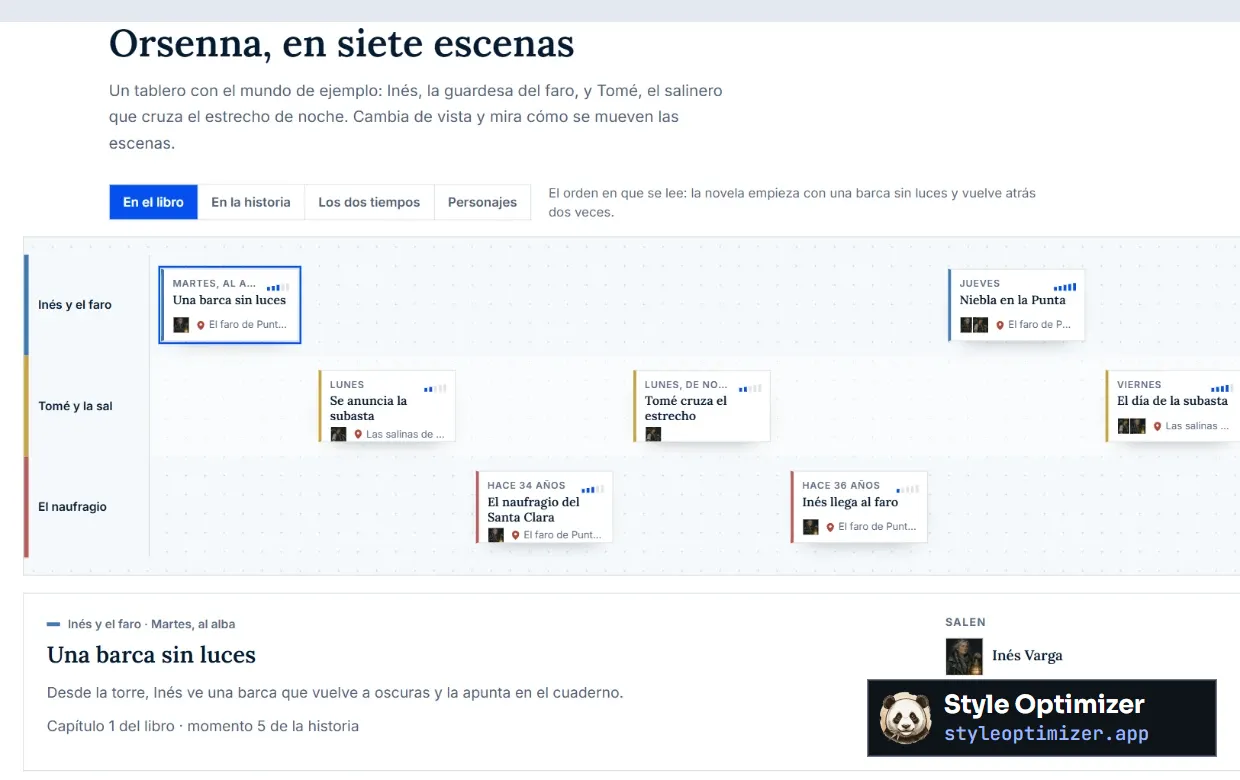
In Threads, the scene board in Style Optimizer’s worldbuilding tools, each scene is a card and each plotline is a lane. The A Story and B Story of Save the Cat sit in two colored lanes, and you can see at a glance whether the B Story vanishes for too long. The sample board tells the story of Orsenna in seven scenes and three plotlines.
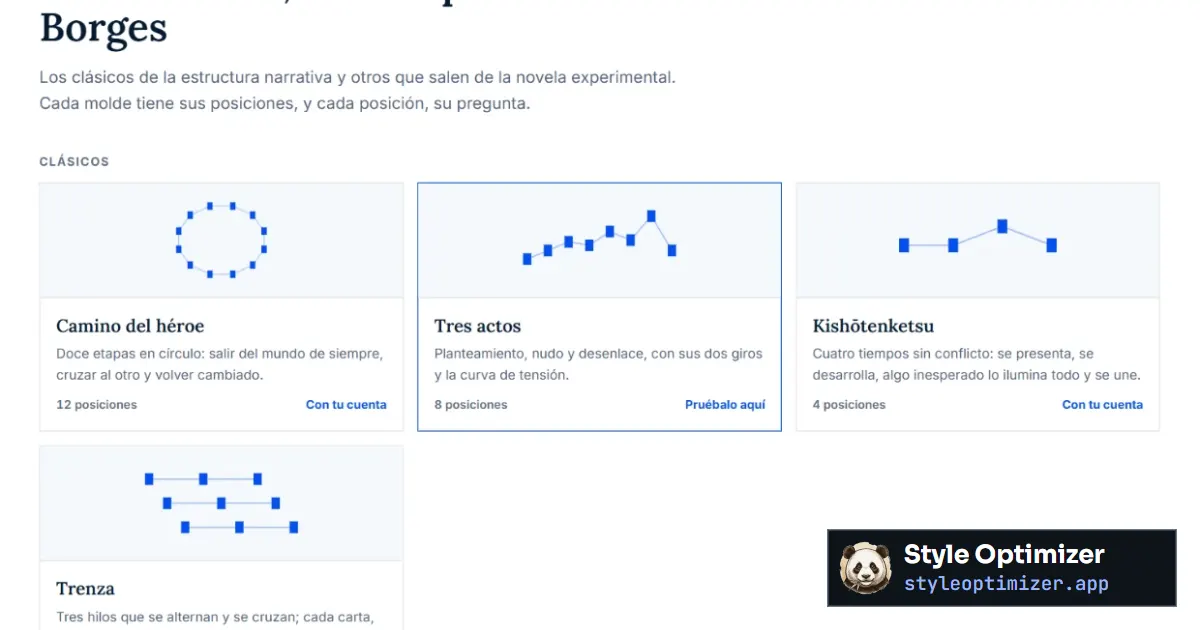
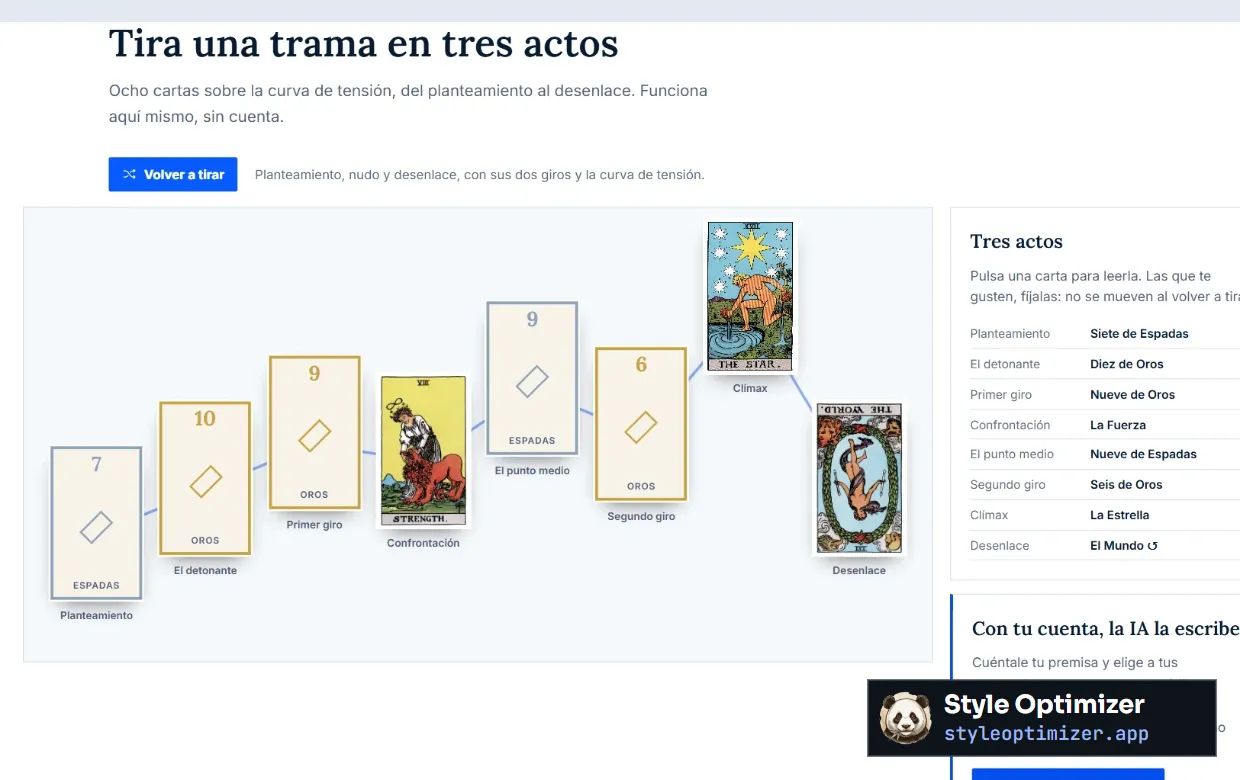
If you prefer a shorter template, the three-act template in Threads has eight positions (setup, inciting incident, first turning point, confrontation, midpoint, second turning point, climax and resolution) that line up with the pillars of Save the Cat.
The ten Save the Cat genres
Snyder grouped stories into ten genres by how they work, beyond their subject matter: Monster in the House (a monster in a closed space), Golden Fleece (the quest for a treasure or goal), Out of the Bottle (a magic wish comes true), Dude with a Problem (an ordinary person facing a huge problem), Rites of Passage (a stage of life), Buddy Love (a pair transformed by each other), Whydunit (the investigation of a crime), The Fool Triumphant (the underdog innocent who wins), Institutionalized (the individual against the group) and Superhero (someone extraordinary in an ordinary world). Above the Treeline would be a Dude with a Problem.
When Save the Cat works for a novel
It pays off most in genre fiction with a clear protagonist and a clear goal: thrillers, romance, fantasy, YA, adventure. Readers of those genres expect certain moments, and the method helps you deliver them on time.
In an ensemble novel, a fragmented one or a slow-burning literary novel, fifteen beats can feel tight. There it works as a checklist: is there a Catalyst? Does something shift at the halfway mark? Is there a moment of defeat before the end? For other shapes, look at the Hero’s Journey or the templates in our guide to novel structure.
Save the Cat beat sheet: FAQ
What does “Save the Cat” mean?
Blake Snyder used it as the name for a piece of advice: early on, the protagonist should do something that earns the audience’s sympathy, like saving a cat, so we follow them even when they have flaws. Over time the name came to stand for his whole fifteen-beat structure method.
What is a beat sheet?
A beat sheet lists the key moments of a story in order, each with its function and approximate position. The Save the Cat beat sheet has fifteen, from the Opening Image to the Final Image. Screenwriters use it to plan a script before writing scenes, and novelists use it the same way for chapters.
Does Save the Cat work for novels?
Yes, once you convert screenplay pages into percentages of the book. Jessica Brody did exactly that in Save the Cat! Writes a Novel (2018). It works best in genre novels with a clear goal. In ensemble or fragmented novels, use it as a checklist and keep the template loose.
What’s the difference between Save the Cat and the Hero’s Journey?
The Hero’s Journey describes a mythic path in twelve stages, with figures like the mentor and the threshold guardian, and suits adventure and fantasy. Save the Cat is more practical and more general: fifteen beats with set positions for any genre, designed to control pacing and the timing of each twist.
Where does the Midpoint go in a Save the Cat novel?
Right in the middle: page 55 of a 110-page screenplay, or word 40,000 of an 80,000-word novel. It’s the scene where the story flips with a false victory or a false defeat, and where the protagonist stops reacting to events and starts acting on their own.