How to Create Characters for a Novel: Seven Steps and an Example
November 21, 2026 · Equipo Style Optimizer
How to create characters for a novel: start with what the character wants and what they fear, find the wound that explains that fear and give them a contradiction. Then come their voice, their relationships and the change the story will demand of them. These seven steps work best in order, and below we apply them to an invented protagonist from start to finish. If you’re struggling to get going, a birth chart can hand you a starting point in a minute; you’ll find how further down.
Before you create a character: what role do they play?
A character exists to serve a story. Before you invent a past for them, decide where they stand: protagonist, antagonist, secondary character with an arc of their own, or a figure who appears in a single scene. The protagonist and the antagonist deserve all seven steps; the waiter who delivers a note needs only one sharp trait. You’ll find the full classification in types of characters.
For our example we’ll create the protagonist of a short novel: Celia Arana, forty-six, a diver on a search-and-rescue team at a reservoir in the Pyrenees. For now she’s a job and a place. By the end of the seven steps she’ll be a person.
How to create characters in seven steps
1. Desire: what exactly do they want?
Desire drives the plot. It has to be concrete and checkable, so readers know in every chapter whether the character is getting closer or further away. “To be happy” floats in the air; “to get transferred to a desk job before winter” can be measured.
Celia wants a job on dry land. She has applied for a transfer three times, and the next opening comes up in November.
2. Fear: the button the plot will press
Fear is whatever the character would do anything to avoid. Choose it with the ending in mind, because the story has to drive them straight into it. A fear the plot never touches is just set dressing.
Celia is afraid of being trapped underwater in the dark. Every dive in the reservoir, with half a meter of visibility, is a negotiation with that fear.
3. The wound: where the fear comes from
The wound is the event in the past that explains the fear and the crooked way the character protects themselves. You can tell it in two lines or keep it to yourself; what matters is that you know it and that it shows in what they do.
When Celia was eleven, she waited on the shore while they searched for her father, who had gone fishing on the reservoir. They found him on the third day. She became a diver so that no family would ever have to wait three days again.
4. The contradiction: what doesn’t fit
A perfectly consistent character reads like a brochure. The contradiction is something they do that clashes with what they claim to believe or with what they fear. Readers sense it before they can name it, and it’s what keeps them watching.
Celia fears dark water, and she’s the best on the team in dark water. She keeps asking for a transfer, yet every time the on-call phone rings, she’s the first one at the dock.
5. Voice: how they speak and how they think
Voice grows out of a character’s work, background and wound. Decide three things: which words they use that nobody else would, what they never talk about and how they react under pressure. Write a paragraph of them talking about anything at all, and read it aloud.
Celia measures the world in meters of depth and minutes of air. She speaks little, in short sentences, and makes dark jokes that outsiders find cruel. She never talks about her father.
6. Relationships: who puts them to the test
Characters reveal themselves in front of other people. Look for at least two relationships that pull in opposite directions: someone who pushes them toward what they want and someone who pushes them toward what they need.
Her sixteen-year-old daughter, Noa, wants to get certified as a diver, the last thing Celia wants. Her partner, Iñaki, has covered for her for years whenever she freezes at the bottom, and he retires in the spring.
7. The arc: what has to change
Put everything together and ask what the character needs. It almost never matches what they want, and the distance between the two is the arc: the novel is the journey from one to the other. We cover it in depth in character arc.
Celia wants out of the water. She needs to accept that she can’t save everyone and let others help her. The climax confronts her with a dive only she can make, with Iñaki already retired and Noa on the shore, waiting, just as Celia did at eleven.
The profile that comes out of the seven steps
| Step | Question | Celia Arana |
|---|---|---|
| Desire | What exactly do they want? | A job on dry land before November |
| Fear | What would they avoid at all costs? | Being trapped underwater in the dark |
| Wound | What happened to them? | The three-day search for her father |
| Contradiction | What doesn’t fit? | Fears dark water and always volunteers to go down |
| Voice | How do they talk? | Short sentences, meters and minutes, gallows humor |
| Relationships | Who tests them? | Noa, who wants to dive; Iñaki, who’s leaving |
| Arc | What do they need? | To let others carry part of the weight |
Seven lines are enough to write the first scene. Her looks, her daughter’s exact age or the name of the reservoir can wait until the story asks for them. If you’d like a template to fill in, there’s one in our character profile guide, and for putting the character on the page, see how to describe a character.
Creating characters with a birth chart
When the page is blank, a little structured chance helps. A birth chart deals out traits you wouldn’t have combined yourself and arranges them in layers: the Sun gives what the character pursues, the Moon what they need to feel safe and the Ascendant the face they show the world. It works as an invention tool, the same way dice or a deck of cards do.
For a quick sketch, pick three placements and answer one question for each:
- Sun sign: what does this character want?
- Moon sign: what are they afraid of losing?
- Ascendant: what flaw or mask do others see first?
That sketch is a seed. The seven steps above turn it into someone who can carry a novel.
In AstroLab, Style Optimizer’s character creator, you set eight personality sliders and get a chart that matches them: Sun, Moon, Ascendant, six planetary aspects, three house placements and a psychological biography. You can build it by hand or ask the AI for it.
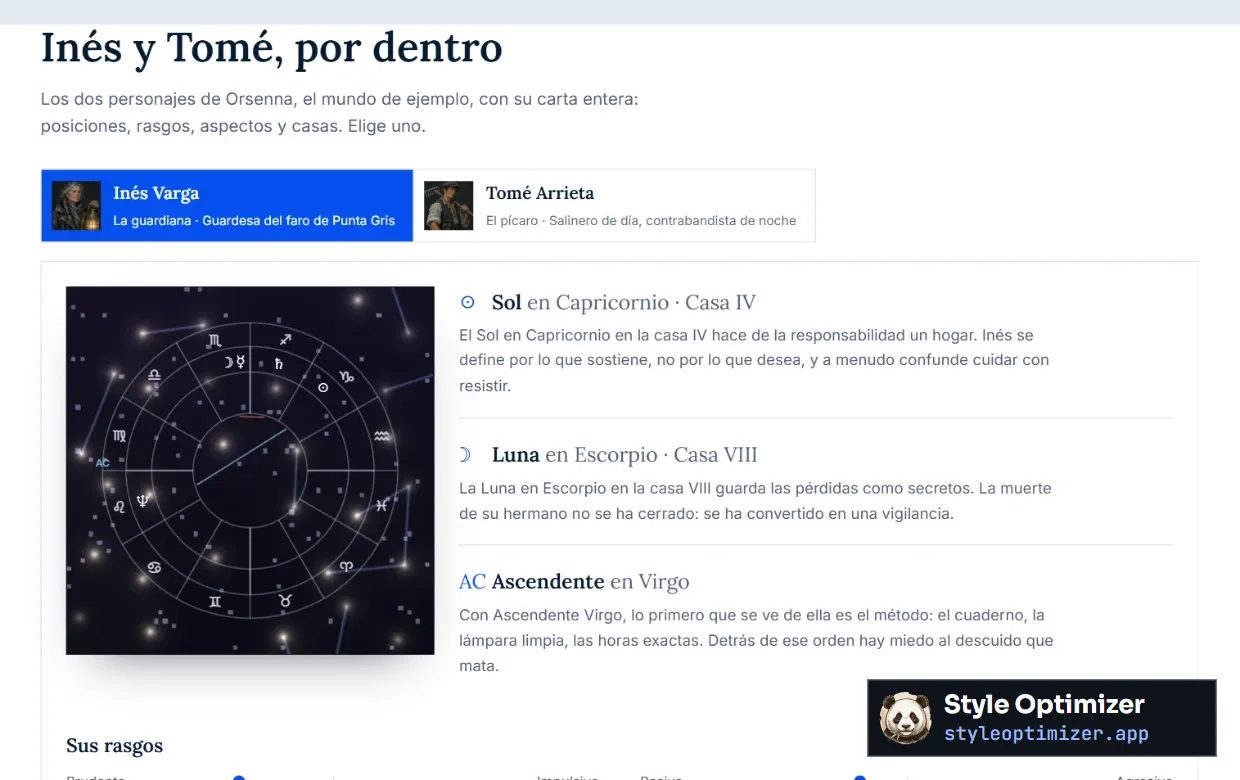
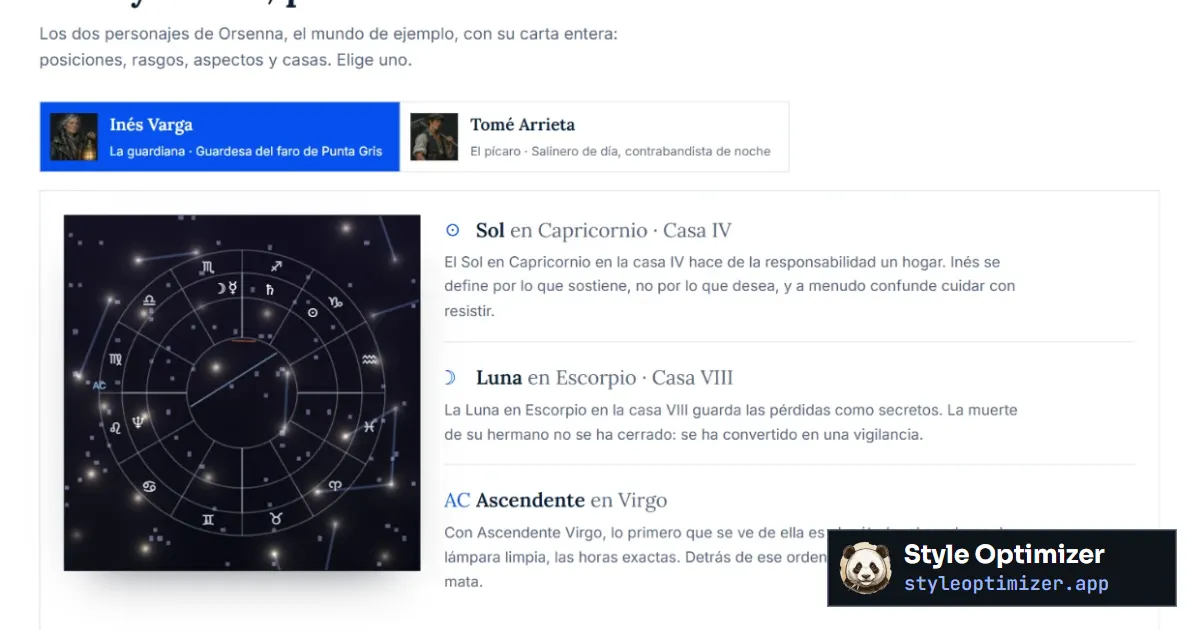
See how it lines up with the seven steps in Inés Varga, the lighthouse keeper from the sample world. Her Sun in Capricorn gives her the desire: to hold things up, to do her duty, to endure. Her Moon in Scorpio in the 8th house gives her the wound: her brother’s death, which she has turned into vigilance. Her Ascendant in Virgo gives her the voice and the mask: the logbook, the polished lamp, the exact hours.
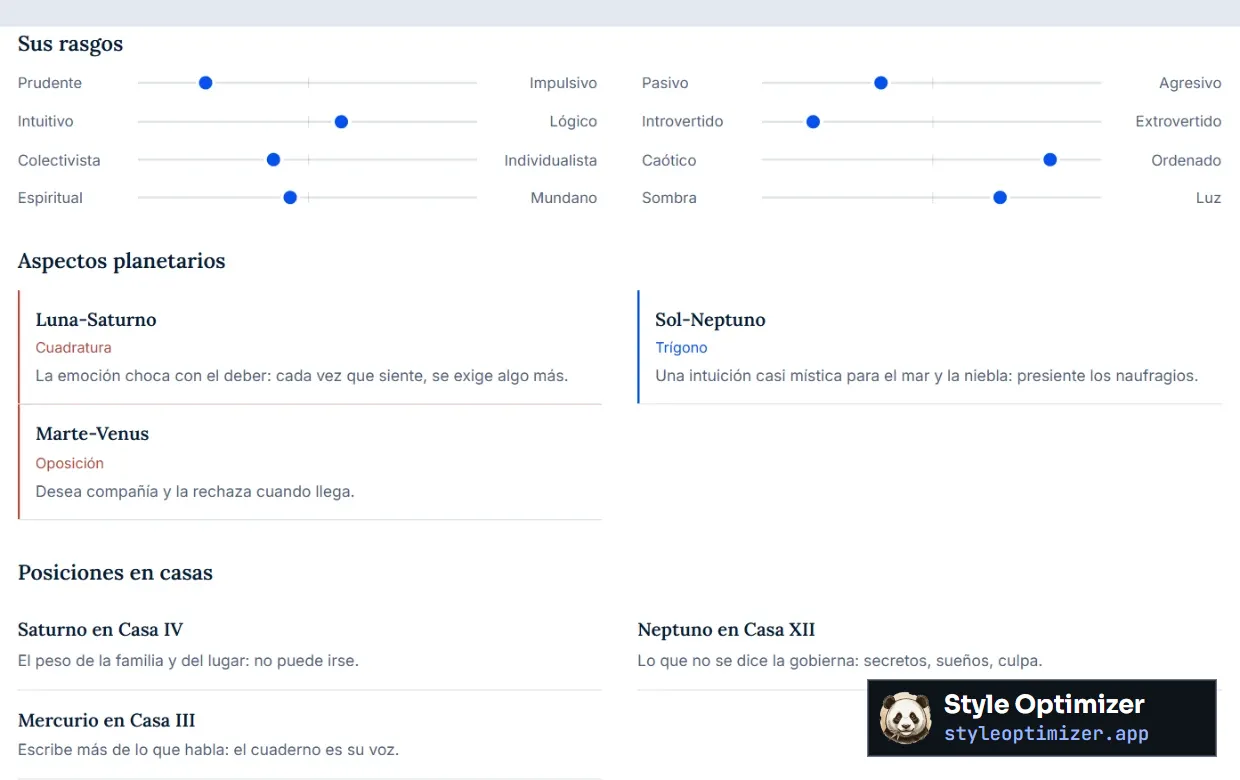
Aspects are contradictions ready to use. Moon square Saturn: every time she feels something, she demands more of herself. Mars opposite Venus: she longs for company and pushes it away when it arrives. There’s step 4 solved, with a scene for each.
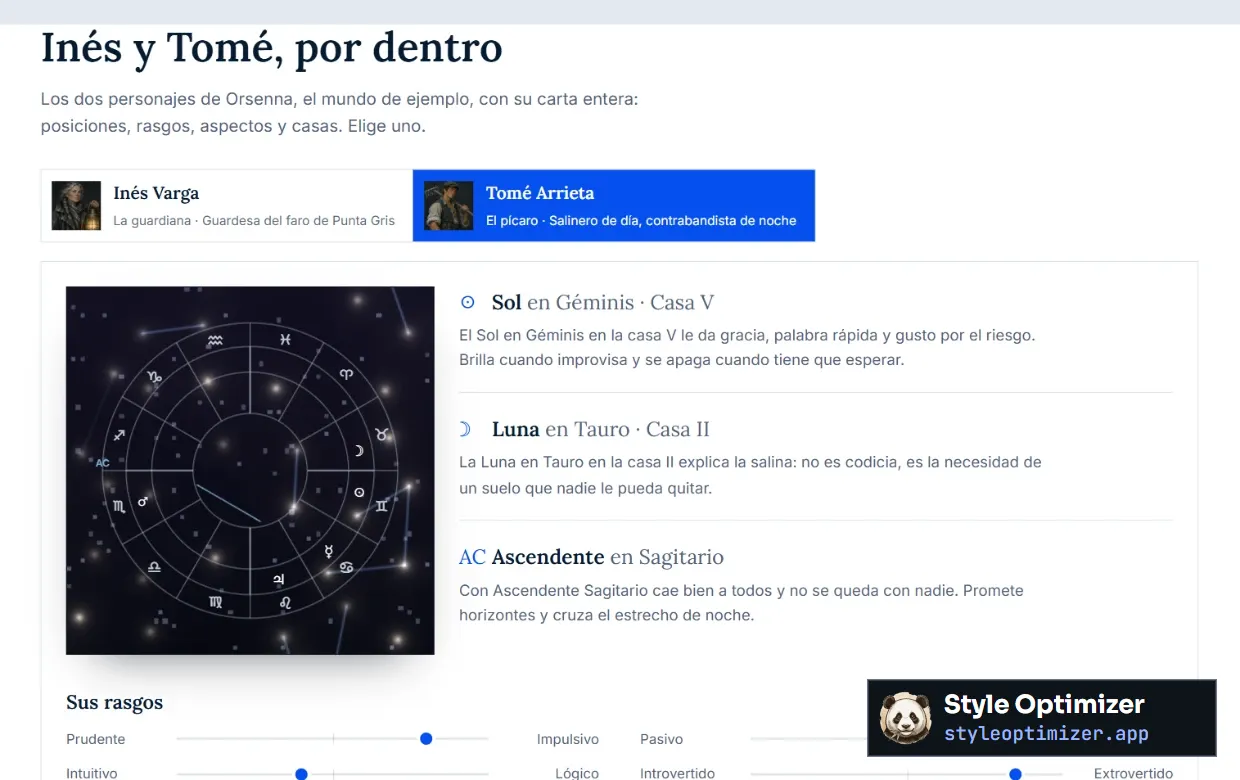
Tomé Arrieta, the salt maker, carries his contradiction in his trade. His Moon in Taurus explains why he clings to the salt pan; his Ascendant in Sagittarius, why he crosses the strait at night. Synastry compares the two charts and shows where Inés and Tomé clash, which is where the plot lives. To read each sign in depth, see the personalities of the twelve zodiac signs.
Creating a character with the I Ching
The other route is the hexagram. In I Ching Characters you reach one of the sixty-four hexagrams by four paths: building its face line by line, tossing the coins, choosing it from the catalog or starting from a degree of the zodiac. The hexagram becomes the character’s face and their profile, which you can fill in yourself or have the AI write. If the method interests you, start with the I Ching for writers.
Common mistakes when creating a character
- Filling in forty details before you know the story. Eye color rarely generates a scene; fear generates several.
- An abstract desire. If it can’t be checked, the plot loses its compass.
- A wound that never shows. If the past doesn’t change how they act today, cut it.
- Characters who all sound alike. Cover the names in a dialogue scene: if you can’t tell who’s speaking, the voices need work.
- A protagonist with no contradiction. Check yours with the test in flat and round characters.
FAQ: how to create characters
Where do I start when creating a character for my novel?
With what they want and what they fear. Those two answers tell you where they’re heading and what they’ll have to go through to get there, which is the plot in miniature. The name, the looks and the backstory come later, once you know which scenes they’ll carry and what those scenes need.
How many characters does a novel need?
As many as the story asks for, each at a different depth. A short novel can stand on a protagonist, an antagonist and three or four secondary characters with real weight. If two secondary characters do the same job, merge them: the one who remains grows stronger, and readers have fewer names to keep track of. Incidental characters need a single trait.
What is a character creator for writers?
A tool that helps you invent and store fictional characters with their traits, history and relationships. AstroLab, in Style Optimizer, starts from a birth chart or an I Ching hexagram to propose a personality with contradictions, and keeps the profile alongside the places, maps and scenes of your novel.
How do I make my character feel real?
Give them a visible contradiction and make them choose between two things they want. Readers believe in a character when they see them choose at a cost, and when they do something unexpected that makes sense on reflection. Show them in scenes, through gestures and actions, and let readers draw their own conclusions.
Can I use astrology to create characters if I don’t believe in it?
Yes, as an invention tool. A birth chart works like a deck of cards with rules: it deals out traits, desires and tensions you wouldn’t have combined and arranges them in layers. What brings the character to life is what you write with those traits afterward, as with any other method.