How to Start a Story: Six Ways to Open, With Examples
November 21, 2026 · Equipo Style Optimizer
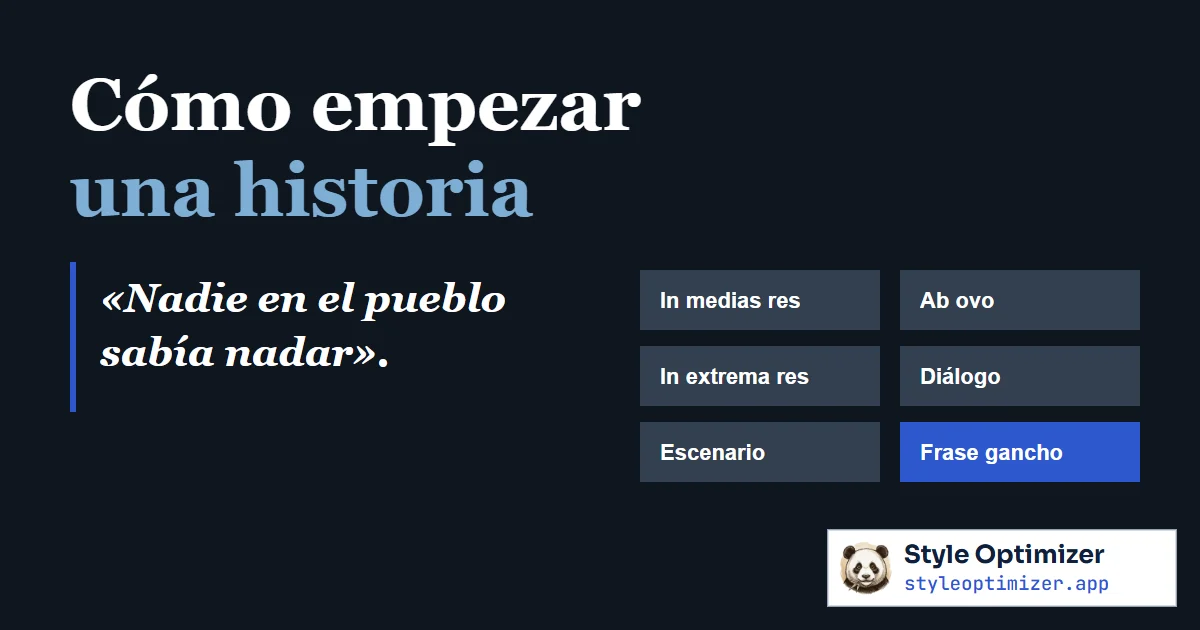
There are six classic ways to start a story: in the middle of the action (in medias res), at the very beginning (ab ovo), at the end (in extrema res), with dialogue, with the setting or with a hook line. None of them is better than the rest. What every good opening shares is a first page that raises a question readers want answered. Below you’ll find each one with an example, plus the worn-out openings worth revising.
Check your first paragraph
Before you read on, print or copy out the first paragraph of your story and ask three questions. Which of the six openings below is it closest to? What question does it leave readers with? And does it fall into any of the tired openings listed further down? If you can’t answer the second question, that paragraph is the one to work on.
Six ways to start a story
1. In medias res: in the middle of the action
The story is already underway when readers arrive. Whatever happened before comes out later, a little at a time. It’s the most common opening in contemporary fiction because it hooks fast. Example: “Marta slammed the door and took the stairs two at a time.” We cover it in depth in our guide to in medias res.
2. Ab ovo: from the very beginning
The story starts at the origin: the protagonist’s birth, the founding of a town, “once upon a time.” It’s the natural shape of folktales, family sagas and memoirs. Example: “I was born in the coldest winter Duluth had ever seen, and my mother always said that explained my temper.” The risk is a slow start, so if you choose this opening, make every line earn its place.
3. In extrema res: at the end
You reveal the ending, or one of its consequences, up front, and the story tells how things got there. Plenty of crime novels open on the body, and plenty of great novels open with a sentence that announces a death or a ruin. Example: “He died on a Tuesday, and I was at the movies.” Readers already know what happens, so they read to find out how and why.
4. With dialogue
A voice opens the story. It works when the first line already sets up a relationship or a conflict. Example: “If you walk out that door, don’t come back,” my father said. Skip the small talk: “Hi, how are you?” hooks no one. To keep the attribution out of the way, see our guide to dialogue tags.
5. With the setting
The story begins with a place or an atmosphere. Many nineteenth-century novels open this way, and it works when the place weighs on the story: a city that smothers, a sea that threatens. Example: “The city was a gray smear under the rain, and the streetlights came on one by one along the river.” Bring in someone to look at that place soon. If this opening suits you, our guide on how to describe a setting will help you make it vivid.
6. With a hook line
A short statement, blunt or strange, that demands an explanation. Example: “Nobody in town knew how to swim.” The rest of the first chapter has to live up to that promise.
What the first page has to do
- Introduce someone. A character, even in passing, with something that sets them apart.
- Raise a question. Why is she running down the stairs? Who died? What happens once he walks out the door?
- Set the tone. From the first lines, readers should sense whether they’re in for a comedy, a drama or a ghost story.
- Ground the reader just enough. Where and when, only as much as they need to find their footing.
Tired openings worth avoiding
- The wake-up. The alarm goes off, the character opens their eyes and the day begins. It’s the most overused opening in the slush pile.
- The weather. “It was a dark and stormy night.” If the weather doesn’t matter to the story, start somewhere else.
- The dream. An intense scene that turns out to be unreal. Readers feel cheated.
- The mirror. The character looks at their reflection and describes themselves. There are better ways to describe a character.
- The explanation. Two pages of backstory before anything happens. That context can wait; there’s more on this in our guide to the infodump.
How to choose the opening for your story
- Find the moment everything changes. Many stories start best right there, or just before it.
- Write three different openings for the same story: one in the action, one with dialogue and one from the end. Read them aloud and keep the one that makes you want to go on.
- Revisit the opening when you finish. The first chapter usually gets its real form once the book is done and you know what it needs to set up.
- Try cutting. Delete the first paragraph, or the first page, and see whether the story starts better with the second.
The narrator’s point of view also changes the effect of the first sentence a great deal. Try your opening in first, second or third person. And if you’re working on something short, you’ll find the full process in how to write a short story.
How to start a story: FAQ
What does in medias res mean?
It’s Latin for “into the middle of things.” It means opening the story once the action is already underway.
What is in extrema res?
Opening at the end, or at a moment close to the ending, and then telling how things got there.
How do I start a short story?
With the protagonist already caught up in their problem, in as few lines as possible. A short story has no room for a long introduction.
What makes a good first sentence?
One that forces readers to read the second. It’s usually concrete, holds something unexpected and leaves a question open.