Story Ideas: Seven Places to Find Them, Plus Ready-Made Prompts
November 21, 2026 · Equipo Style Optimizer
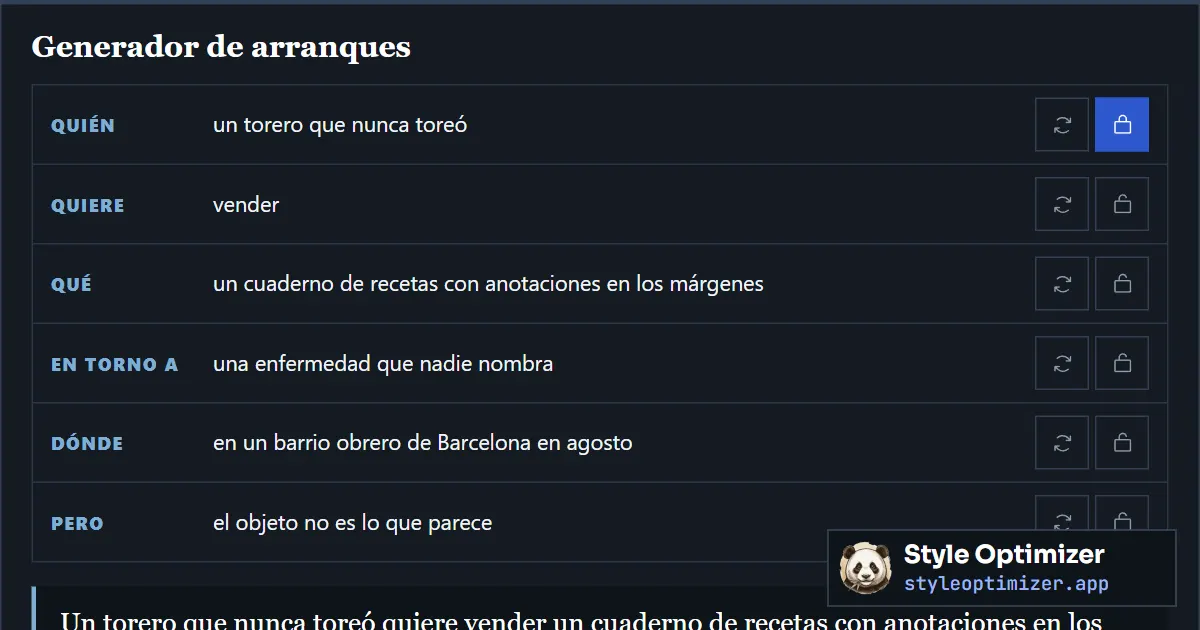
A good story idea fits in one sentence: someone wants something, and something stands in the way. Build it from six pieces (who, wants, what, around what, where and but) and you have a premise ready to turn into a scene. Below you’ll find how each piece works, seven places to find ideas and eight prompts you can start writing right now.
The anatomy of a story idea
- Who: a job brings a voice, a schedule and a world with it. A piano tuner walks into strangers’ homes; a late-night cab driver hears confessions.
- Wants and what: the desire has to be concrete, something that can be held or lost. “Get back the key to the family vault” gives you scenes; “be happy” gives you none.
- Around what: the past that weighs on everything else. An inheritance nobody has divided, or a gambling debt, explains why the desire hurts.
- Where: a place with its own rules. A town that’s emptying out demands different scenes from a big city.
- But: the obstacle. This is the piece that turns a situation into a story.
Write your premise as one sentence that links all six. If a piece leaves you cold, swap it for another. If you like everything except the end of the sentence, change only the “but”: it’s the piece that moves the story most.
Eight story prompts to start with
Each one is built from the six pieces above. Take one as it is, or keep half and replace the rest.
- A piano tuner wants to buy back her late father’s piano, which the family sold to pay his debts, in a seaside town in the off-season, but the new owner refuses to let anyone touch it.
- A night-shift cab driver wants to return a briefcase a passenger left behind, after years of keeping quiet about what he hears, in a city under a snowstorm, but the passenger was dropped at an address that doesn’t exist.
- A retired schoolteacher wants to finish the novel her husband left half-written, in the house they shared for forty years, but every chapter describes a woman who isn’t her.
- A teenage lifeguard wants to win the summer swimming race his brother never lost, in a lake town the year the dam is due to open, but the night before, someone is found in the water.
- A locksmith wants to get back the key to the family vault, which her mother refused to hand over before she died, in a village whose cemetery is being moved, but the lock on the vault has been changed from the inside.
- A wedding photographer wants one week without work, haunted by a photo he deleted years ago, at a mountain hotel booked solid for a wedding, but the bride is the woman in that photo.
- An astronaut wants to come home in time for her daughter’s birthday, after a mission that went wrong on her watch, on a station losing contact with Earth, but the only way back means leaving someone behind.
- A small-town librarian wants to save the library from closing, guarding the one book no patron has ever checked out, in a town voting on its future, but the library’s oldest donor wants it closed.
Seven sources of story ideas
- The “what if…?” question. What if the neighbor who waters your plants has been reading your mail for years? A small twist on everyday life is enough to begin.
- An object with a history. A clock stopped at a particular time, a suitcase nobody claims. Ask who had it before and why they gave it up.
- A place about to change. The last week of a neighborhood movie theater, the family house going up for sale. Places in transition force characters to decide.
- A job you know. What you know about your own work is material few people have: the routines, the jargon, what goes unsaid.
- A small news item. The local section of a newspaper is full of half-told stories: a dog that finds its own way home, a lottery prize nobody claims.
- A memory with a different ending. Take something that happened to you and change the decision you made. The story lies in what would have happened.
- A constraint. Write with no dialogue, over a single night, or through the eyes of whoever knows least. Limits push you toward ideas you’d never have gone looking for.
Ideas for what you’re writing
For a short story, a single change in someone’s life is enough: any of the prompts above is already a short story if the “but” is resolved in one scene. We go deeper in how to write a short story. For a novel, the idea has to carry several conflicts: write two premises for the same character, keep both “buts” and turn them into plot and subplot, as explained in plot and subplot. For flash fiction, keep only the obstacle and write just the moment it appears.
From idea to first page
Copy your premise at the top of the page and write the first scene in twenty minutes, without editing. Then choose how to open it with six ways to start a story and, if the idea keeps growing, lay it out in a scene outline.
If you’d rather let chance pick the pieces, our story idea generator rolls a situation, a character, a complication and a writing constraint, and how to turn an idea into a story takes it from there.
More ideas and challenges
Our writer’s block exercises combine a situation, a character and a complication, and the 101 creative writing exercises give you one for every day. With an account, Style Optimizer’s plot prompts branch a premise into a tree of scenes you can take to the editor.
FAQ
How do I come up with an idea for a story?
Combine a character with a concrete desire and an obstacle. If nothing comes, take one of the seven sources above, such as an object with a history or a place about to change, and keep whichever detail gives you an image.
What if I don’t like my idea?
Keep the pieces you like and replace the others. Changing only the obstacle is often enough to turn the idea around.
Can I use these story prompts freely?
Yes. They’re here to get you writing, and the story that comes out of them is yours.
How do I turn a story idea into a plot?
Ask what the character does first to get what they want, how the obstacle answers, and what they try next. Three or four of those moves give you the spine of a plot. When you have them, put each one on its own line as a scene and you have your outline.