How to Write a Short Story: Seven Steps, Structure and Length
November 21, 2026 · Equipo Style Optimizer
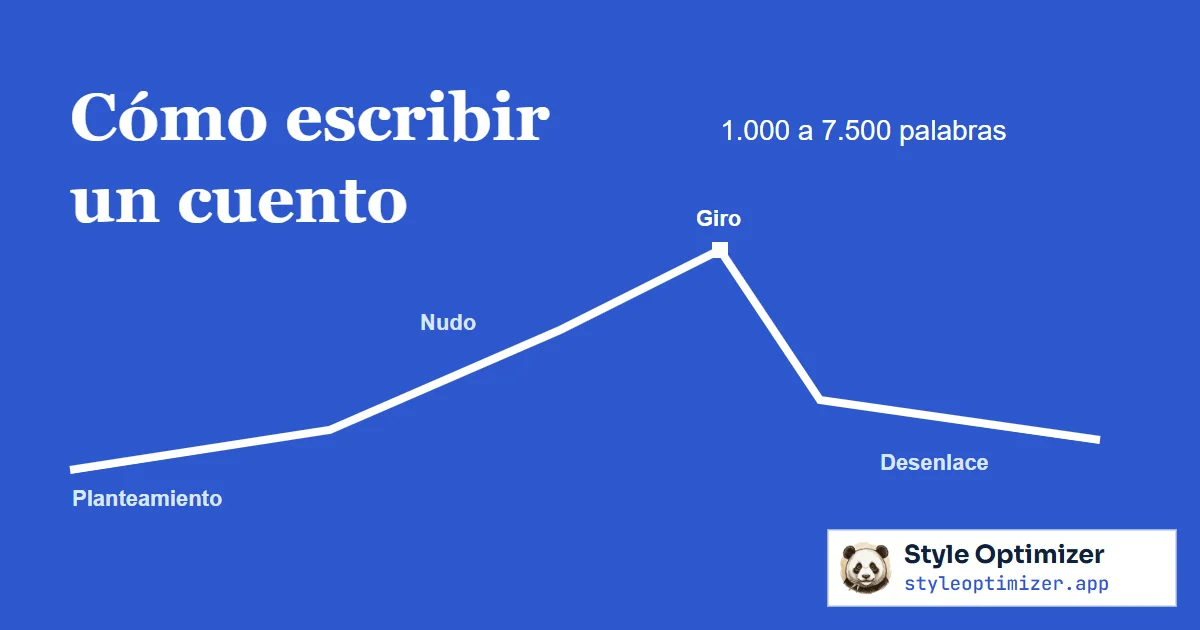
To write a short story you need a character who wants something, an obstacle that stands in the way and an ending in which something has changed. Every other choice follows from those three. A short story tells a single conflict in a few pages, with few characters and a final effect readers carry away with them. Here’s the process in seven steps, along with the structure, the usual lengths and a quick way to find an idea today.
Start with an idea
Combine four ingredients and you have the seed of a story. Pick one of each, at random if you like, by writing options on slips of paper:
- A situation: a funeral, a job interview, a power outage, a night train.
- A character: a retired locksmith, a girl who lies for her mother, a bus driver on his last shift.
- A complication: someone recognizes them, a letter arrives at the wrong address, the money is short.
- A constraint: it all happens in one room, in under an hour, or without a word of dialogue.
A retired locksmith at a funeral, recognized by someone whose door he once opened, all in one room: that already asks to be written.
How to write a short story in seven steps
1. Choose a single situation
A novel can span a lifetime; a short story fits into an afternoon, a conversation or a journey. If your idea needs many settings and years of history, it’s probably a novel. If it fits into one decisive moment, it’s a short story.
2. Give your character a desire
Something concrete they want in that situation: to get their money back, to hear their father apologize, to catch a train in time. Without desire there’s no conflict, and without conflict there’s no story.
3. Start as late as you can
Enter the story once the problem is already in motion. Long introductions are the most common mistake in early stories. You’ll find the keys to this technique in in medias res, and more on first lines in how to start a story.
4. Complicate things
Put an obstacle in the way and, just as the character is getting past it, add another. Around the middle of the story, a turning point that changes what readers thought they knew works well.
5. Decide the ending before you write it
You don’t need to know every sentence, but you do need to know where you’re heading. A story with an ending planned in advance has fewer unnecessary scenes, because each one pushes toward it.
6. Write the draft in one sitting
A short story is best written in a single push, even if it comes out rough. Its unity of effect shows more when the draft is born in one or two sessions.
7. Revise and adjust the length
Cut the scenes that change nothing, the explanations readers have already understood and the repeated adjectives. Then count the words: if you’re submitting to a magazine or a contest, the word limit is a rule, and it pays to come in with room to spare.
Short story structure
| Part | What happens | Approximate share |
|---|---|---|
| Beginning | Who the character is, where they are and what they want. Better in motion than in description. | About 15–20% |
| Middle | The obstacles grow. The turning point goes here. | About 60–70% |
| Ending | The character gets or loses what they wanted, and something changes. | About 10–20% |
Many modern stories rearrange this order: they open with the ending, tell two stories at once or leave the resolution open. It works when the change of order adds something, such as tension or a surprise the linear order wouldn’t give you.
How many words is a short story?
There’s no official figure, but magazines, contests and awards tend to work with these ranges. The short story, novelette and novella bands are the ones the Nebula and Hugo awards use:
| Type | Typical word count |
|---|---|
| Microfiction | Up to 100–300, depending on the market |
| Flash fiction | Up to about 1,000 |
| Short story | Under 7,500 |
| Novelette | 7,500–17,500 |
| Novella | 17,500–40,000 |
Before you submit, read each magazine’s or contest’s guidelines: many set their own limits, often well below 7,500 words.
Types of ending
- Closed: the conflict is resolved and readers know what happened.
- Open: the story ends before the resolution, with enough clues for readers to imagine it. The story itself is complete; the resolution is what’s left in the reader’s hands.
- Twist: a final fact changes the meaning of everything before it. It works if, on a reread, the clues were all there.
- Circular: the last scene echoes the first, but the character, or the reader, is no longer the same.
Common mistakes in early short stories
- Opening with the character waking up or with a description of the weather.
- Too many named characters for so few pages.
- Explaining at the end what the story has already shown.
- An ending that depends on coincidence or turns out to be a dream.
- Dialogue that tells readers what the characters already know. Let characters talk to each other, and trust readers to keep up.
Once it’s written, read it aloud before you send it out: you’ll hear the rhythm, the repetitions and any slips in the narrator’s voice.
FAQ: how to write a short story
What’s the difference between a short story and flash fiction?
Mostly length. Flash fiction usually stays under about 1,000 words and often hinges on a single image or a single turn, while a short story has room for a full arc with obstacles and a turning point. Both tell a single conflict.
How many pages is a short story?
Roughly between two and thirty. In standard manuscript format a page holds about 250 words, so a 3,000-word story runs to about twelve pages.
How do I start writing a short story if I have no ideas?
Combine the four ingredients above, or pick one of our writing exercises. A good way in is to start from a concrete image: a suitcase on a platform, a woman counting coins.
What if the story is for children?
The steps are the same, but the reader’s age decides almost everything: the length, the vocabulary and the ending.
Do I need to plan a short story before writing it?
Knowing three things is enough: who wants what, what stands in the way and how it ends. With that you can write the draft and discover the rest along the way.