Novel Structure: Parts, Acts and How to Plan Your Book
November 21, 2026 · Equipo Style Optimizer
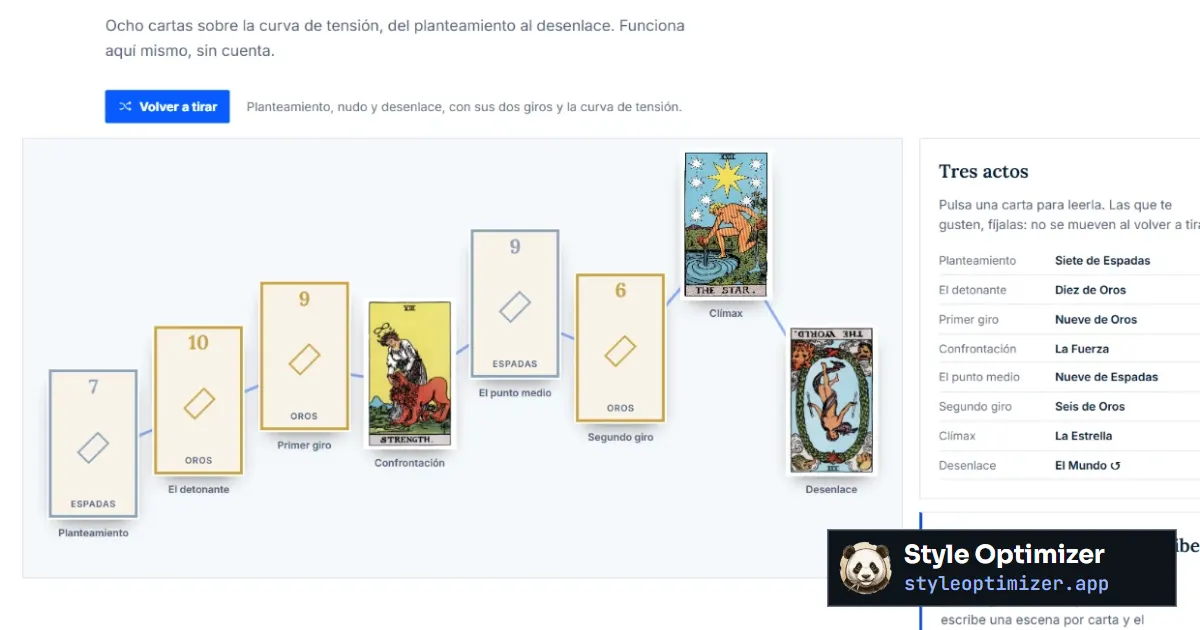
Novel structure is the order in which a book’s parts are arranged so the story moves forward: a beginning that sets up the conflict, a middle that complicates it and an ending that resolves it. The most widely used template is three-act structure, with a turning point at the end of the first act and another at the end of the second. Other templates have more stages or follow a different logic, like the Hero’s Journey or kishōtenketsu. Below you’ll find each one, plus the math to see how many words each section of your book gets.
How long each part of your novel should be
Pick a template and a target length. If you don’t know your length yet, start from 80,000 words, a common size for adult fiction, and adjust later. In three acts, that gives you roughly 20,000 words for Act I, 40,000 for Act II and 20,000 for Act III, with the first turning point around word 20,000 and the midpoint at 40,000. At about 250 words per page, that’s a 320-page book.
The parts of a novel
“Parts of a novel” can mean two things: the pieces of the book as a physical object, and the units of the story. It helps to keep them apart.
The parts of the book
| Part | What it is |
|---|---|
| Cover and title page | The cover carries the title, author and artwork; the title page, inside, repeats the title. |
| Copyright page | Publisher, ISBN and rights information. |
| Dedication and epigraph | Who the book is for, and the quotation that opens it. Both are optional. |
| Prologue | An opening text by the author or someone else. In fiction, it’s often already a scene from the story. |
| Parts and chapters | The body of the novel. Parts group chapters; chapters group scenes. |
| Epilogue | A scene or text after the ending, often with a jump in time. |
| Author’s note and acknowledgments | At the back, outside the fiction. |
The units of the story
Inside the text, the smallest unit is the scene: one continuous action in one place and time. Several scenes make a chapter, and several chapters make a part or an act. Chapter length is up to you: some run half a page, some forty. What counts is that each one ends with something that pulls the reader into the next.
Narrative structure: beginning, middle and end
This is the foundation of every story, and it goes back to Aristotle, who asked in the Poetics that a tragedy have a beginning, a middle and an end. A well-known fairy tale like Little Red Riding Hood shows it clearly:
- Beginning, or setup. It introduces the character, their world and what they want or have to do. Little Red Riding Hood sets off for her grandmother’s house with a basket.
- Middle, or rising action. The conflict appears and gets more complicated. The wolf tricks her, gets there first and takes the grandmother’s place in bed.
- End, or resolution. The conflict is resolved and the situation is changed. In the Brothers Grimm version, a huntsman cuts them both out of the wolf’s belly.
Alongside those three parts, a literature class usually asks for the elements of a story: narrator, characters, setting, time and plot. Structure organizes the plot; the other elements give it a voice, a place and a period.
The order of telling
Beginning, middle and end describe what happens. The author decides the order in which to tell it:
- Linear, or ab ovo: from the start, in chronological order.
- In medias res: in the middle of the action, with the earlier events told later. The Odyssey opens with Odysseus far from home, years after the Trojan War.
- Ending first: the book opens with the outcome and then explains how it came about. Gabriel García Márquez’s Chronicle of a Death Foretold announces in its first line that Santiago Nasar is going to be killed.
- Circular: the ending returns to the image or place of the opening.
Three-act structure
This is the version of beginning, middle and end used in film and in much of commercial fiction, popularized by screenwriter Syd Field in Screenplay (1979). It splits the story into three blocks in a rough 25-50-25 ratio, with two turning points as hinges:
| Act | Share | What happens | How it ends |
|---|---|---|---|
| I. Setup | ≈ 25% | The protagonist’s world and what throws it off balance (the inciting incident). | First turning point: a decision with no way back. |
| II. Confrontation | ≈ 50% | Rising obstacles. Halfway through, the midpoint flips the story. | Second turning point: all seems lost. |
| III. Resolution | ≈ 25% | The climax, where everything is at stake, and the resolution. | A new balance. |
The second act is where most novels stall, because it’s the longest. The midpoint splits it into two manageable halves: before it, the protagonist reacts; after it, they act. The turning points that close each act have their own guide: plot twist and turning point.
In Threads, the scene board in Style Optimizer’s worldbuilding tools, this template becomes an outline with eight positions, each with its own question: setup (what balance is there at the start?), inciting incident, first turning point, confrontation, midpoint (what flips halfway through?), second turning point, climax and resolution.
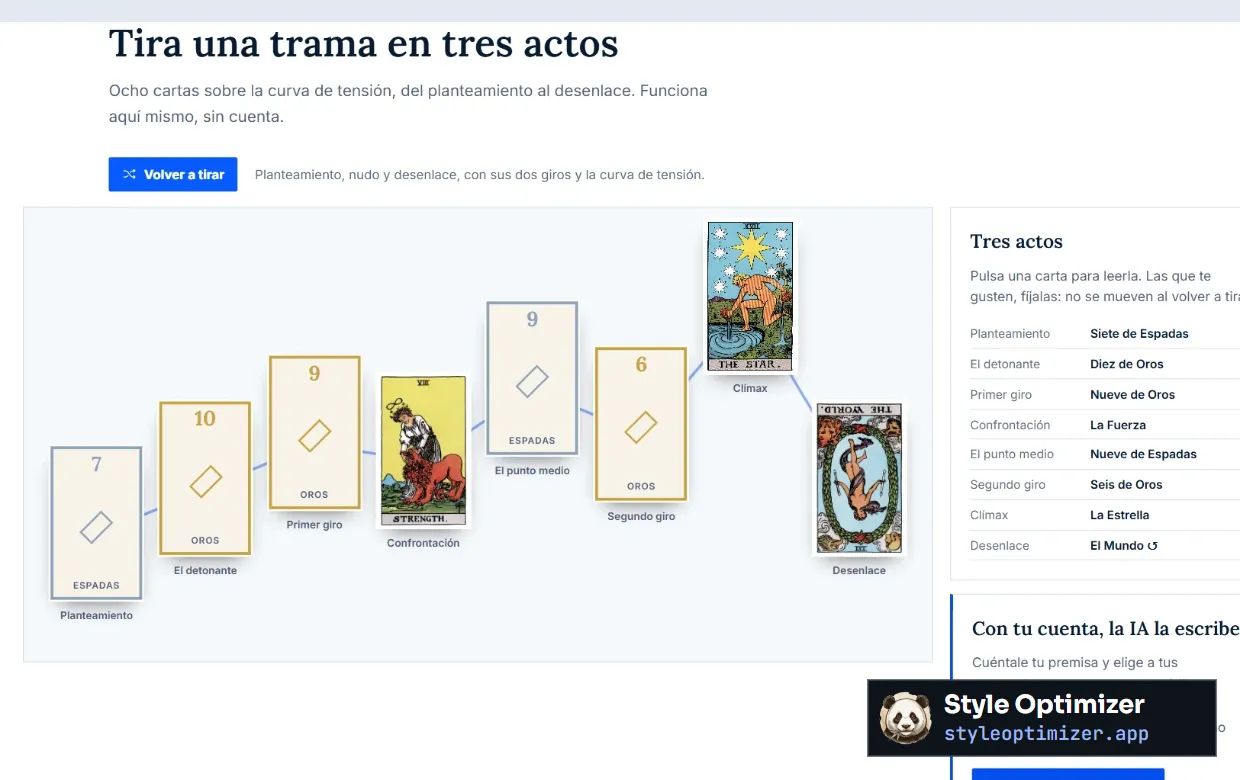
Other templates for structuring a novel
Three acts is the most common template, and others fit certain stories better:
- The Hero’s Journey. Twelve stages in a circle, in Christopher Vogler’s version based on Joseph Campbell: leave the ordinary world, cross into the other one and come back changed. It suits adventure and fantasy.
- Save the Cat. Blake Snyder’s fifteen beats, each with a set place along the way. It’s three acts in finer detail.
- Kishōtenketsu. Four movements from the Chinese and Japanese tradition: introduction, development, a twist that brings in something unexpected, and the reconciliation that ties it all together. It does without a central conflict, which makes it good for quiet, intimate stories.
- Seven-point structure. Hook, first plot turn, first pinch point, midpoint, second pinch point, second plot turn and resolution. Novelist Dan Wells popularized it, and you plan it starting from the end.
- Freytag’s pyramid. Five parts for drama (exposition, rising action, climax, falling action and denouement), described by Gustav Freytag in 1863.
- Braided structure. Several plotlines that alternate and cross, each with its own arc. It’s the structure of the ensemble novel.
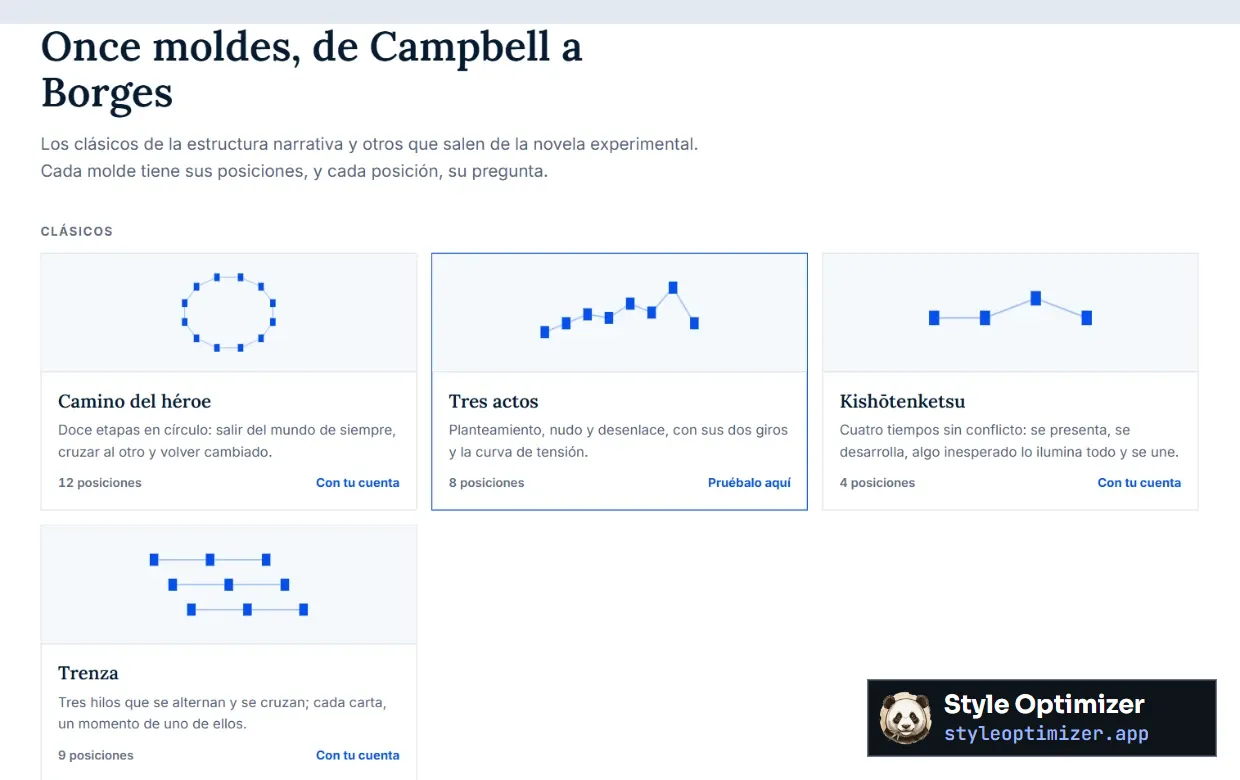
The Threads templates add seven experimental shapes to those four, such as the circle in the manner of One Hundred Years of Solitude, the mosaic of Julio Cortázar’s Hopscotch and the Borgesian labyrinth, plus one based on the I Ching in which each line of the hexagram is a stage.
How to structure a novel, step by step
- Know your ending. Knowing where the story goes tells you what the beginning has to set up. One sentence is enough.
- Choose the template that fits your story. An adventure calls for the Hero’s Journey; a thriller, tight three acts; a novel with several voices, the braid.
- Place the pillars first: inciting incident, first turning point, midpoint, second turning point and climax. Five scenes that, written in one line each, already tell the novel.
- Measure the sections. In 80,000 words, for example, the first turning point lands around word 20,000. If your first act runs twice that long, you know where to cut.
- Fill the gaps between pillars with scenes and build your outline: one line per scene, with who’s in it and what changes.
- Check the structure after the first draft. The written novel rarely matches the plan, and that’s the version you need to measure.
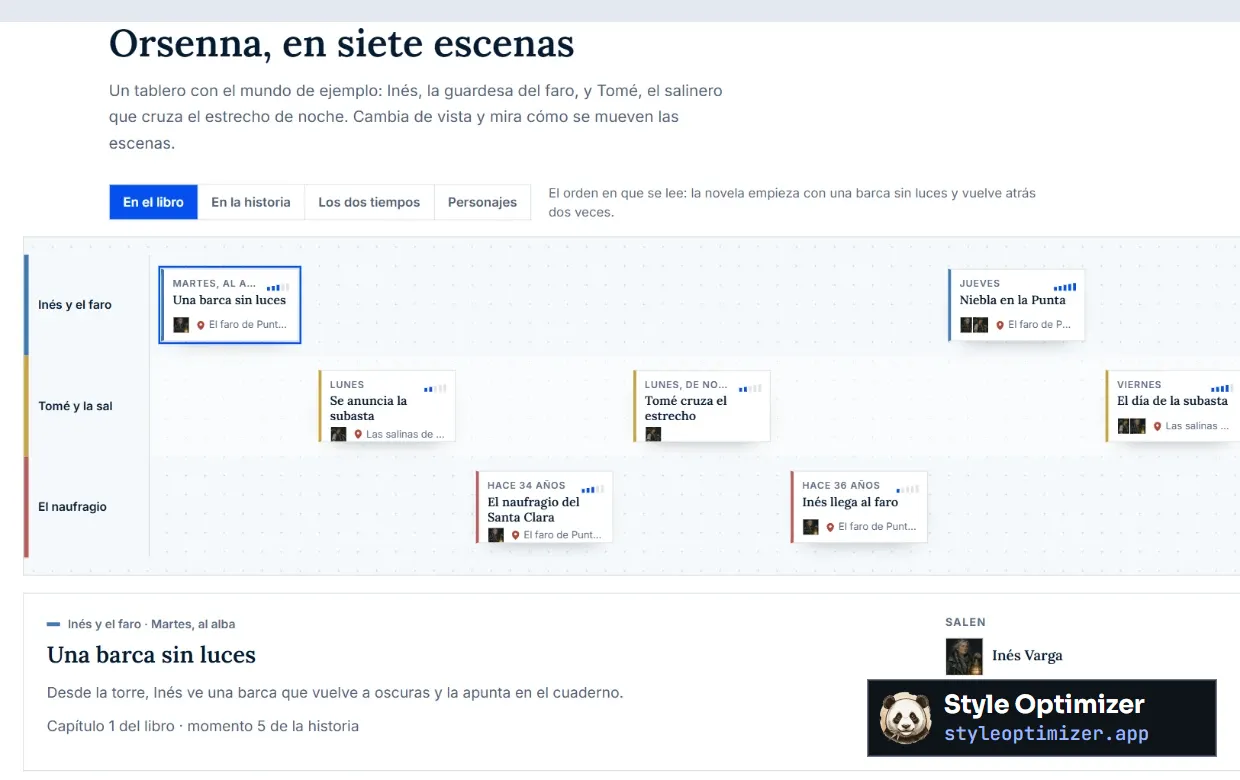
In Threads you see the structure on the outline itself: scenes are cards, each plotline has its lane and acts are marked as sections of the board. The templates start the board with one scene per position and each act in its own section.
If your novel is set in an invented world, our guide on how to create a fantasy world covers the groundwork to lay before the outline.
Novel structure: FAQ
What are the three parts of narrative structure?
Beginning, middle and end. The beginning introduces the characters, the setting and the starting situation; the middle sets up the conflict and complicates it up to the point of greatest tension; and the end resolves it and shows how things stand afterward. It’s the base of short stories, novels and films, even when the author tells the parts in a different order.
What’s the difference between three-act structure and beginning, middle and end?
They’re the same idea at different levels of detail. Three acts give rough proportions (a quarter, a half and another quarter) and fix two turning points as hinges between the acts, plus a midpoint in the second. Beginning, middle and end is the classroom version, without measurements or specific turning points.
Does every novel have to follow three-act structure?
Many literary novels use other shapes: fragments, alternating voices, circular or spiral structures. Three acts work very well in genre fiction and in stories with a clear protagonist and goal. Knowing them lets you decide with judgment when to follow them and when to choose a template that suits your story better.
How many chapters should a novel have?
It depends on total length and the pace you want. Short chapters speed up reading and are common in thrillers; long chapters give room for reflection. A practical approach is to outline by scene first and then group scenes into chapters that end with something unresolved.
How do you plan a novel before writing it?
In three steps: a one-sentence premise (who wants what, and what stands in the way), a structure template with its pillars in place, such as the inciting incident, the turning points and the climax, and an outline with one line per scene. With that you can write the first draft knowing where you’re headed, and adjust the plan when the story surprises you.