Scene Outline: What It Is, an Example and a Template
November 21, 2026 · Equipo Style Optimizer
A scene outline, or scene list, is the ordered list of the scenes in a story, with the bare minimum for each one: what happens, who’s there, where it takes place and what changes. In film and television it’s the step between the idea and the script; in a novel it’s the skeleton of scenes that lets you see the whole plot on two pages before you write a single line. Below you’ll find a template to fill in and a complete example.
A scene outline template for your novel
Eight cards are enough for a first version. Use index cards, sticky notes or one row per scene in a spreadsheet, and give each card these five fields, one sentence apiece:
- Scene: a short title.
- Who: the characters present.
- Where: the place.
- Wants: what the character is after in the scene.
- What changes: how the scene ends differently from how it began.
Lay the cards out in a line and shuffle them until the order feels right. A card with “What changes” left blank marks a scene that still has to earn its place.
What is a scene outline?
The same tool turns up in several crafts under different names, always as a step-by-step working order. Screenwriters call it a step outline: the scenes of a film before the dialogue. In TV and radio production, the running order of a show is the rundown. For novelists, it’s the list of scenes the author follows while drafting. In every case it condenses: one or two lines per scene, with no dialogue or description, to show order and pacing.
Scene outlines for film, TV and radio
In film
A film step outline numbers the scenes and gives each its slug line: interior or exterior, location and time of day. Underneath come one or two sentences of action. For example: “12. INT. KITCHEN – NIGHT. Lucy finds a train ticket in her father’s coat and pockets it without a word.” With it, the screenwriter can see where the turning points land and which scenes are dead weight before writing any dialogue.
In television and radio
In a series, the outline for each episode divides the scenes among the A plot, the B plot and sometimes a C plot. In a show (a newscast, a magazine program), the rundown is the order of broadcast: open, segments, interviews, video packages, commercial breaks and close, each item with its running time. A radio rundown adds the theme music, promos and station IDs, minute by minute, to fit the time slot.
A novel’s scene outline: what each scene needs
A novel has no camera and no running time, so the fields change. These five cover almost everything:
- Scene. A short title to identify it: “The Auction,” “The Late-Night Call.”
- Who. The characters present and, if you alternate points of view, whose eyes we see through.
- Where. The location. This column warns you if twenty scenes happen in the same kitchen.
- Wants. The character’s goal in that scene. A scene without desire is just a snapshot.
- What changes. How it ends differently from how it began: new information, a broken relationship, a decision. This is the column that matters most.
You can add the point in story time, if the novel jumps around, and the plotline each scene belongs to. Outline by scene and group the scenes into chapters at the end.
How to write a scene outline, step by step
- Write the story in three sentences. Who wants what, what stands in the way and how it ends. That’s your compass for deciding which scenes belong.
- Jot down the scenes you can already see, in any order.
- Place them on a structure. Three acts, with their two turning points, is the simplest mold; you’ll find the others in novel structure and a fifteen-beat breakdown in the Save the Cat beat sheet. The gaps that remain are the scenes you’re missing.
- Fill in “What changes” for each one. If two consecutive scenes change the same thing, merge them. If one stays the same from start to finish, give it a conflict or cut it.
- Check your plotlines. Mark which plotline each scene belongs to and see how long each one takes to come back. A subplot that vanishes for a hundred pages gets forgotten; we explain why in plot and subplot.
- Decide the reading order. Choose whether you start at the beginning, in the middle or at the end, and where the flashbacks go.
The outline changes as you write, so update it every few chapters. The turning points that hold the whole thing up have their own guide in plot twists and turning points.
Scene outline example for a short novel
The Inventory is a short novel invented for this example, about 35,000 words long. Mae, an antiques appraiser, returns to the coastal town where her aunt Ruth has just died, to inventory the house and sell it within three days. Twelve scenes, in reading order:
| Scene | Who | Where | Wants | What changes |
|---|---|---|---|---|
| 1. The Arrival | Mae | The train and Ruth’s house | To do the inventory in three days and sell | The house looks as if Ruth were coming back: the table is set for two. |
| 2. The Attic Key | Mae and Jonah, the carpenter next door | The front porch | To get the attic key from Jonah | Jonah refuses: Ruth asked him to open it himself. Mae no longer feels the house is hers. |
| 3. The Grandfather Clock | Mae | The living room | To appraise the good furniture fast | Inside the clock are photos of Ruth with a woman Mae doesn’t know. |
| 4. The Lawyer’s Office | Mae and the estate lawyer | The lawyer’s office in town | To sign and put the house on the market | First turning point: there’s a second heir, Irene Shaw, and without her signature the sale is stuck. |
| 5. The Harbor Bar | Mae and Jonah | The bar by the harbor | To find out who Irene is | Irene lived with Ruth for twenty years, and the whole town knew. |
| 6. The House on the Hill | Mae and Irene | Irene’s house | To buy out her share | Irene keeps her share and asks only for what’s in the attic. |
| 7. The Attic | Mae | The attic, at night | To see what Irene wants | Second turning point: twenty years of letters from Ruth to Irene, and a sealed envelope addressed to Mae. |
| 8. The Call | Mae and her mother, on the phone | The kitchen | To get her mother to explain | Her mother knew, and cut off her sister because of it. Mae hangs up: the low point. |
| 9. The Storm | Mae, Irene and Jonah | The house, during a power outage | To return the letters and close the matter | Irene reads one aloud. Mae realizes Ruth waited for her every summer. |
| 10. The Inventory | Mae | The whole house | To finish the job | She values each object by its story and decides to stay a month. |
| 11. The Signing | Mae, Irene and the lawyer | The lawyer’s office | To divide the estate | Irene will live in the house; Mae takes the clocks. |
| 12. The Return | Mae | The train, a month later | To go back to the city | She opens her aunt’s envelope. Final image: the same train as at the start, heading the other way. |
Every row leaves the story somewhere new: scenes 4 and 7 are the two turning points, 8 is the low point and 12 answers the first. And you can see what’s missing: Jonah disappears between scenes 5 and 9, and he might deserve a scene in between.
Your novel’s outline on an outline board
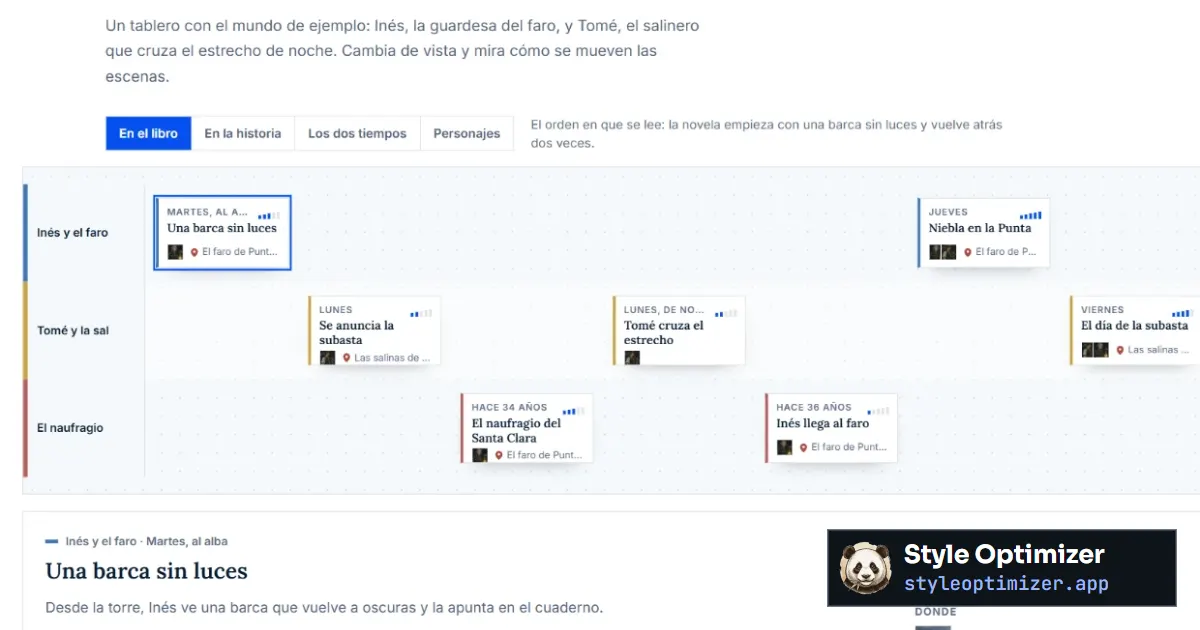
Once a novel has several plotlines or jumps around in time, a table falls short. That’s what Style Optimizer’s outline board is for: each scene is a card and each plotline a lane with its own color. The sample board is Orsenna, an invented world with two protagonists, Inés Varga, keeper of the Punta Gris lighthouse, and Tomé Arrieta, the salt maker, told in seven scenes.
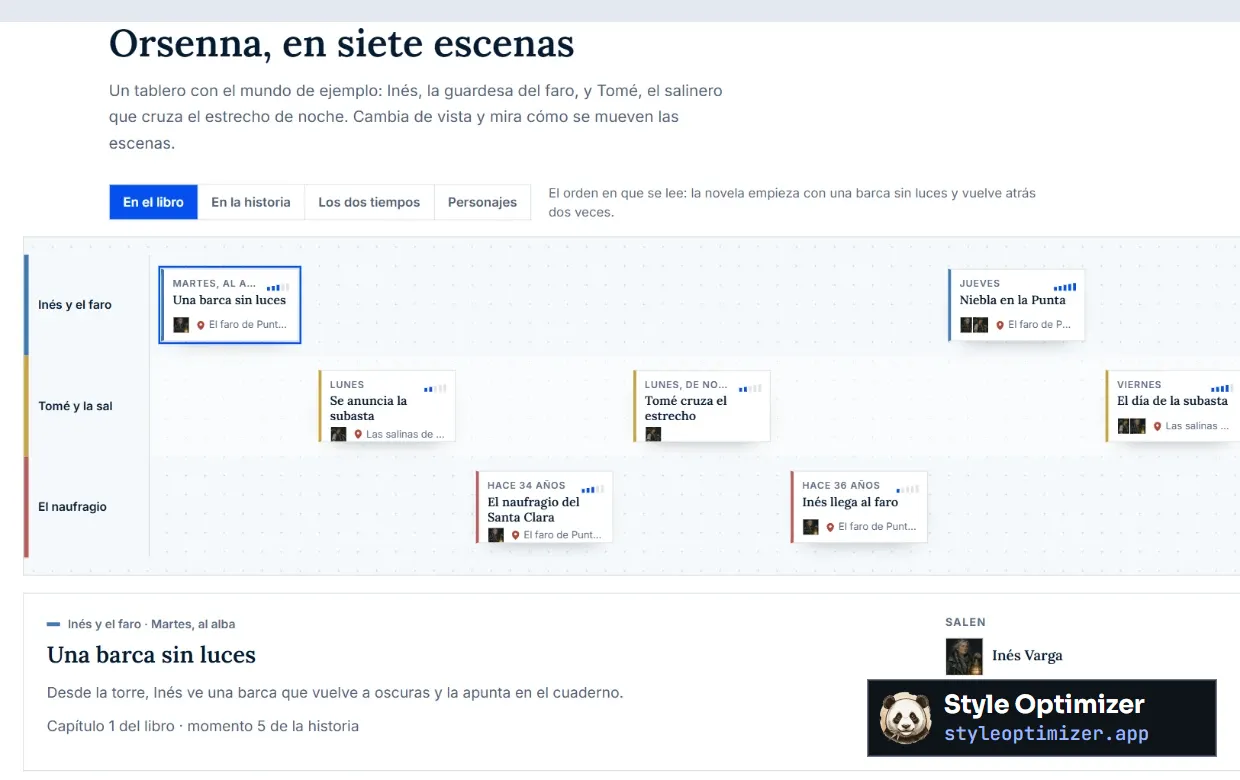
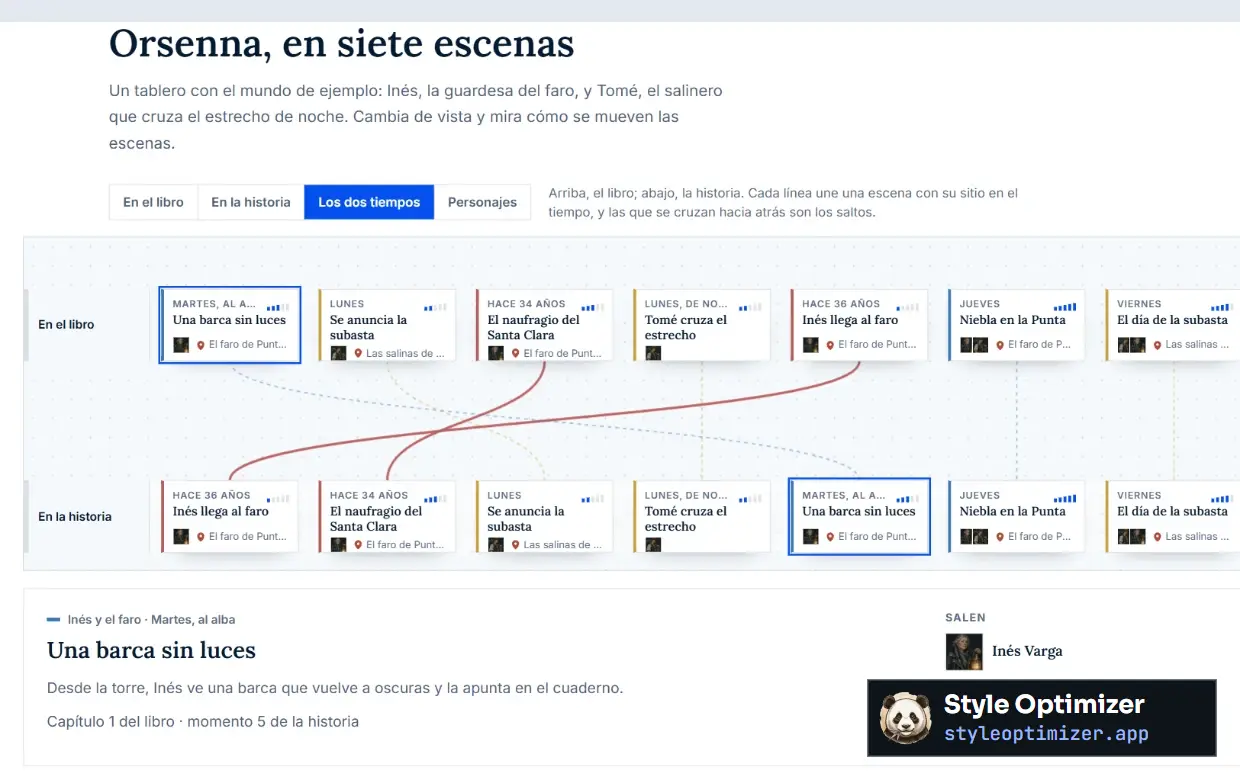
Each scene has two positions: its place in the book and its place in the story. The Orsenna novel opens with “A Boat Without Lights,” on a Tuesday at dawn; chapter three jumps thirty-four years back, to the wreck of the Santa Clara, and chapter five to Inés’s arrival at the lighthouse. The two-timelines view shows this with lines: the book on top, the story below, and the lines that cross backward are the jumps.
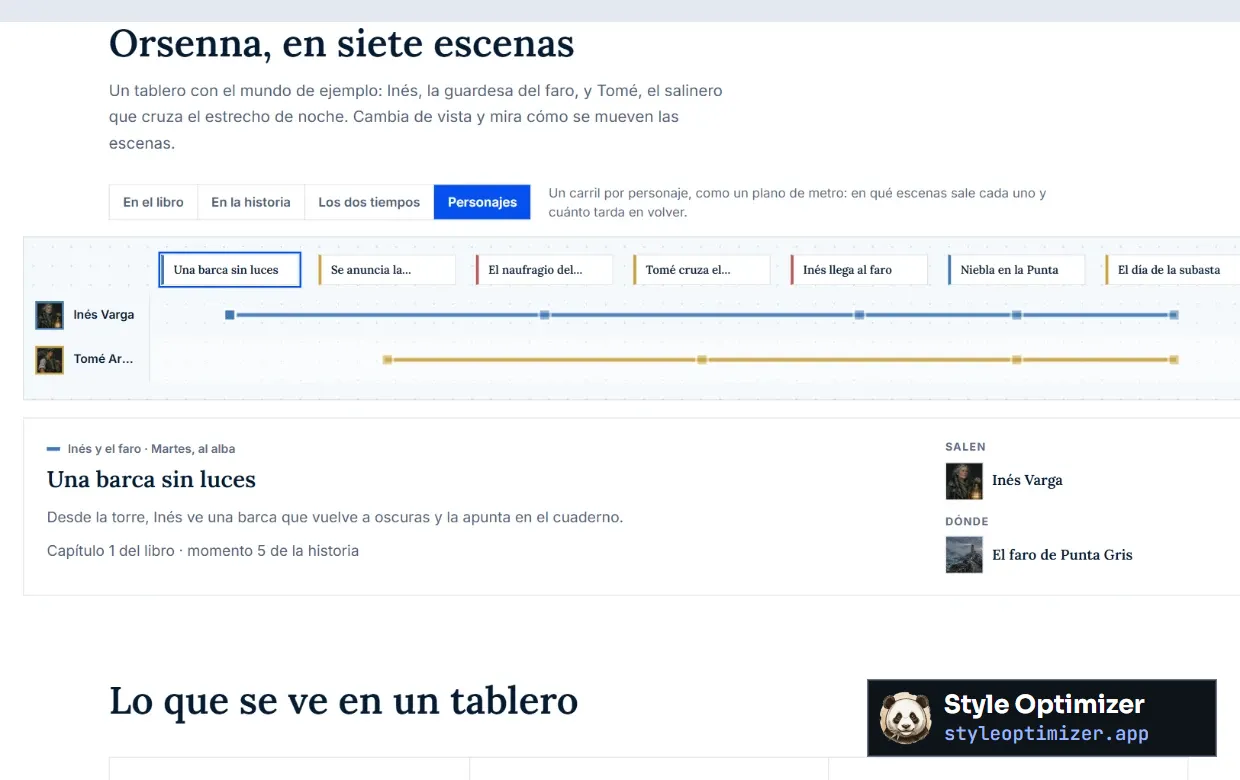
The characters view swaps the lanes: one per character, like a subway map, with the scenes each one appears in. The board flags any thread that has gone too many scenes without showing up.
You can download the outline as Markdown or print it, with acts and scenes in book order. And if you’re still looking for the plot, Style Optimizer’s plot prompts roll a seed with word dice, tarot or the I Ching and branch it out all the way to the scene. For more on drawing ideas from the cards, see tarot for creative writing.
Scene outline FAQ
What’s the difference between a scene outline, a synopsis and a treatment?
A synopsis tells the whole story in prose, in one or two pages. A treatment develops it scene by scene, also in prose and in more detail, sometimes with a line or two of dialogue. The scene outline is the most schematic of the three: a numbered list of scenes with one or two lines each, designed to show order and pacing at a glance.
How many scenes does a novel outline have?
It depends on length and pace. An 80,000-word novel with scenes of about 1,500 words comes to roughly fifty scenes; a short novel like the one in the example fits in twelve to fifteen. More than the number, what matters is that every scene changes something and that no plotline goes too long without appearing on the page.
Should I outline a novel before I start writing?
It helps plotters a great deal and can get in the way of pantsers, who discover the story as they write. A middle path works for almost everyone: a short outline with the key moments (opening, turning points and ending) before you start, and a full outline after the first draft, to revise the order, the pacing and any plotlines left hanging.
Can I outline my novel in Word, Excel or Google Sheets?
Yes: a table with one row per scene and columns for who, where, wants and what changes works in any program. The trouble starts when you move scenes around and track several plotlines at once. That’s what card boards are for, and Style Optimizer’s also separates the order of the book from the order in which the story happens.
For the whole process, from idea to finished draft, see how to write a novel.