How to Write a Novel: From First Idea to Finished Manuscript
November 21, 2026 · Equipo Style Optimizer
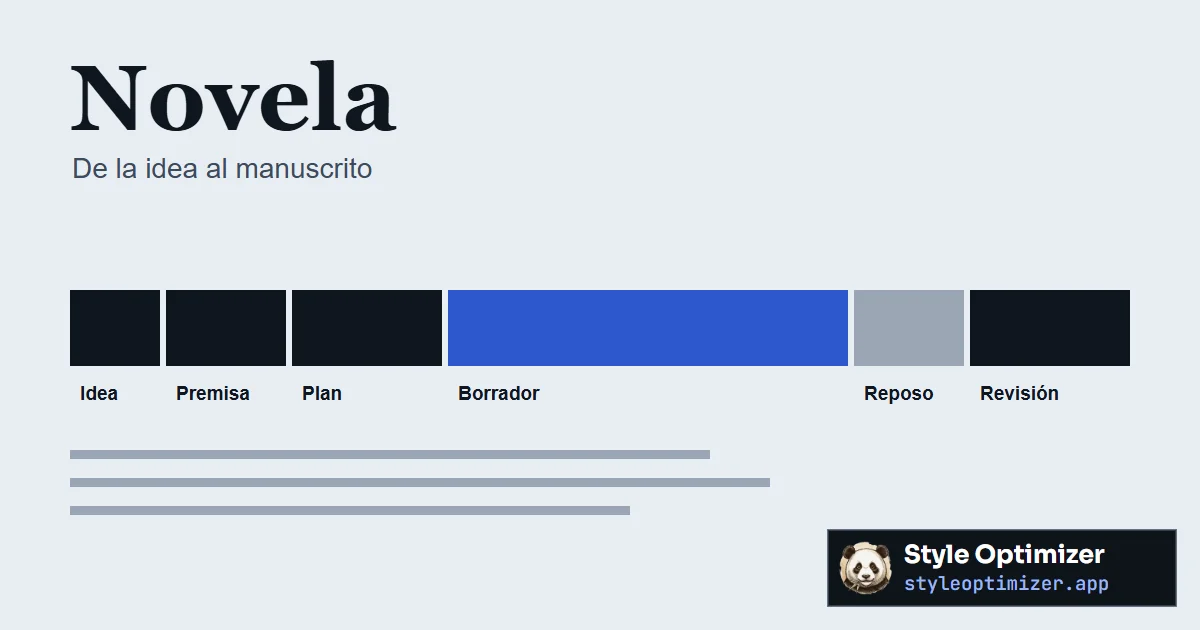
To write a novel you need three things: an idea that can sustain hundreds of pages, a method that carries you to the end of the draft and a revision done with some distance. This guide walks through the whole process in eight steps, from the first idea to a manuscript you’re ready to show.
Many novels are abandoned soon after they’re started because nobody worked out how much work 70,000 words spread across a year really is. So that’s where we begin.
Work out how long it will take you
The math is simple, and doing it before you start changes how you see the project. Multiply three numbers: the words you can write per session, the sessions per week and the weeks you have.
A 70,000-word novel, at 500 words per session and five sessions a week, comes to 140 sessions: 28 weeks of drafting. At 300 words a session, the same book takes about 47 weeks. Run it with your own numbers, and pick a daily target you could hit even in a bad week.
1. Find an idea that can carry a novel
An idea for a novel needs a conflict that can’t be settled in a single scene. “A woman returns to her hometown” is a situation. “A woman returns to her hometown to sell her mother’s house and finds that half the street thinks she owes them money” already has pressure, people involved and questions to answer.
Three questions help you tell whether your idea is big enough:
- Who loses something important if this goes wrong? With nothing at stake, the story stays an anecdote.
- What can get worse? Write down five complications. If you struggle to reach three, it may be a short story.
- Do you want to spend two years with this? An idea that bores you on page 30 weighs a ton by page 200.
If you’re missing a starting point, our writing exercises put combinations in front of you that you wouldn’t have gone looking for.
2. Write your premise in one sentence
The premise says who wants what, what stands in the way and what happens if they fail. It has a practical use: when you’re lost in chapter 14, it reminds you what the book is about.
An insurance investigator has to prove that the fire at her brother’s factory was an accident, before the company finds out she signed the policy herself.
If you can’t get it into one sentence, you don’t yet know what your novel is about. That’s useful information, and it’s better to have it before you write 300 pages.
3. Decide how much you’ll plan
Some authors write with a complete outline, and others discover the story as they write it; plotters and pantsers both finish novels. They run into different problems: heavy planners risk never starting, and improvisers tend to rewrite more.
A middle path that works for a first novel is to fix five points before you begin: the opening, the first turning point, the midpoint, the crisis and the ending. Between those five points, write freely. The Hero’s Journey is another classic skeleton, and a scene outline, with one card per scene, helps if you’re juggling several plots.
4. Get to know your characters before they speak
What you need to know about a character boils down to six questions: what they want, what they fear, what lie they tell about themselves, what they’re willing to do, what they would never do and what makes them change. You’ll find them in our character profile, without the usual forty fields.
To decide how much weight each one carries in the plot, review the types of characters: protagonists, antagonists, secondary characters and extras call for very different amounts of work. The seven steps in how to create characters take you from a name to a full person.
5. Choose your narrator and tense
Switching from first to third person halfway through the book means rewriting the whole thing, so test it first. Write the same two-page scene with two different narrators and keep whichever one feels easier to continue. You’ll find the options in types of narrator and in first, second and third person.
6. Finish the first draft
The first draft has a single obligation: to exist. These rules head off most abandoned novels:
- A pace that survives your worst week. Better 300 words five days a week than 2,000 one Saturday in three.
- No rereading from the beginning. Read only the last page to pick up the thread. Polishing chapter one for months is the most common way never to finish.
- Note the problems and keep going. If you change something that affects earlier chapters, leave a note and carry on as if it were already fixed.
- Stop in the middle of a scene. Tomorrow you’ll know exactly where to pick up.
- Count the days. A writing streak turns consistency into something you can see.
On days when nothing comes, ten minutes of freewriting before your session can get you moving.
How many words is a novel?
| Type | Approximate word count | Printed pages (about 250 words per page) |
|---|---|---|
| Short novel | 20,000–50,000 | 80–200 |
| Mid-length novel | 50,000–90,000 | 200–350 |
| Long novel | 90,000–120,000 | 350–470 |
| Fantasy or series | 120,000 or more | 470 or more |
These are typical ranges, and they shift with genre and publisher. The page count also depends on trim size and typesetting: the same book runs shorter at 6×9 in than at 5.5×8.5 in. Before you query literary agents, check the usual length for your genre; if you’re entering a contest, its guidelines set the limit.
7. Let it rest, then revise in layers
Put the draft away for at least four weeks without looking at it. Then revise in this order, from big to small, so you don’t polish scenes you’re going to cut:
- Structure: are there chapters you don’t need? Does the tension sag in the middle? Does the ending answer the question the opening asked?
- Characters: does the protagonist change? Do they all sound the same? Our guide to dialogue tags helps keep the focus on what they say.
- Scenes: each one should change something. If nothing changes, cut it or merge it. Watch out for infodumps, too.
- Prose: repetitions, verbal tics, adverbs and rhythm. This is the layer where an editor with style analysis pays off most.
8. Find readers and decide how to publish
Two or three beta readers will tell you where they got bored and where they stopped believing you. If you want a reading of the whole book before you send it out, a manuscript assessment gives you the complete map.
Then you’ll choose between querying agents and publishers, self-publishing or entering it in writing contests.
FAQ: how to write a novel
How long does it take to write a novel?
It depends mostly on your pace. At 500 words five days a week, a 70,000-word draft takes about 28 weeks; with time to rest and revise, a little over a year. The calculation at the top of this page works with your own numbers.
Can I write a novel if I’ve never written anything before?
Yes, and many authors debut that way. It helps to write three or four short stories first, to practice openings and endings in a small space. Our guide on how to write a short story covers the process.
Where do I start writing a novel?
With the scene you most want to write, even if it happens halfway through the story. Chapter one usually gets rewritten once you know how the book ends, so there’s little point in waiting for it to come out perfect.
Can I use AI to write a novel?
It’s useful for testing ideas, spotting problems and asking questions about your text. If you’re submitting the book to a contest, an agent or a publisher, check first what their terms say about this kind of use.
For the first page, see how to start a story, and to plan the whole book, novel structure.