Repeated words, alliteration and internal rhyme: listen to your prose
November 7, 2026 · Equipo Style Optimizer
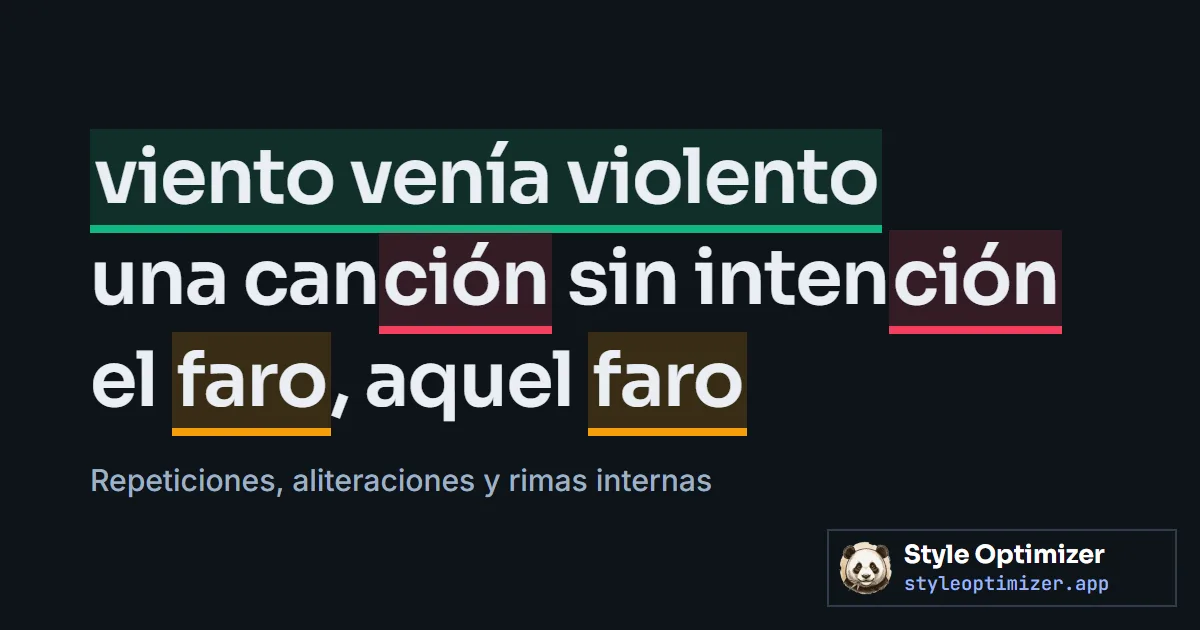
Some mistakes are invisible: you hear them. A word that returns two lines later, three words in a row starting with the same sound, two endings that rhyme in the middle of a sentence. Reading silently, they slip by; read aloud, or in the reader's head, they ring out. That is why the Style Optimizer editor has a new group in Style from today: Sound and repetition.
Where to find it
Open a text in the editor, go to the Style tab and click «Analyze text». Four categories appear at the end of the list: same words close together, alliterations, internal rhymes and cacophonies. Each one shows its count; click it and the text is highlighted, and the arrows take you from one finding to the next.
Everything runs in your browser, without AI: it uses no credits, your text stays on your device, and you can run it as often as you like.
Sound and repetition reads Spanish prose: the sound rules (c and qu, the stressed vowel) follow Spanish pronunciation, and the screenshots below show Spanish text, with a gloss in each caption.
Same words close together
It marks the same word when it comes back within 50 words. Each repeated word gets its own color, so you see at a glance what repeats and where.
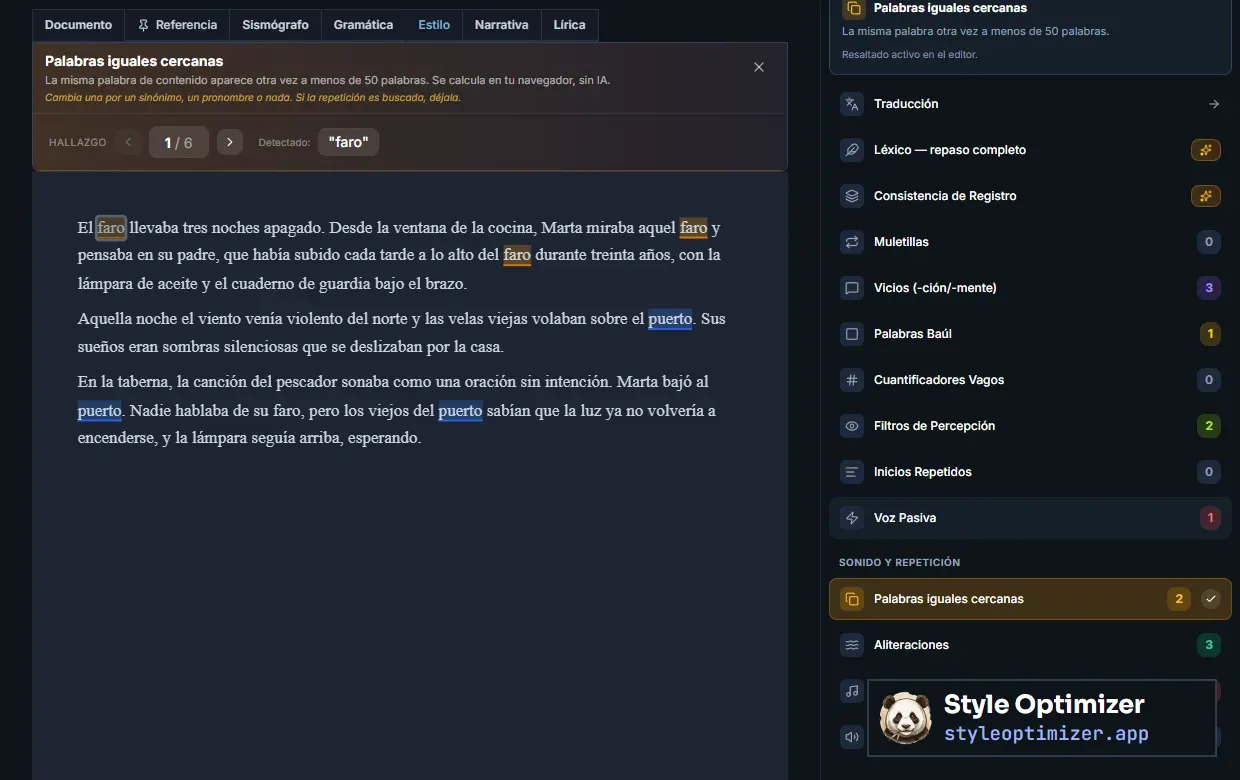
What to do: swap one of the two for a synonym, a pronoun or, quite often, nothing at all. If the repetition is deliberate, because you want to press on an idea, keep it.
Alliterations
It marks several words in a row that begin with the same sound, like «tres tristes tigres», the Spanish tongue-twister about three sad tigers. It goes by sound, not spelling: «casa» and «queso» alliterate even though one starts with c and the other with qu.
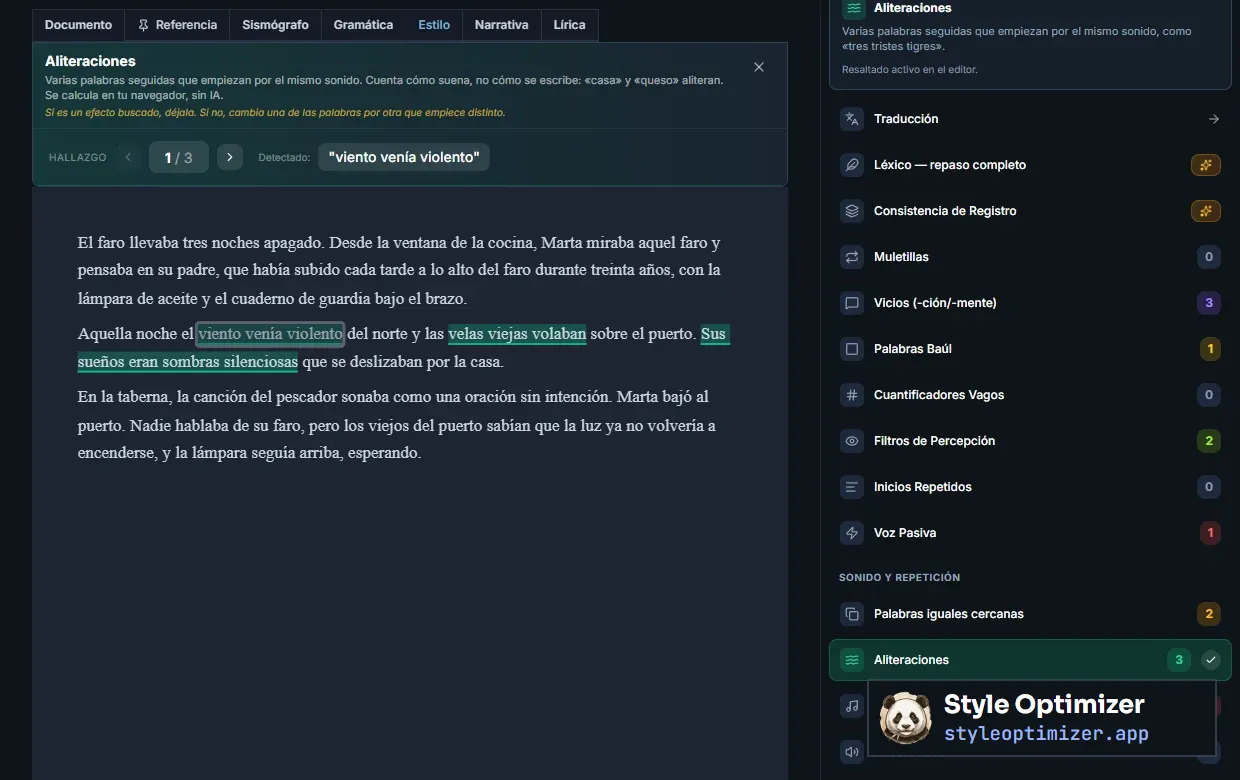
Alliteration can be a gift: it adds rhythm, imitates a sound, stays in the memory. The one to watch for is the alliteration that turns up by accident in a sentence that doesn't call for it. There is more on this in Alliteration and cacophony.
Internal rhymes
It marks words in the same sentence that rhyme, six words apart or fewer. The rhyme counts from the stressed vowel, as in poetry.
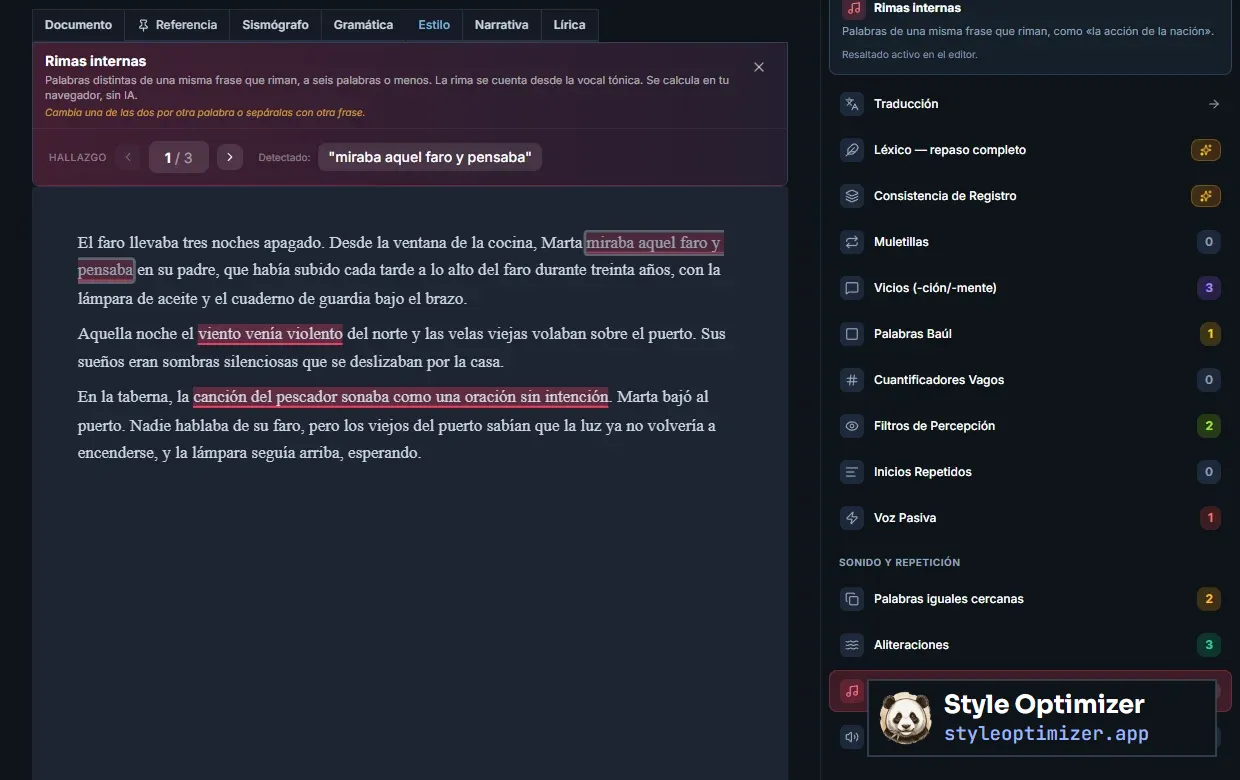
In prose, an internal rhyme usually sounds careless, especially with endings like -ción, -mente or -aba, the Spanish cousins of -tion, -ly and -ing. Change one of the two words or move it to another sentence.
And cacophonies
Cacophonies are the clashes between neighboring words: the end of one word repeated at the start of the next, as in «pensaba bastante», and an «a» before a word that begins with a, as in «va a acabar».
One way to use it
- Write first, listen later. Let it stay out of your way while you write. When you revise a chapter, go through the four categories one after another.
- Start with same words close together. They are the most noticeable and the easiest to fix.
- Read aloud whatever it marks. If it sounds right, keep it: Style points it out, you decide.
All of this week's news, with the rebuilt I Ching, the Magic Diary and reactions in your inbox, is in the Dev Diary (in Spanish). And to try it now, open the editor.