Types of Characters: Main, Secondary and How to Classify Them
November 21, 2026 · Equipo Style Optimizer
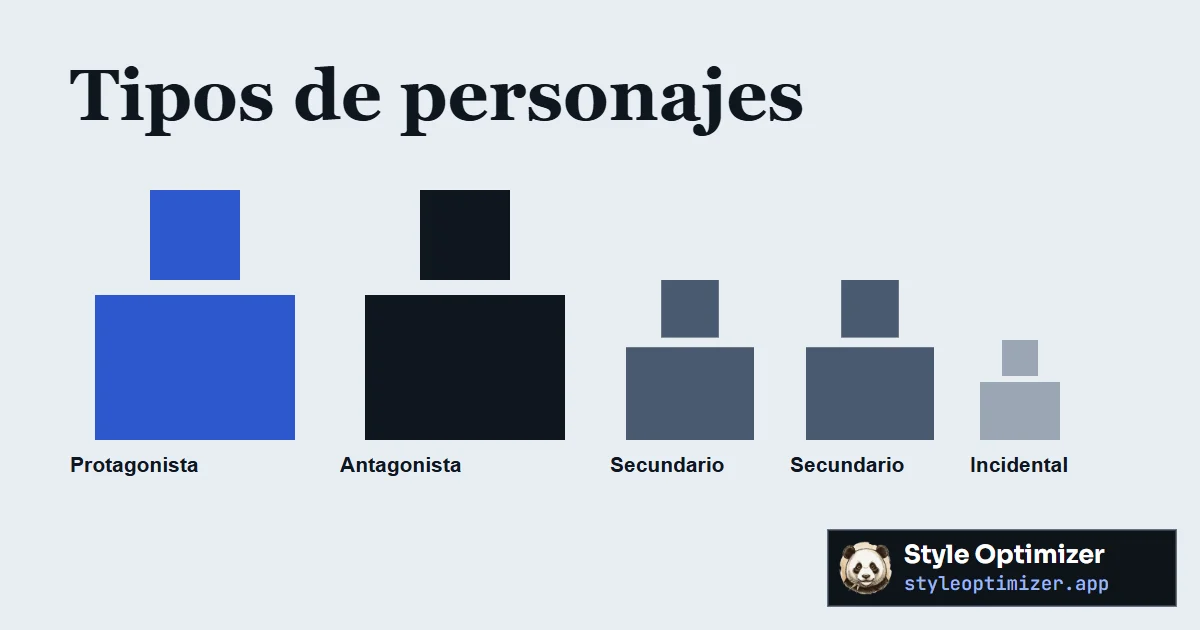
A character in fiction is any being that acts in the story: a person, an animal, a robot or even a house, if the story gives it a will. The types of characters fall into three classifications: by how important they are to the story, by how much they change, and by the role they play in the plot. Every character belongs to all three at once.
This guide sums up each classification with examples and explains what to do with it while you write. Further down you’ll find a link to a profile template for building your own.
Types of characters by importance
| Type | What they do | Example |
|---|---|---|
| Protagonist | Drives the story: wants something, and what happens to them is the plot. | Sherlock Holmes |
| Antagonist | Opposes the protagonist. Can be a person, a group, a law or an illness. | Javert in Les Misérables |
| Deuteragonist | Second in importance, closely tied to the protagonist. | Dr. Watson |
| Secondary | Carries weight in parts of the plot and helps or hinders the hero’s path. | Hermione and Ron in the early Harry Potter books |
| Tertiary or incidental | Appears for one specific job and disappears. | The waiter who delivers a note |
| Extra or background | Brings the setting to life and barely acts. | The crowd at a market |
What is a main character?
A main character is one without whom the story wouldn’t exist: their desire or conflict drives the plot from start to finish. The protagonist and the antagonist are main characters, sometimes joined by the deuteragonist. An ensemble novel spreads that weight across several characters, and a short story usually has only one or two.
What is a secondary character?
A secondary character carries weight in one part of the story without leading it: they help or hinder the protagonist, give them someone to talk to or carry a subplot of their own. A good secondary character wants something for themselves, even if the novel doesn’t follow them to the end. If two secondary characters do the same job, they usually work better merged into one.
Types of characters by how they change
Round and flat
This distinction comes from E. M. Forster, in Aspects of the Novel (1927). Flat characters can be summed up in a single trait and behave predictably. Round characters have contradictions and can surprise the reader while staying believable.
A flat character can be perfectly useful. The key is choosing well: a secondary character with four lines works better with one sharp trait, while a flat protagonist runs out of steam within a few chapters.
Static and dynamic
Dynamic characters change over the course of the story. Static characters end as they began. Sherlock Holmes barely changes from one case to the next, and that’s part of his charm. Emma Bovary, by contrast, is transformed and destroyed. That journey is called the character arc.
Stock characters and stereotypes
A stock character stands for a recognizable group, like the miser, the rogue or the braggart soldier of classical comedy. When one is repeated without any variation, it becomes a stereotype. If your character resembles one of these, give them something the type would never do: a miser who secretly pays a stranger’s tuition is already someone else.
Types of characters by their role in the plot
These classifications look at what the character does in the story, whoever they are.
Greimas’s actants
The linguist A. J. Greimas reduced any story to six roles, the actants, which come in pairs:
- Subject and object: the one who desires and what they desire.
- Sender and receiver: the one who sets the quest in motion and the one who benefits from it.
- Helper and opponent: the one who makes the quest easier and the one who blocks it.
If your novel is stuck, fill these six slots with your story. An empty slot often explains why the plot isn’t moving.
Propp’s seven character functions
Vladimir Propp studied Russian folktales in Morphology of the Folktale (1928) and found seven spheres of action: the villain, the donor, the helper, the princess and her father, the dispatcher, the hero and the false hero. It’s a very useful list for fables and fairy tales.
Archetypes
The mentor, the shadow, the threshold guardian and the trickster are figures that recur in myths across many cultures. They’re explained in our guide to character archetypes and fit the stages of the Hero’s Journey.
Create your character
A classification helps you sort; a character is built with questions. What do they want, what do they fear, what lie do they tell about themselves and what will make them change? You’ll find the full template in our character profile guide.
How to use this while you write
- List every character and write their type by importance next to each name. If you have six “main” characters, your reader probably won’t know whom to follow.
- Decide who changes. At the very least the protagonist should end up different, or the story should show why they refuse to change.
- Give the antagonist their own logic. Write a page from their point of view in which they’re right.
- Merge secondary characters. If two characters do the same job, combine them and the result will carry more weight.
- Give incidental characters one visible trait. A single sentence is enough for the reader to remember them.
For an unusual angle, start from zodiac signs or from an I Ching hexagram: both hand you traits you wouldn’t have combined on your own. And once your characters start talking, our guide to dialogue tags will help you keep the focus on what they say.
Types of characters: FAQ
What characters does a short story need?
A short story usually has a protagonist, sometimes an antagonist and very few secondary characters, because the limited space forces each character to play a clear role. Traditional tales also feature recognizable figures like the hero, the villain, the helper and the donor.
What’s the difference between a main character and a protagonist?
The protagonist is one of the main characters: the one who drives the story. The antagonist and the deuteragonist are main characters too, because the story can’t stand without them.
What is a secondary character for?
A secondary character carries weight in part of the story without driving it: they accompany, help, hinder or carry a subplot. They give the protagonist someone to clash with and someone to lose, and they bring out sides of the protagonist that wouldn’t show on their own. They work best when they want something for themselves, even if the novel doesn’t follow them to the end.
Can a story have more than one protagonist?
Yes. In ensemble novels, several characters carry the story at once. Each of them then needs their own desire and their own conflict.
What is a fictional character?
A being created for a story, even when based on a real person. A historical figure who appears in a novel is still a fictional character, because the author decides what they think and what they say.
Is the narrator a character?
Only when they take part in the story, as a first-person protagonist or a witness. An external narrator tells what happens without stepping in. The differences are explained in our guide to types of narrator.