First, Second or Third Person: How to Choose Your POV
November 21, 2026 · Equipo Style Optimizer
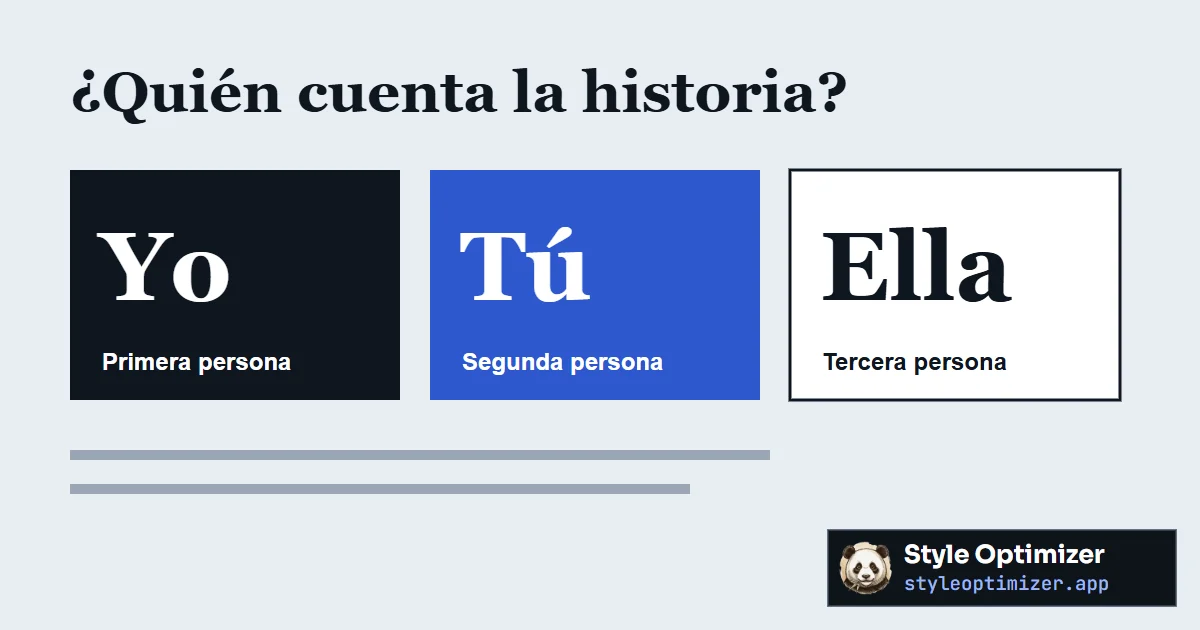
A story can be told in first person (I), second person (you) or third person (he, she, they). First person brings closeness and a single point of view; second person, strangeness and intimacy; third person, the freedom to move among characters. To choose, ask yourself two things: how much the storyteller needs to know, and how close you want readers to stand. If you already have a draft, the checks below will tell you whether you’ve stuck to your choice.
Check which person your draft is in
Take a page of your draft and circle the pronouns that refer to the main character. All “I” means first person; all “you,” second; a name with “she” or “he,” third. Then count whose thoughts the page enters. If you’re in third person and the page goes inside two heads in the same scene, you’re writing omniscient, whether you meant to or not.
The same paragraph in three persons
Here’s how a simple scene changes as you move from one person to another:
- First: “I opened the letter in the lobby, standing up, because I couldn’t wait to get upstairs. I knew the handwriting before I read my name.”
- Second: “You open the letter in the lobby, standing up, because you can’t wait to get upstairs. You know the handwriting before you read your name.”
- Third: “Elena opened the letter in the lobby, standing up, because she couldn’t wait to get upstairs. She knew the handwriting before she read her name.”
The information is the same, but in first person readers are inside Elena; in second, they’re made to be her; in third, they watch her from a step back and could, if the narrator wished, also learn what the neighbor coming down the stairs is thinking.
First person point of view
The storyteller is a character in the story: the protagonist or a witness. It’s the natural choice for memoir, coming-of-age novels and any story where how something is lived matters more than what happens. Jane Eyre, The Catcher in the Rye and The Great Gatsby are told this way, the last one by a witness, Nick Carraway, who watches Gatsby from close by.
- Strengths: instant closeness, a voice with personality and the possibility of a narrator who deceives themselves or the reader.
- Limits: you only know what the narrator knows. Everything that happens away from them has to reach them through someone else.
- The trap: a narrator who describes their own face in a mirror or knows what everyone else is thinking.
Second person point of view
The narrator addresses a “you,” who may be the protagonist talking to themselves, another character or the reader. It’s the rarest of the three and the most striking. Jay McInerney’s Bright Lights, Big City and Carlos Fuentes’s Aura use it from start to finish; Italo Calvino uses it in If on a Winter’s Night a Traveler to speak directly to whoever is reading.
- Strengths: intensity, a sense of obsession or guilt, and a hypnotic effect in short pieces.
- Limits: it wears readers out over long stretches and puts them in a place they may not want to be.
- Where it works: short stories, prose poetry, scenes of trauma or memory, and how-to formats turned into fiction.
Third person point of view
It’s the most common choice for novels. The narrator stands outside the story and refers to the characters by name. But there are several kinds of third person, depending on how much the narrator knows:
- Omniscient: knows everything, enters any head and can reveal the future. It’s the narrator of Middlemarch and War and Peace. We cover it in depth in omniscient narrator.
- Limited: stays close to one character and knows what they know. It combines the intimacy of first person with the flexibility of third, and it’s the most common choice in contemporary fiction.
- Objective: tells only what a camera would record, without entering anyone’s head. Hemingway’s “Hills Like White Elephants” is the classic example.
You’ll find every variant in types of narrator.
First, second or third person: comparison
| First | Second | Third | |
|---|---|---|---|
| Pronoun | I, we | You | He, she, they |
| Distance | Minimal | Minimal and uncomfortable | Variable |
| What’s known | What the narrator knows | What the “you” knows | Anything from one mind to all of them |
| Most common in | Memoir, young adult fiction, crime fiction | Short stories, experimental fiction | Novels in every genre |
| Difficulty | Medium | High | Medium; high for omniscient |
How to choose your point of view
- Do you need to show things your protagonist can’t see? If the plot depends on what happens in another city or another head, third person saves you a lot of tricks.
- Is the character’s voice the main draw? If the way they talk and see the world is what hooks readers, try first person.
- Do you want readers to be suspicious? First person makes room for an unreliable narrator.
- Is the piece short and intense? That’s where second person works best.
- Still unsure? Write the first scene twice, in first person and in third person limited, and keep the version that makes you want to keep writing.
The choice also affects how you open. An in medias res opening in first person plunges readers straight in; in omniscient third, it lets you look down on the scene before you descend into it. For more ways to begin, see how to start a story.
Common point of view mistakes
- Switching person by accident. It happens during revision, when a paragraph comes from an earlier draft. Reading the chapter aloud catches most of these slips.
- Head-hopping in third person limited. If, in the same scene, we know what two characters are thinking, the narrator has stopped being limited.
- A first-person narrator who knows everything. If your narrator reports what someone else is thinking, give them a reason: they were told, they worked it out or they’re imagining it.
- Letting the tense drift. Choosing first person and present tense is a decision, and it’s worth keeping throughout the text.
Point of view: FAQ
What point of view do most novels use?
Third person, especially third person limited to one character. First person is very common in young adult fiction, crime fiction and autofiction.
Can you mix first and third person in a novel?
Yes, as long as there’s a clear pattern: by chapter, by part or with a different narrator for each timeline. What confuses readers is a switch without reason inside a single scene.
Does a second-person narrator talk to the reader?
Sometimes, but more often the “you” is the protagonist talking to themselves, or a specific character the narrator is addressing.
What’s the difference between a first-person protagonist and a first-person witness?
Both tell the story in first person. The protagonist tells their own story; the witness tells someone else’s, watching from close by, the way Dr. Watson does with Sherlock Holmes.