How to Describe a Character: Looks, Gestures and Personality
November 21, 2026 · Equipo Style Optimizer
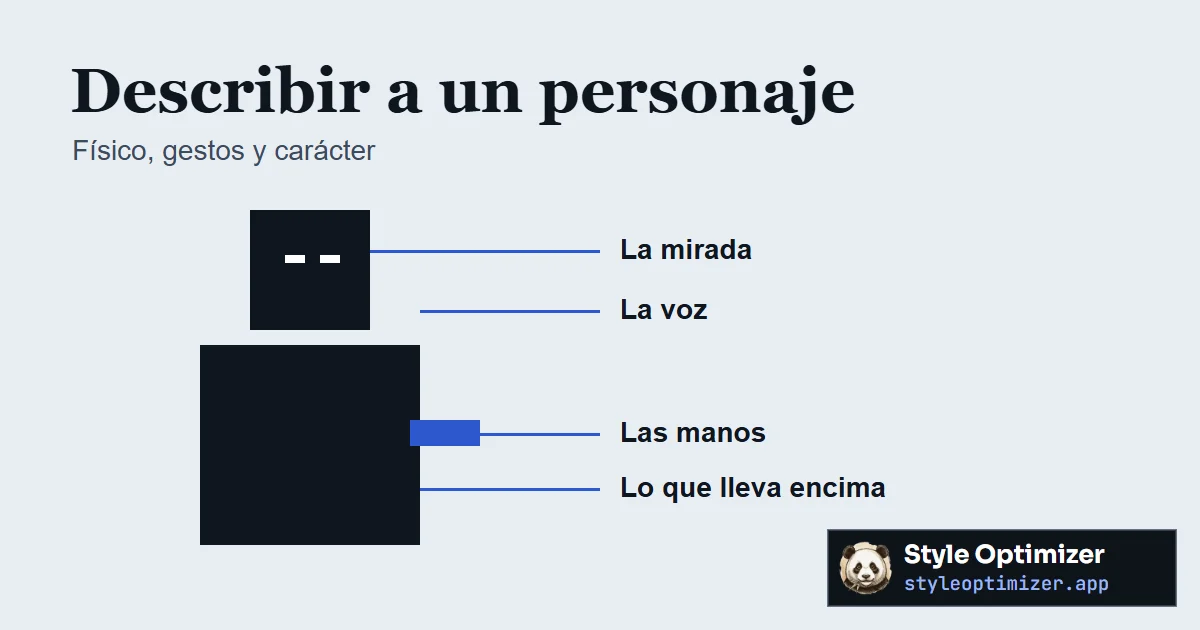
To describe a character, choose a few traits that say something: one or two physical details nobody else has, a gesture they repeat and an action that shows who they are. Classical rhetoric calls the physical description prosopographia and the description of character ethopoeia; together they make a portrait. A good portrait is rarely a list. It’s spread through the scene, carried by what the character does, says and carries around. Below you’ll find how to do it, examples and two exercises to check your own description.
The ways to describe a character
| Name | What it describes | Example |
|---|---|---|
| Prosopographia | Physical appearance: body, face, clothes, voice | “Her nails were bitten to the quick, and her coat was two sizes too big.” |
| Ethopoeia | Character, habits, way of thinking | “He never argued; he simply waited for the other person to get tired.” |
| Portrait | Both at once | “She laughed behind her hand, as if asking permission to be happy.” |
| Caricature | Exaggerated traits, for humor or satire | “His nose entered a room a few seconds before he did.” |
The third example is the most useful one in fiction: a physical gesture that reveals character. One sentence like that tells readers more than a paragraph of adjectives.
How to describe a character’s appearance
- Pick the trait nobody else has. Everyone has eyes and hair. A scar on the lip, a crooked tooth or a pigeon-toed walk is what sets a person apart.
- Describe through someone else’s eyes. A mother and a police officer notice different things about the same girl. Point of view chooses the details for you.
- Use clothes and objects. An expensive watch on a frayed strap tells a story of money lost.
- Keep them moving. A character who walks in, sits down or lights a cigarette describes themselves. Static portraits read like mug-shot descriptions.
- Use the other senses. The voice, the smell, the rough palm of a handshake. Sight is the sense we use most and the one that surprises least.
How to describe personality
Personality comes across best indirectly. Instead of writing that someone is stingy, show them splitting the check down to the penny. There are four routes:
- What they do, especially when they think nobody’s watching.
- What they say and how they say it: their verbal tics, what they leave unsaid, how they treat people who can do nothing for them.
- What they own: their home, their car, what’s in their bag.
- What others say about them, which isn’t always accurate.
If you want to know your character inside out before describing them, fill in a character profile: what they want, what they fear and what lie they tell about themselves. And to judge how much description each one needs given their role, see the types of characters.
Check the senses in your description
Take a character description you’ve written and mark each sensory word with a different color: sight, hearing, touch, and smell or taste. Then look at the page. If it’s all one color, almost always sight, add a sound or a texture and read it again. A single creak of a leather jacket or the smell of cough drops can bring a character closer than three lines about their looks.
Concrete words make characters come alive
“She was a sad, kind person” leaves no image behind. “She saved the doorman the Sunday paper and never asked about his wife” leaves a whole person. The difference lies in concrete words, the ones you can see or touch, as opposed to abstract ones. Go through your description and underline every word you couldn’t photograph (kind, sad, mysterious, strong). Each one is a candidate for a detail or an action. Our guide to concrete and abstract words explains the difference in depth.
Verbs help as much as nouns: “he dropped into the chair” describes more than “he sat down, tired.” When you catch a verb propped up by an adverb, look for a single verb that does both jobs.
An example, before and after
Before: “Mr. Hollis was an older man, tall and thin, with white hair and blue eyes. He was very serious and a little unfriendly, but deep down he was a good person.”
After: “Mr. Hollis had to duck to get into the bakery, and he did it slowly, as if the doorframe owed him something. He always ordered the same thing without saying good morning. Then, with the loaf under his arm, he stood for a moment on the sidewalk breaking off the heel for the sparrows.”
The second version never says “tall,” “serious” or “good person,” and readers know all of it. The same technique works for places, as you’ll see in how to describe a setting.
Common mistakes when describing characters
- The mirror. The character looks at their reflection and describes themselves. It’s the most worn-out device in fiction.
- The inventory. Hair, eyes, nose, height and clothes in a single paragraph, right at the start. Spread the traits across the scene.
- Clichés. Emerald eyes, porcelain skin, a toothpaste-ad smile. If you’ve read it many times, so have your readers.
- Describing what doesn’t matter. If eye color will never matter to the story, you can probably leave it out.
- Contradicting the description. A “shy” character who talks nonstop in every scene. If they contradict themselves, make it deliberate.
How to describe a character: FAQ
How much should you describe a character?
Less than you think. Readers fill in the picture from very little: two or three well-chosen traits are enough for a protagonist, and one for a secondary character.
Should the description come all at once or spread out?
Spread out is better. Give one trait when the character appears and add the others as the scene needs them.
How do I describe a character in first person?
Through what they do and how others react to them. A narrator can also describe themselves by comparison: “My sister got our father’s height; I got his fear of dogs.” If you’re still deciding on point of view, see first, second or third person.
What is prosopographia?
The description of a person’s physical appearance. Describing their character is called ethopoeia, and combining the two makes a portrait.