Flat and Round Characters: Differences and Examples
November 21, 2026 · Equipo Style Optimizer
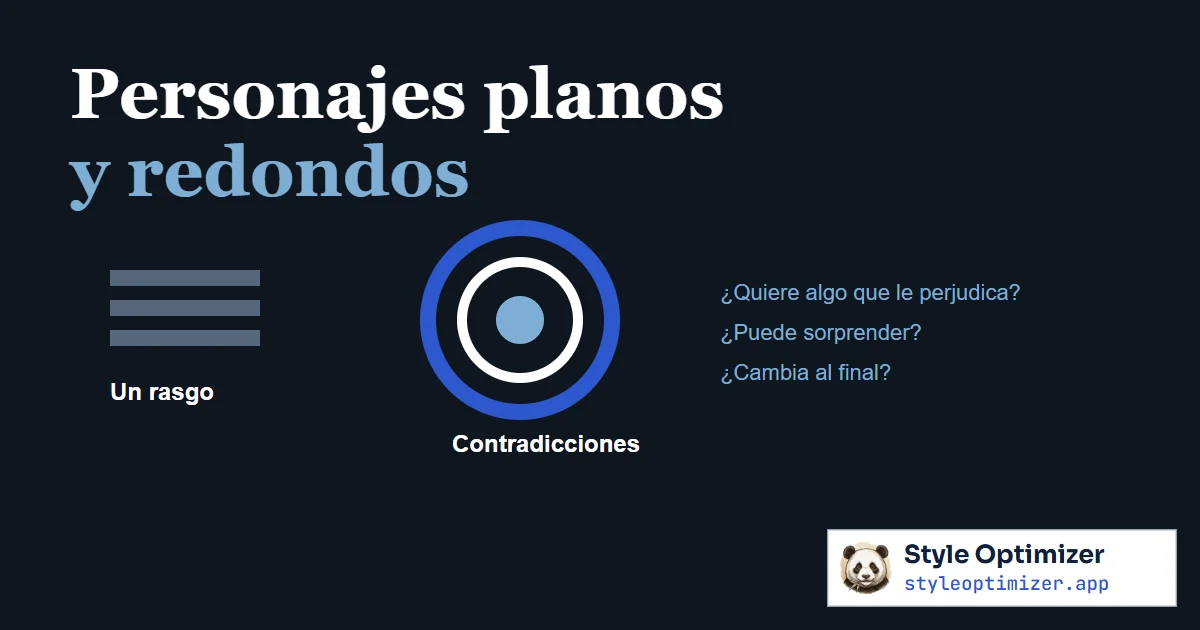
A flat character can be summed up in a single trait and always acts the way we expect. A round character has contradictions, changes and can surprise the reader while staying believable. The novelist E. M. Forster drew the distinction in Aspects of the Novel (1927), and it’s still the quickest way to tell whether a character can carry a novel. Run one of yours through the six questions below and see what it’s missing.
Is your character flat or round? Six questions
Answer each one with a yes or a no:
- Contradiction. Do they have two traits that pull against each other?
- Costly choices. Do they ever have to choose between two things they want?
- Surprise. Have they done something you didn’t see coming that still made sense afterward?
- Change. Are they different at the end from how they started, or do they visibly resist changing?
- Past. Do you know something from their past that shapes how they act now?
- The one-sentence test. Can you sum them up in one sentence without losing anything? (Here, a yes counts against roundness.)
Five or six answers on the round side, and you have a round character. Three or four, and they’re on their way. Two or fewer, and they’re flat, which is fine for a secondary character and a warning sign for a protagonist. Each answer on the flat side points to one of the steps further down.
Differences between flat and round characters
| Flat character | Round character | |
|---|---|---|
| Traits | One dominant trait, sometimes a catchphrase or a quirk they repeat | Several, and some of them clash |
| Behavior | Predictable: you know what they’ll do before they do it | Can surprise, and on reflection the surprise makes sense |
| Change | Usually ends as they began | Usually changes, though not always |
| Inner life | Seen from the outside | Has doubts, desires and a past that weigh on them |
| Where they work | Secondary roles, comedy, fables, short stories | Protagonists and antagonists in novels |
| Risk | Sliding into stereotype | Getting lost in nuances the reader never sees |
Examples of flat and round characters
Forster’s own example of a flat character was Mrs. Micawber in David Copperfield, who keeps declaring that she will never desert her husband. Dickens filled his novels with characters like her, and many are unforgettable: one well-chosen trait sticks in the memory.
The Dursleys in Harry Potter are flat on purpose: they exist so readers feel the injustice the protagonist lives with. Severus Snape, by contrast, is round, because for seven books he seems to be one thing and turns out to be another, and on a reread everything fits. Emma Bovary is round too: she wants a life out of a novel, deceives herself, ruins herself, and readers understand and judge her at the same time.
Cervantes gives the classic example of two round characters who rub off on each other: as Don Quixote goes on, the knight grows more sensible and Sancho Panza more of a dreamer.
Flat and static: two different measures
People often mix them up, but they measure different things. Flat or round describes a character’s complexity; static or dynamic describes whether they change over the course of the story. A detective in a mystery series can be round and static: complex, full of contradictions, and the same person in every case. And a flat character can change all at once on the last page, though it rarely feels believable. You’ll find the other classifications in types of characters, and the shape of change in character arc.
When a flat character works best
- In secondary roles with little space. The cab driver who appears in one scene needs one sharp trait and nothing more. Give him a past, and readers will expect him to come back.
- In comedy. Humor thrives on repetition: the character who always reacts the same way is funny precisely because of it.
- In fables and short fiction. In two thousand words there’s no room for everyone to be complex.
- To make the protagonist shine. A world of simple characters throws the one who doubts into relief.
The trouble starts when the flat character is the protagonist. Readers spend three hundred pages with someone to see how they change or how they hold out, and a character who fits in a sentence runs out of steam early.
How to turn a flat character into a round one
- Give them a contradiction. A woman who’s generous with strangers and stingy with her brother. A coward who takes a risk for an animal. Contradiction is what keeps readers watching.
- Make them face a costly choice. Characters reveal themselves when they choose between two things they want. Choosing between something good and something bad barely counts as a decision.
- Find their past, even if you never tell it. Knowing what happened to them at twelve changes how you write the way they walk into a room. Use a character profile or, if a little chance helps, build their temperament from their zodiac sign.
- Plan a surprise. Write a scene where they do something unexpected. Then go back and plant one or two details that explain it. Forster put the whole idea in one line: “The test of a round character is whether it is capable of surprising in a convincing way.”
- Show it on the page. Complexity that lives only in your notes never reaches the reader. To make it visible, work on how you describe the character through gestures and actions.
If your character follows a familiar model, like the mentor, the trickster or the rebel, take a look at character archetypes: the archetype gives you the base, and what makes the character round is whatever your version does differently. For the full process from scratch, see how to create characters.
Flat and round characters: FAQ
Who came up with flat and round characters?
The British novelist E. M. Forster, in Aspects of the Novel, a book based on lectures he gave at Cambridge in 1927.
Can a protagonist be flat?
Yes, especially in short stories, fables, adventure novels and comedy. In a long novel a flat protagonist tends to wear thin, because readers need something left to discover about them.
What is a stock character?
One who stands for a recognizable group, like the miser or the rogue. Stock characters are almost always flat. Repeated without any variation, they become stereotypes.
How can I tell if my character is round?
Try the sentence test: if you can sum them up in one sentence without losing anything, they’re flat. Then the surprise test: if they never do anything you don’t expect, they’re flat too. The six questions above combine those two tests with four more.