Character Arc: Types, Internal Conflict and Examples
November 21, 2026 · Equipo Style Optimizer
A character arc is the inner change a character goes through over the course of a story: they start out believing something, the plot puts that belief to the test, and they end up transformed, ruined or more certain than ever. It grows out of internal conflict, the gap between what the character wants and what they truly need. For an arc to happen, the character has to be capable of change, and the checklist below tells you whether yours is.
Checklist: can your character carry an arc?
Answer these six questions about your character:
- Do they hold a contradiction, two things that pull against each other?
- Do they make decisions that cost them something?
- Can they surprise the reader and still feel believable?
- Can you picture them changing?
- Do they have a past that weighs on the present?
- Can you sum them up in a single sentence? If you can, they may be too simple.
A character who comes out flat on this checklist will struggle to sustain an arc: they lack contradiction and costly choices, which are the raw material of change. To build a character with that depth from the start, use a character profile.
What is a character arc?
The plot tells what happens to the character; the arc tells what those events do to them inside. That’s why it’s also called a transformation arc: the journey between who they are in the first scene and who they are in the last. The two movements are bound together. Each plot twist squeezes one of the character’s beliefs, and each decision they make pushes the plot toward the next twist.
You can tell a well-built arc because the final scene would have been impossible at the start. If the character in chapter one could have done what they do at the climax, the story has rolled over them without leaving a mark.
Types of character arcs
| Arc | At the start | At the end | Example |
|---|---|---|---|
| Positive | Believes something false about themselves or the world | Discovers the truth and changes | Ebenezer Scrooge in A Christmas Carol |
| Negative | Believes something false or faces a temptation | Sinks deeper into it | Macbeth; Dorian Gray |
| Flat | Already knows a truth | Holds on to it and changes others | Atticus Finch in To Kill a Mockingbird |
Positive arc
This is the most common. Scrooge starts out convinced that money protects him from everything and everyone; three spirits show him what that belief has cost him, and on Christmas morning he’s a different man. Elizabeth Bennet, in Pride and Prejudice, trusts her eye for judging people, and a letter from Darcy proves she has misjudged both him and Wickham. The change comes because the plot forces her to look.
Negative arc
The character sees the way out and chooses the opposite. Macbeth hears a prophecy, and each crime demands the next. Dorian Gray keeps his face untouched while the portrait bears the marks of what he does. Readers need to see the exit the character refuses: that’s where the tragedy lies.
Flat arc
The protagonist already knows what matters and holds to it against everything; the world around them is what changes. Atticus Finch defends Tom Robinson knowing he’ll lose, and his daughter Scout, who narrates the novel, is the one transformed. It’s the usual arc for detectives and series heroes. Character archetypes such as the mentor often live flat arcs.
Internal conflict: want versus need
Internal conflict is the character’s struggle with themselves: between two desires, between a desire and a fear, between what they want and what they need. The plot supplies the external conflict (a rival, a storm, a law); the character brings the internal one from page one.
The most useful way to frame it is to separate the want, the conscious goal they pursue and can say out loud, from the need, what they truly lack and can’t see. Scrooge wants to be left alone with his money; he needs to reconnect with people. The arc is the path from one to the other, and the climax is the moment the character chooses.
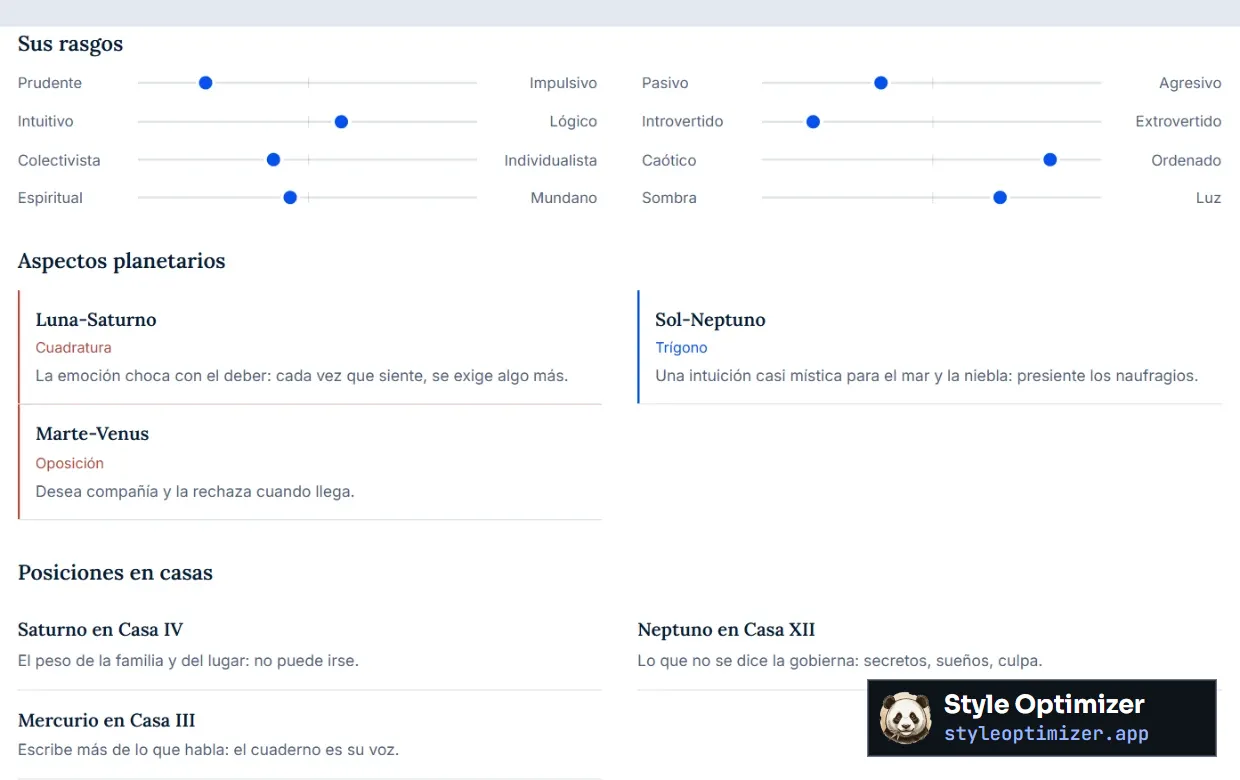
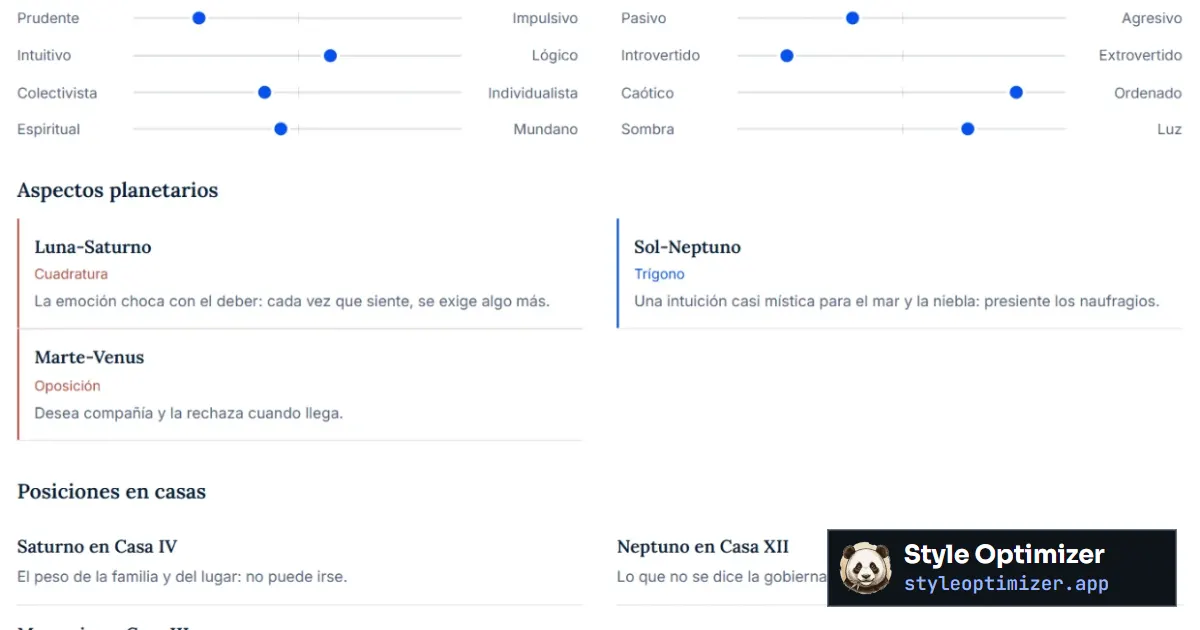
A birth chart hands you ready-made internal conflicts. In AstroLab, Style Optimizer’s character tool, the chart of Inés Varga, the lighthouse keeper of Orsenna, comes with two: Moon square Saturn, “emotion collides with duty,” and Mars opposite Venus, “she longs for company and pushes it away when it comes.” Either one could carry a novel. Our guide to zodiac signs for characters shows how to read them.
The lie your character believes
In Creating Character Arcs (2016), K. M. Weiland suggests framing internal conflict as a lie: a false idea the character believes and that has served them until now. “If nobody needs me, nobody can hurt me.” “Whoever’s in charge is right.” “If I handle everything myself, it won’t happen again.” The lie usually comes from an old wound, and a positive arc is the journey toward letting it go. Write it as a single first-person sentence: if it sounds like something the character would say and mean, it works.
A character arc outline in five moments
This outline works for any arc. Here it’s applied to a possible arc for Inés Varga, whose lie might be “if I watch over everything myself, no one else will be lost at sea,” born from her brother’s death.
- The lie at rest. The character’s world runs on the lie. Inés logs every boat in her notebook and lets no one up into the lighthouse.
- The trigger. Something tests the lie. From the tower she sees a boat coming back in the dark, with no lights, and she doesn’t know whose it is.
- More of the same. The character goes after what they want with the lie intact, and it seems to work. Inés keeps watch for longer, alone, and finds out the boat belongs to Tomé, the salt maker.
- The crisis. The lie costs too much. A shipwreck in the fog proves that one person in a tower isn’t enough.
- The choice. The character acts on the truth or clings to the lie, and that decides the type of arc. Inés asks for help from the only person who knows the strait at night: Tomé.
If in the fifth moment Inés turned him in and shut herself away in the lighthouse, you’d have a negative arc built on the same first four moments. Moments 2 and 4 usually coincide with the plot’s turning points.
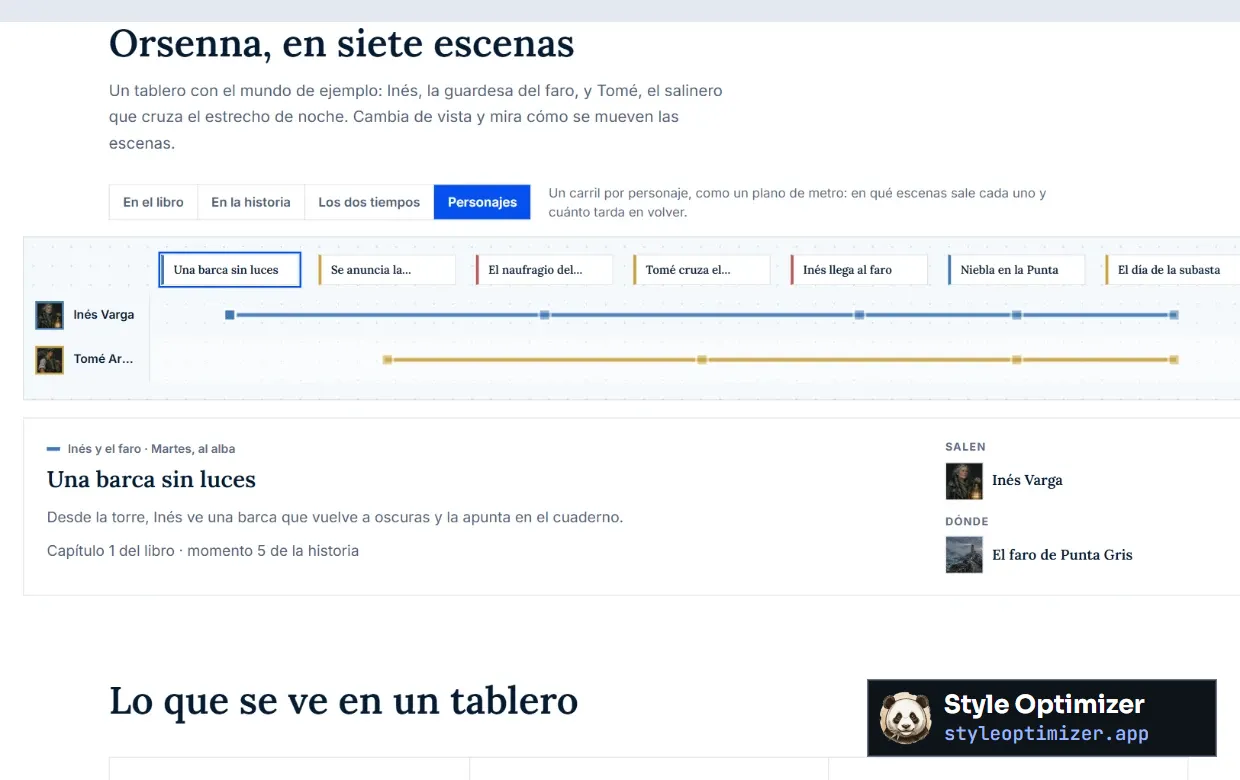
To check that the arc is spread well across the book, put it on your outline. In Threads, the scene board in Style Optimizer’s worldbuilding tools, the Characters view draws one lane per character with the scenes they appear in. Mark which scene holds each of the five moments: if all five pile up in the last third, the change will arrive all at once and the reader won’t buy it.
Character arcs in a novel with several protagonists
In an ensemble novel, each protagonist needs an arc of their own, and they work best when they cross. Inés learns to ask for help; Tomé, who lives by never committing to anyone, could learn to stay. The two arcs feed each other: one character’s crisis is the other’s opportunity. Secondary characters with weight can have a minimal arc of two or three scenes, and the rest stay as they are.
When you design the arcs, start from a profile with want, need and fear, like our character profile. The antagonist can have an arc too, and if they change at the last moment, the climax gains a layer.
Character arc: FAQ
What is a transformation arc?
It’s another name for the character arc, used mostly for the positive arc: the inner journey of a character who starts the story believing something false, faces events that test that belief and ends up changed. It rests on the internal conflict between what they want and what they need.
What’s the difference between internal and external conflict?
External conflict pits the character against something outside: another person, society, nature. Internal conflict pits them against themselves: a fear, a false belief, two desires that rule each other out. Good stories connect the two, so the outer obstacle forces the character to resolve the inner one.
Does every character in a novel need an arc?
The ones who matter do: the protagonist and, in many novels, the antagonist and one or two secondary characters. The rest work better without one, because change takes scenes and space. A character who appears three times and comes out transformed usually feels forced. For characters with little room, one sharp trait is enough.
How many types of character arcs are there?
The most widely used classification has three: positive, when the character overcomes their false belief; negative, when they sink into it; and flat, when they already know the truth and hold to it while the world changes around them. Within the negative arc, writers often distinguish corruption, fall and disillusionment.
When should a character change in a novel?
The change is decided at the climax, when the character chooses between want and need, but it’s prepared throughout the book. Plant small cracks from the start: doubts, gestures that contradict their belief, a scene where they almost act differently. That way the final change feels surprising and believable at once.