I Ching for Writers: From Hexagram to Scene
October 4, 2026 · Style Optimizer
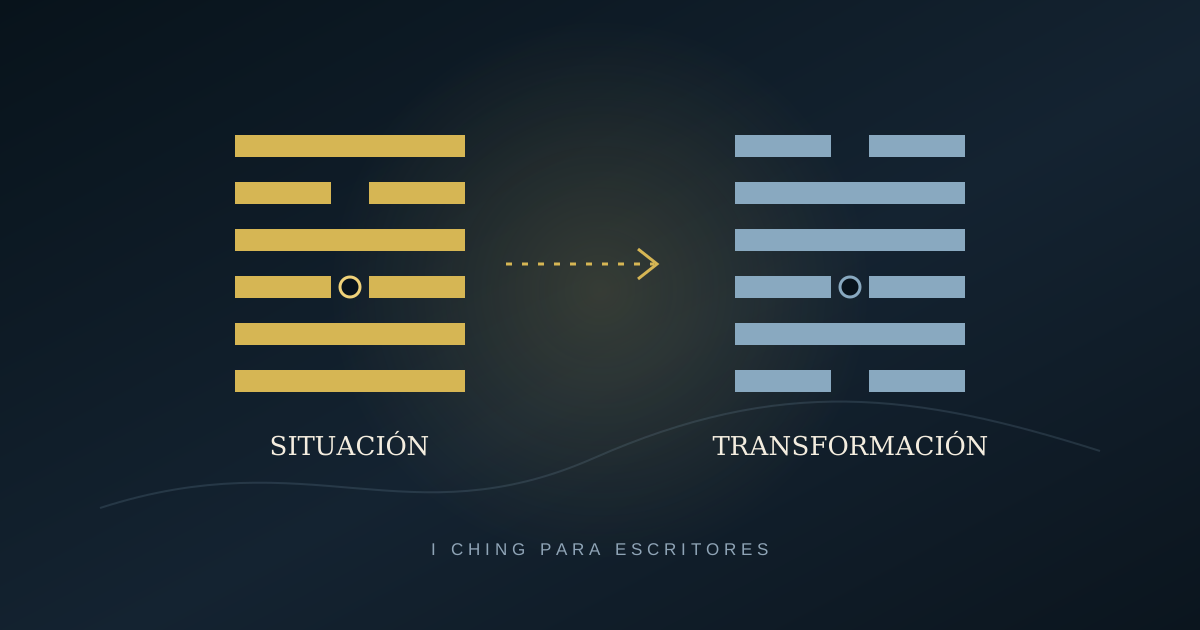
The I Ching for writing earns its place by describing a situation as a provisional balance: forces that advance, yield, wait or transform. The writer’s job is to turn that abstract relationship into a visible decision. Finishing the novel stays with you.
The primary hexagram speaks to the state of the scene. The changing lines show where that state can no longer hold. When they appear, the second hexagram lets you imagine the new relationship the conflict is moving toward.
Cast a hexagram and find its scene
Cast the coins and read your hexagram: free, no sign-up.
What you’re actually reading
A reading is built from six lines stacked from bottom to top. Each one is either yin (broken) or yang (solid). Together they form one of the 64 hexagrams. Some lines are changing lines: as they turn into their opposite, they produce a second sign.
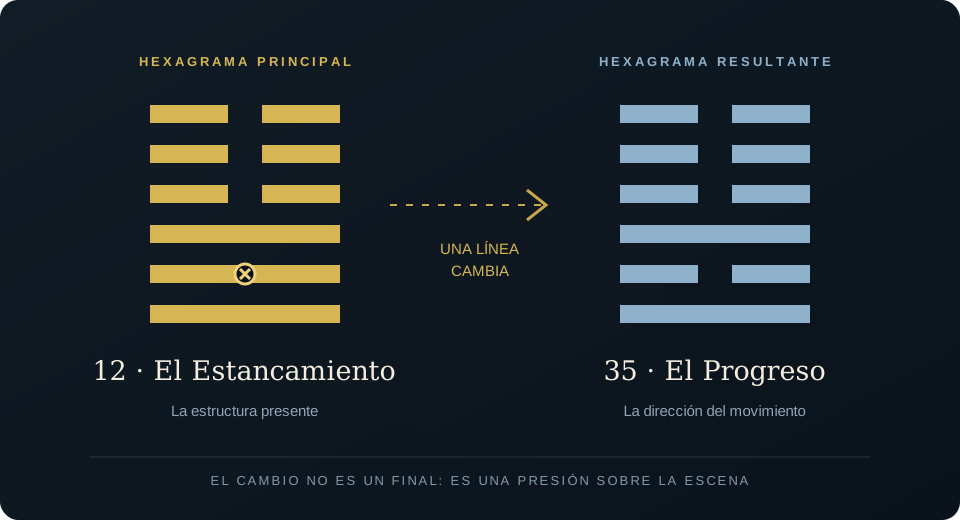
- Primary hexagram: the present configuration, whatever holds the situation together.
- Changing lines: the points where that configuration is under pressure to move.
- Resulting hexagram: the shape the relationship tends toward if the movement plays out.
Treat the second hexagram as pressure to change rather than a guaranteed ending. For a story, that reading is far more productive: it gives you a direction your characters can accept, resist or distort.
How to turn a hexagram into a scene
- Ask an open question. “What tension am I missing in this scene?” gives you far more to work with than “Should I kill off this character?”
- Sum up the present state. Translate the first hexagram into a relationship between two forces, and hold off on writing the solution.
- Locate the movement. If there are changing lines, ask which part of the balance can no longer continue.
- Assign the forces. Decide who pushes forward, who holds back, which institution weighs on them, or which object makes the conflict concrete.
- Write a decision. A scene turns when someone does something they can’t take back without consequences.
Useful questions for a narrative I Ching
The quality of your question shapes the kind of material you get back. These prompts look for dramatic relationships and leave orders and predictions aside:
- Which force dominates this scene, and which one stays hidden?
- What is my protagonist trying to preserve?
- Where is the change they still refuse to acknowledge?
- What decision would make the conflict irreversible?
- What has to give for an alternative to appear?
- How can this transformation show up through actions and objects?
An example: from standstill to release
Suppose the primary sign describes stagnation and the resulting one describes release. The quick translation would be “the problem will sort itself out.” That sentence holds no story.
In a scene, stagnation might take the shape of a family that has spent years upholding a false account of a disappearance. Release arrives when a daughter sells the house and finds, behind a partition wall, the thing that kept everyone bound to the pact. Nobody has to confess out of the blue: the change demands an action, distributes information and reshapes relationships.
The sign imposed a trajectory, from a frozen structure to its opening, and the writer decided which people and events could embody it. The scene itself is the writer’s work.
What to do when there are no changing lines
A stable hexagram still has plenty to say. It may suggest the scene needs to show its current state clearly before you trigger a turn. Ask what behavior keeps that balance in place, who benefits from it, and what it would cost to maintain it for another chapter.
It can also be an invitation to change scale. If the main plot shows no movement, look at a conversation, a gesture or a secondary decision. Stability may be precisely the pressure your character is pushing against.
The I Ching, chance and creative block
Chance becomes useful when you keep reaching for the same solution, or when you try to weigh every possibility before drafting a single one. An outside figure narrows your options for a moment and lets you react. You can reject it afterward: explaining why it doesn’t fit also reveals what the text needs.
The article esoteric techniques for writer’s block compares this tool with Tarot, bibliomancy and automatic writing. This guide focuses on the specific structure of change.
From a general reading to your manuscript
The free reading gives you a structural interpretation at no cost. In the online I Ching you can explore all 64 hexagrams; with an account, Style Optimizer can relate the sign to the conflict and characters of a text you choose to share.
The public reading uses no artificial intelligence, consumes no credits and doesn’t store your question. It’s a way to try out the mechanism before working with context.
Frequently asked questions
How do you read an I Ching hexagram?
Start with the primary sign and its overall image. Then read the changing lines, if there are any, and connect the result to the second hexagram as a transition rather than an inevitable outcome.
What do changing lines mean?
They are yin or yang lines in the process of turning into their opposite. They mark the active points of the reading and let you build the resulting hexagram.
What can I ask to get a story unstuck?
Ask about tensions, decisions and changes: what the character can’t see, what they’re trying to hold on to, or what action would transform the current relationship.
Does the free tool use artificial intelligence?
No. It generates the lines locally and looks them up in a fixed table of 64 hexagrams. Your question is never sent or stored.