Writing Style: What It Is and How to Find Yours
November 21, 2026 · Equipo Style Optimizer
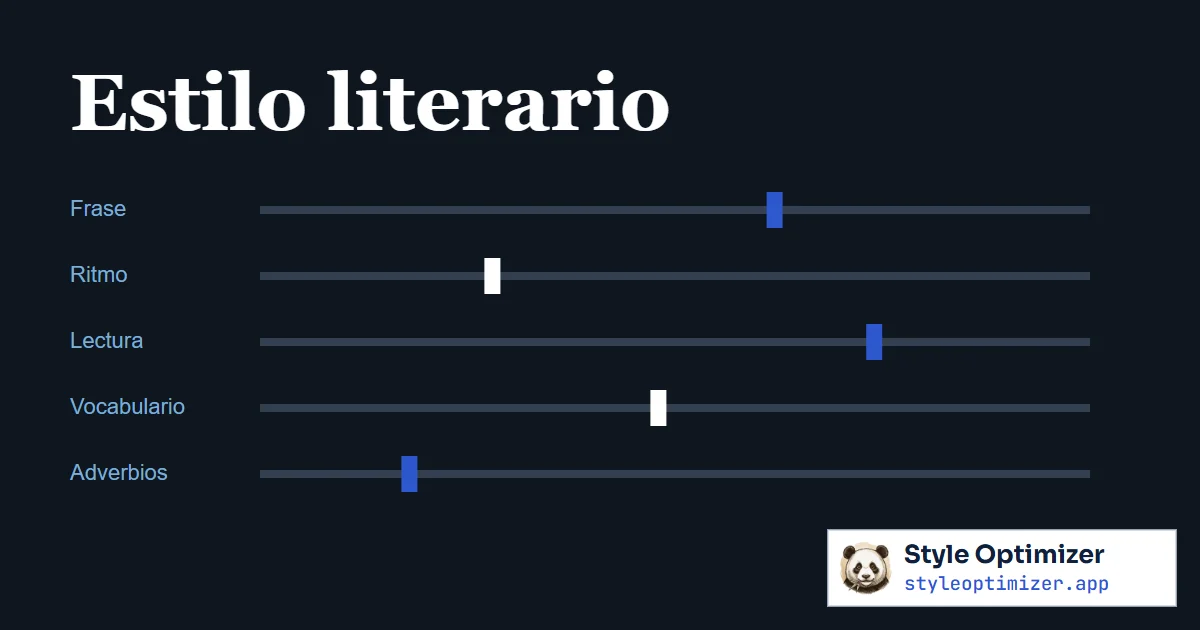
Writing style is the particular way an author uses language: the sentences they build, the words they choose, the rhythm they look for and what they leave unsaid. Two writers can tell the same story and be unrecognizable from each other because of style. Part of a style can be measured, and here you’ll find how to do it with your own text.
The traits that make up a writing style
- The sentence. Its average length, how much it varies and how sentences link together. Our guide to sentence rhythm goes deeper.
- The vocabulary. Formal or everyday, abstract or concrete, varied or recurring. The balance of concrete and abstract words is one of the clearest signals.
- Modifiers. How many adjectives and adverbs the writer uses and what work they give them. There’s more in our guide to -ly adverbs.
- Figures of speech. The metaphors, repetitions and other rhetorical devices that show up often.
- Distance. How close the narrator stands to what they tell, and the tone they tell it in.
- Punctuation. A writer of long, comma-laden sentences and one of short, flat periods sound different even when they tell the same thing.
Style and voice: how they differ
Style is what you can observe: it can be described and measured, and it changes from book to book. Voice is the overall impression an author leaves, the thing that lets you recognize a page of theirs without seeing the name. Working on style consciously is the most practical path toward a voice of your own.
Examples of style in literature
| Trait | Writers who take it far | What it achieves |
|---|---|---|
| Short, precise sentences | Hemingway, Raymond Carver, Joan Didion | Clarity, speed and a great deal left unsaid |
| Very long sentences | Henry James, Virginia Woolf, William Faulkner | Thought in motion and an enveloping effect |
| Spoken language | Mark Twain in Huckleberry Finn, J. D. Salinger | Closeness and a character present in every sentence |
| Lush and ornate | Vladimir Nabokov, Cormac McCarthy, Angela Carter | Density, music and a sensory world |
| Spare and even | Franz Kafka in translation, Kazuo Ishiguro | Unease: the strange told without a change of tone |
No style is better in the abstract. The useful question is whether yours serves what you’re telling.
Direct, indirect and free indirect speech
Style also covers how a narrator reproduces a character’s words and thoughts. There are three ways:
- Direct speech: the words as spoken. “I’m not going back,” she said. We explain the punctuation in how to write dialogue.
- Indirect speech: the narrator reports it in their own words. She said she wasn’t going back.
- Free indirect speech: the narrator’s voice and the character’s blend without markers. She wasn’t going back. Why would she, at this point?
Jane Austen made the last one a staple of the English novel, and choosing it depends on your type of narrator.
How to find your writing style
- Write a lot before you analyze. Style shows up with volume. Creative writing exercises and automatic writing help you produce it without self-censorship.
- Copy out the writers you admire. Two pages copied by hand teach you more about an author’s rhythm than an essay about their work.
- Imitate on purpose, then mix. Write one scene the way a spare writer would and another the way an ornate one would. Notice which one leaves you freer.
- Measure three of your texts. Run three pages from different moments through the sentence length checker. Whatever repeats is your style; whatever varies depends on the text.
- Choose what to keep. Some habits are your signature and others are tics. Repeated words and filler words nearly always belong to the second group.
Editing your style without losing your voice
A spell checker tells you what’s wrong according to the rules. A style analysis shows you decisions you can keep or change. That’s why each number works best as a question: if your novel runs to 30-word sentences, did you decide that or did it get away from you? Readability works the same way: a low score is a problem in a leaflet and can be a strength in a demanding novel.
The sentence length checker measures sentence length, rhythm, readability, how your sentences begin and which words come back most, all in your browser. In your account, Style Optimizer’s style analysis also flags clichés, filler words and weak constructions in English and Spanish texts.
Frequently asked questions about writing style
What is style in literature?
The set of traits with which an author, a work or a period uses language. We speak of Dickens’s style, the style of The Great Gatsby or the style of the Gothic novel.
What are the types of writing style?
It depends on the criterion. By purpose, writing is usually divided into narrative, descriptive, expository and persuasive. By form, people speak of plain, concise, ornate or conversational styles. Academic manuals also use “style” for citation rules such as APA or MLA, which are a different thing.
Can you change your style?
Yes, especially in its conscious parts: sentence length, use of modifiers and narrative distance all change with practice. Many writers adapt their style to each book and are still recognizable.
What is prose?
Writing in continuous lines and paragraphs, without the measure or fixed rhythm of verse. Most novels, short stories and essays are written in prose. If you write in verse, our guides to free verse and enjambment are a good place to start.