Beta Readers: Where to Find Them and What to Ask Them
November 21, 2026 · Equipo Style Optimizer
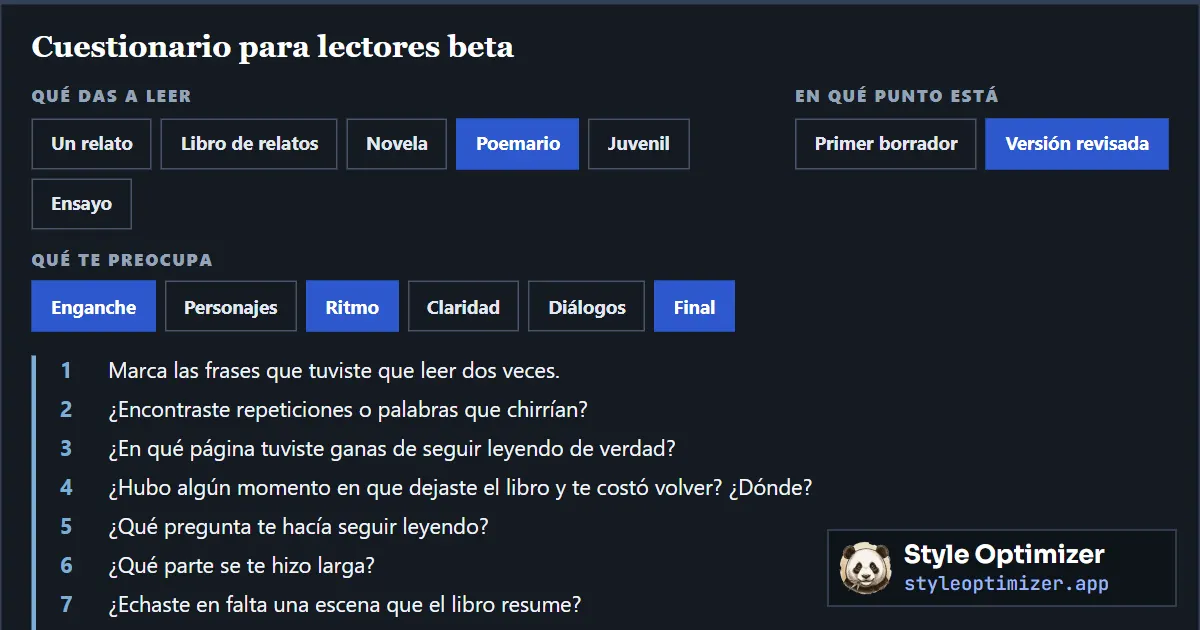
A beta reader reads the revised version of your manuscript the way your future audience would and tells you what the experience was like: where they got hooked, where they got lost, what they expected from the ending. If you’re still on your first draft, what you need is an alpha reader, which we cover in alpha readers vs. beta readers. This guide picks up from there: where to find beta readers, how to ask them and what to ask.
Where to find beta readers
- In a writing group. This is the most reliable source, because the reading goes both ways. Groups that take turns, with a different member reading and commenting each week, keep the feedback coming.
- Through a swap. Read another writer’s manuscript in exchange for a read of yours. It works best with texts of similar length and an agreed deadline.
- Among readers of your genre. A book club, a library reading group or a mystery forum gives you readers who know the conventions of the genre.
- Among people who already read you. If you share your work online, the people who leave thoughtful comments are natural candidates. Send them a private message.
- In a workshop. Classmates already know how you write. Our guide to the online writing workshop explains what to look for in one.
How many beta readers, and when
Three to five per round. With only one, you can’t tell a personal taste from a problem in the text; with more than five, the answers start to repeat. Run two rounds if you can: the first with your revised draft and the second, with new readers, after you’ve made changes. Give them three or four weeks for a novel and one week for a short story or a poetry collection.
How to ask
A short message with the essentials prevents misunderstandings:
Hi Sarah, I’ve just finished revising my novel, a small-town mystery of about 70,000 words. Would you like to read it as a beta reader? I can send the file in whatever format you prefer, along with about ten questions, and three weeks would be plenty. And of course I’m happy to read your work whenever you like.
State the genre and length, the deadline and what you offer in return. If the person says no, thank them anyway: they may read for you next time.
The questions to send your beta readers
Open questions get vague answers. Decide what you’re handing over and what worries you, pick eight to twelve questions from the lists below, number them and send them with the manuscript or paste them into a message.
Hook
- On what page did you decide to keep reading? Was there a point where you nearly stopped?
- After the first chapter, what did you think the book was about?
Characters
- Which character will you remember a week from now, and why?
- Was there a moment when a character did something you didn’t believe?
Pacing
- Mark any chapter or scene that felt long. Where did you start skimming?
- Where could you not put the book down?
Clarity
- Was there anything you didn’t understand, or a name you kept mixing up?
- Did you ever lose track of where or when a scene was happening?
Dialogue
- Did any conversation sound stiff or unnatural?
- Could you tell who was speaking without the tags?
Ending
- What did you expect to happen before you reached the ending?
- Did the ending feel earned? Was any question left open that bothered you?
Ask them, too, to mark the margin wherever they got bored and wherever they couldn’t stop.
What to do with the answers
| What you see | What to do |
|---|---|
| Two or more readers flag the same passage | Fix it: the problem is in the text. |
| A single reader flags something specific | Reread the passage with their comment in front of you, then decide. |
| A reader suggests how to fix it | Keep the symptom; the solution is yours to choose. |
| An opinion about style or genre | Weigh it against what you set out to write: your voice comes first. |
Beta readers for short stories and poems
With a short story, ask in which sentence they understood what it was about and which image stayed with them. With a poetry collection, ask which poem they would read aloud and at which line they got lost. For short pieces, a group that takes turns reading each week gives you a steady supply of readers.
Before you send the manuscript
With readers you trust, the risk is minimal. In the US and the UK, copyright protects your work from the moment you write it; keep dated versions of your files, and in the US you can register the finished book with the Copyright Office if you want formal proof. Once your beta readers stop finding problems, the next step is deciding how to publish: submitting your manuscript to a publisher or self-publishing your book.
Beta readers: FAQ
What is a beta reader?
Someone who reads the revised version of a text before it’s published and reports on their experience as a reader. That reading experience is what they bring.
Do you have to pay beta readers?
The usual arrangement is a swap: you read their work and they read yours. There are also paid manuscript critique services.
How many beta readers do I need?
Three to five per round. When two of them agree on a problem, you can trust it.
Where can I find beta readers online?
In writing groups, online workshops, book clubs and writing communities, especially ones built around your genre. People who already comment on your work are a good place to start.
What’s the difference between a beta reader and an alpha reader?
The alpha reader reads the first draft; the beta reader reads the revised version. We go into detail in our post on alpha readers.