Tarot for Creative Writing: 7 Spreads for Storytellers
October 4, 2026 · Style Optimizer
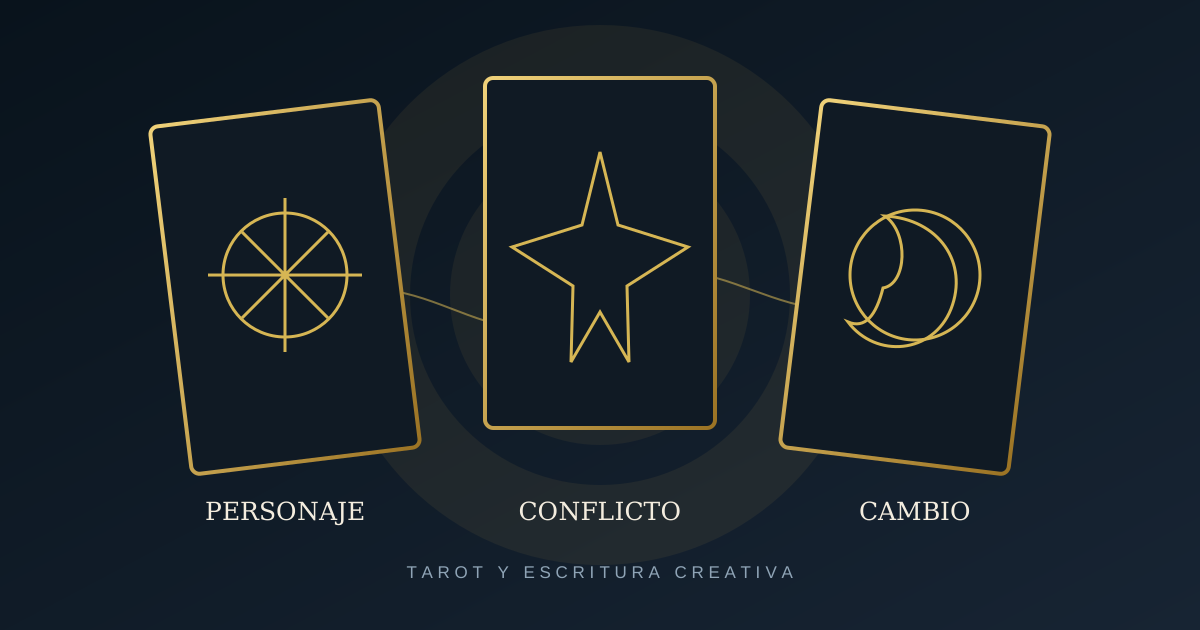
Tarot and creative writing share the same raw material: images that hold more than one reading. A card offers a force (desire, rupture, waiting, dominance, loss) and leaves the writer to decide who embodies it, what it collides with and what consequences it produces. The plot is yours to build.
Using Tarot to write only requires treating the cards as narrative constraints; whether they predict anything is beside the point. Instead of asking “What’s going to happen?”, ask “What would have to happen for this image to be true inside my story?”
Try a draw for character, conflict and change
Draw a free card and turn it into a prompt for your story.
How to turn a card into story material
The most common mistake is translating the meaning literally. If The Tower turns up, the thing that falls could be a reputation, an alibi or a character’s idea of their own family just as easily as a building. The arcanum offers a relationship; the scene has to make it concrete.
- Name the force. Boil the card down to a verb or a tension: to burst in, to hide, to dominate, to abandon, to rebuild.
- Give it a body. Decide which character, institution or object carries that force.
- Add resistance. An image without opposition describes a state; with opposition, it produces conflict.
- Demand a visible action. Swap “she feels everything crumbling” for something that can happen in a room.
- Keep only what’s fertile. The card is a trigger; you’re free to drop any symbol that doesn’t serve the story.
Seven Tarot spreads for writers
1. Character, mask and need
The first card describes what the character shows; the second, what they try to hide; the third, what they need to learn even if they don’t want to yet. This spread keeps you away from character sheets made only of adjectives.
2. Desire, obstacle and price
Define a concrete goal, what stands in its way and what the protagonist will have to lose to move forward. The price keeps the resolution from coming too cheaply.
3. Protagonist, antagonist and bond
The third card explains what the adversaries share and leaves the question of who wins open. A strong bond lets the antagonism become more than a mechanical opposition.
4. Before, disruption and after
Use it to build a scene. The first card sets the initial balance; the second introduces the event that breaks it; the third shows the new situation, which may or may not be a resolution.
5. Secret, clue and reveal
Turn each arcanum into a piece of distributed information. Readers should be able to reinterpret the clue once they learn the secret.
6. Place, threat and rule
A quick way to create a story space. The rule states what behavior the place demands and what happens when someone breaks it.
7. Expected ending, rupture and true ending
First write the ending that seemed inevitable. The second card introduces a decision or a discovery; the third forces you to imagine a close that keeps every earlier consequence intact.
The Major Arcana as shifting roles
The Emperor can be anyone who imposes order, and The Hermit anyone who chooses to withdraw, crown and beard optional. The cards work best as mobile positions: ordering versus improvising, withdrawing versus intervening, preserving versus transforming. The same character can start under The Chariot and end under The Hanged Man.
This also keeps you from duplicating a general theory of character. If you want to tell function, personality and arc apart, see the guide to character archetypes. Here, Tarot acts as a mechanism for combination and surprise.
An example: The High Priestess, The Tower and The Star
As a character, The High Priestess suggests someone who guards a piece of knowledge and has made silence part of her identity. The Tower brings a public revelation that makes further concealment impossible. The Star leaves room for many endings: it might ask her to share that knowledge and accept a kind of exposure she used to fear.
The concrete scene could take place at a conference. A researcher discovers that someone has published, as their own, the archive she kept hidden to protect another person. She has to choose between exposing the theft, which also reveals the secret, and keeping quiet and losing control of the story.
When to use one card and when to use several
One card works for opening up an image or making a single decision. Three cards let you build a relationship. A larger spread pays off when each position answers a different question; if every position roughly means “what happens next,” it only adds noise.
With online Tarot for writers you can draw an arcanum for free and, with an account, get a narrative reading tied to your manuscript. The public tool doesn’t store your question or use artificial intelligence.
To compare this method with other forms of controlled chance, read esoteric techniques for writer’s block.
Frequently asked questions
Do I need to know Tarot to use it for writing?
No. Start with the Major Arcana and one narrative question per position. The image, the name and a few associations are enough to give you a useful constraint.
Which spread works best for creating a character?
Try three cards: mask, desire and need. Then turn each result into observable behavior and check where they contradict each other.
Can Tarot write a story for me?
It combines symbols and opens possibilities, while causality, voice and detail remain your decisions. The writing starts precisely when you justify the relationship between the cards.
Does the free draw use AI?
No. It shuffles a fixed list of arcana in your browser. It never sends or stores a manuscript.