How to Create a Fantasy World: A Step-by-Step Guide
November 21, 2026 · Equipo Style Optimizer
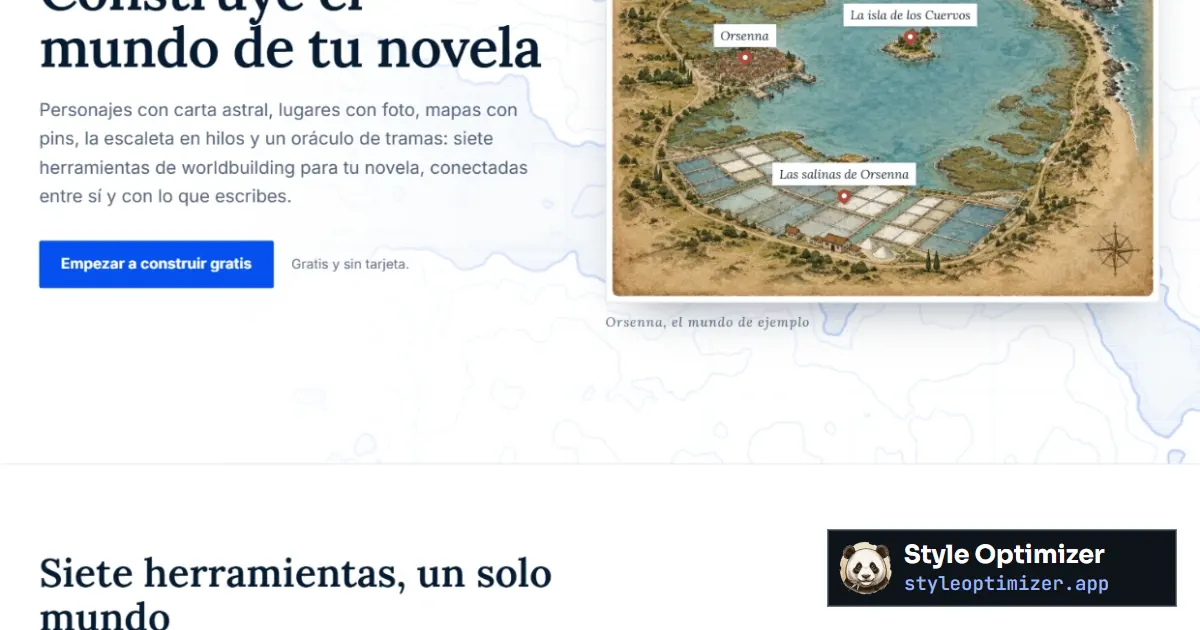
To create a fantasy world, start with the story you want to tell and build only what that story touches: the land, who holds power, how people make a living, what they believe, what magic costs and what happened before. Every answer should be able to turn into a scene. Below you’ll find twelve questions to get you started and a step-by-step guide built around a sample world.
Twelve questions to build your fantasy world
Ask yourself who rules, what is scarce, what people take for granted, what magic costs, where the border lies and what everyone remembers wrong. Answer each in a sentence or two, with proper names. “Water is scarce” gives you little to work with; “The well in the square belongs to the bishop, and you pay by the bucket” already has a scene inside it. If you want the definition of the term and the case for keeping a world bible, read worldbuilding: where to start.
How to create a fantasy world, step by step
The steps follow the order in which one thing explains the next. The land decides what grows, what grows decides who gets rich, and whoever gets rich decides what people believe in public. To see it in action, we’ll use a kingdom invented for this guide, Ember: a volcanic plateau where magic is paid for with memories.
1. From story to world
Write your novel’s central conflict in one sentence and underline the nouns. For Ember: “An archivist discovers that the king has used magic to erase all memory of a lost war.” Now you know what you need to invent: an archive, a court, a war and a magic that erases. The rest of the world can wait until the story asks for it.
2. Geography: the land is in charge
Settle three physical facts before you draw anything: the climate, the water and whatever separates one people from another (mountains, sea, desert). Rivers rise in the highlands and run to the sea, cities grow beside water, and mountain passes turn into customs posts. In Ember, the volcanic soil is fertile but it shakes. Houses are low, the archives are carved into rock, and every earthquake reopens an old quarrel over who has to rebuild.
3. Power: who rules, and why people allow it
All power rests on something: force, law, blood, money or faith. Choose the main support and a secondary one that might fail. Ember’s king rules because he controls the memory mages and because the people remember a long peace. If that peace turns out to be invented, the support breaks, and that’s your novel.
4. Economy: what is scarce
Ask what’s missing and who controls it. Scarcity creates trade routes, smuggling, taxes and wars. In Ember, salt is scarce. It arrives through a single mountain pass, and the family that collects the toll holds more real power than many nobles. One well-chosen scarce good hands you a trade for a character, a possible villain and a reason to travel, all at once.
5. Beliefs: what people take for granted
A full pantheon is less useful than knowing what ordinary people believe without thinking: what brings bad luck, how the dead are sent off, what counts as shameful. In Ember, the dead are buried with an object they were always forgetting, so they won’t come back looking for it. A detail like that defines a culture in a single line of dialogue.
Magic systems: cost before power
A magic system holds tension when readers know what it costs to use. Brandon Sanderson put it in his Second Law: a magic system’s limitations are more interesting than its powers. In Mistborn, Allomancers burn metals they’ve swallowed, and with no metal there’s no power. In Earthsea, Ursula K. Le Guin ties magic to the true names of things and to the Equilibrium of the world, and every spell has consequences.
Pick at least one of these four prices and write it into your world notes:
- A physical price: exhaustion, pain, years of life, a material that runs out.
- A social price: mages are feared, watched or owned by the crown.
- A price in knowledge: it takes study, a language or a name few people know.
- A personal price: in Ember, every spell erases one of the mage’s own memories, and old mages no longer recognize their children.
Decide, too, what magic can never do. That limit is what forces your characters to find another way out at the climax.
6. History: what happened, and what people say happened
Three or four past events that still weigh on the present are enough: a war, a founding, a disaster, a betrayal. For each one, write two versions: the one that gets taught and the one that took place. The gap between them is a source of conflict you can reveal bit by bit across the novel.
7. Places: a few, each with character
Most novels move among a handful of settings. Give each one a purpose, a smell and a secret. The archive in Ember smells of sulfur and candle wax, and it has a room that appears on no floor plan. Place names tell their own history, so make each people’s names sound distinct.
8. The map comes last
Drawing the map first locks in distances before you know which journeys the story needs. Draw it once you know the important routes and how long they take. On foot, people cover roughly 15 to 20 miles (25–30 km) a day, and a map that respects that keeps the city that was three days away in chapter two from sitting one day away in chapter twenty. If your story leaves the kingdom and heads for space, the next step is how to create a fictional planet with believable physics.
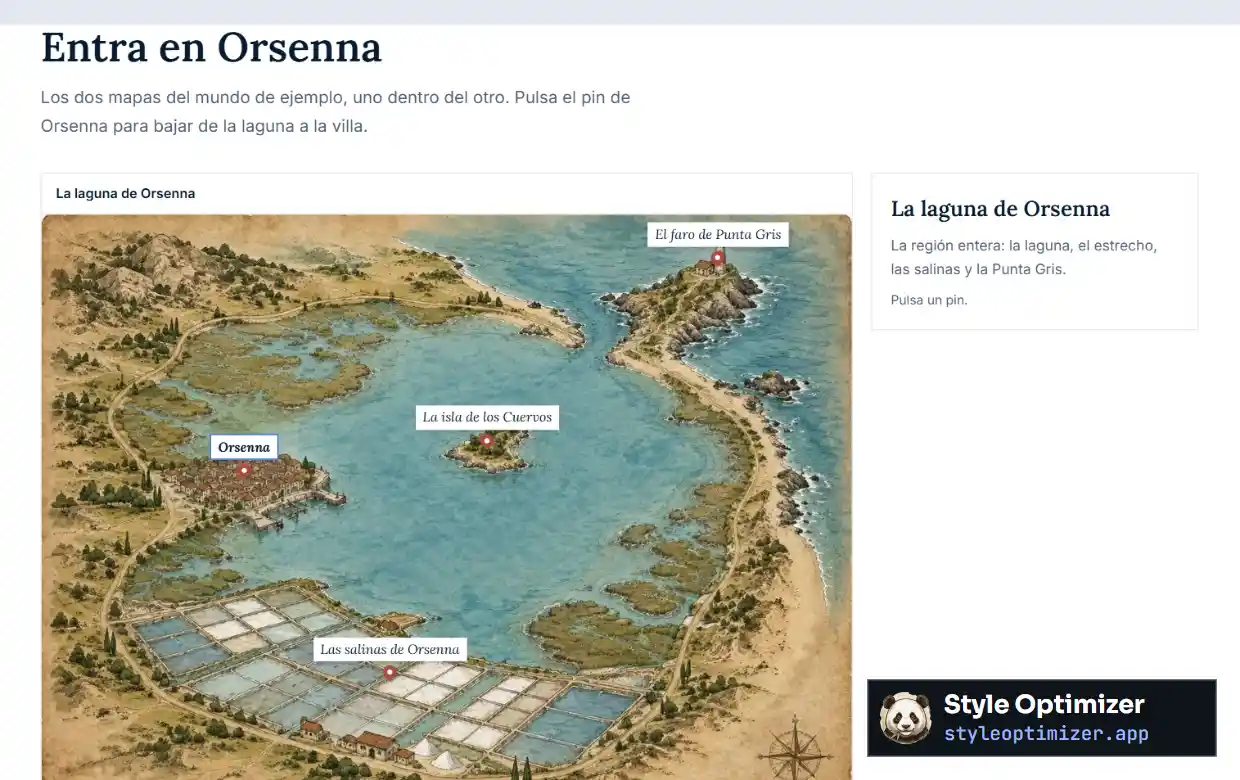
With Style Optimizer’s maps, you upload your map, real or hand-drawn, and pin your places onto it. Each pin opens its profile or a smaller map: from the lagoon to the town, from the town to the square.
How to bring your world into scenes without an infodump
The world reaches readers through what characters do, want and fear. Three pages on the history of the kingdom is an infodump, and there are concrete fixes:
- Give the fact when a character needs it. Readers learn how the salt toll works when the heroine can’t pay it.
- Show the rule broken. A mage who can no longer remember his daughter’s name explains the cost of magic better than a chapter of theory.
- Let characters take things for granted. Two Ember neighbors argue over the price of a burial without explaining the rite, and readers piece it together.
- Spread it out. One new fact per scene, and only if it moves something.
You’ll find more techniques and examples in what an infodump is and how to avoid it. And to make a landscape visible without explaining it, see how to describe a setting.
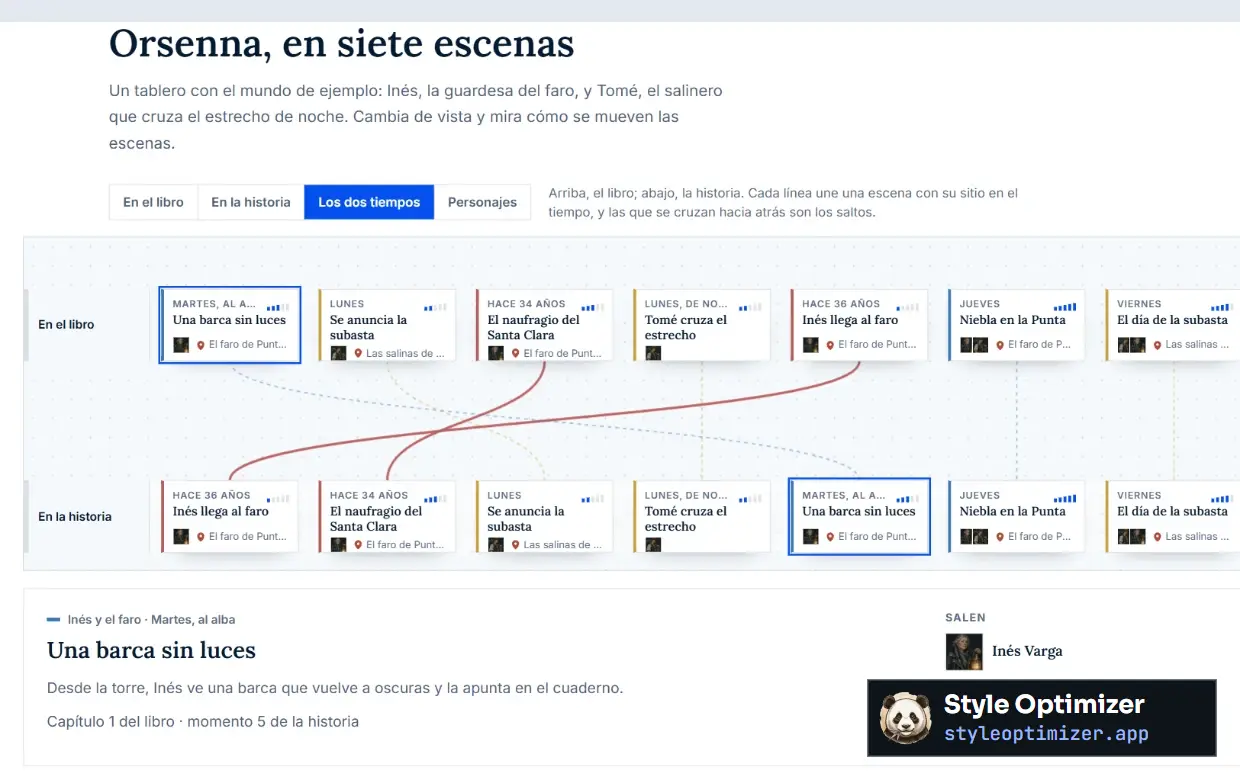
To decide which scene reveals each piece of the past, Style Optimizer’s outline board lays your scenes out on two lines: the order readers meet them and the order in which they happened. The lines that cross backward are your reveals.
Your fantasy world in Style Optimizer
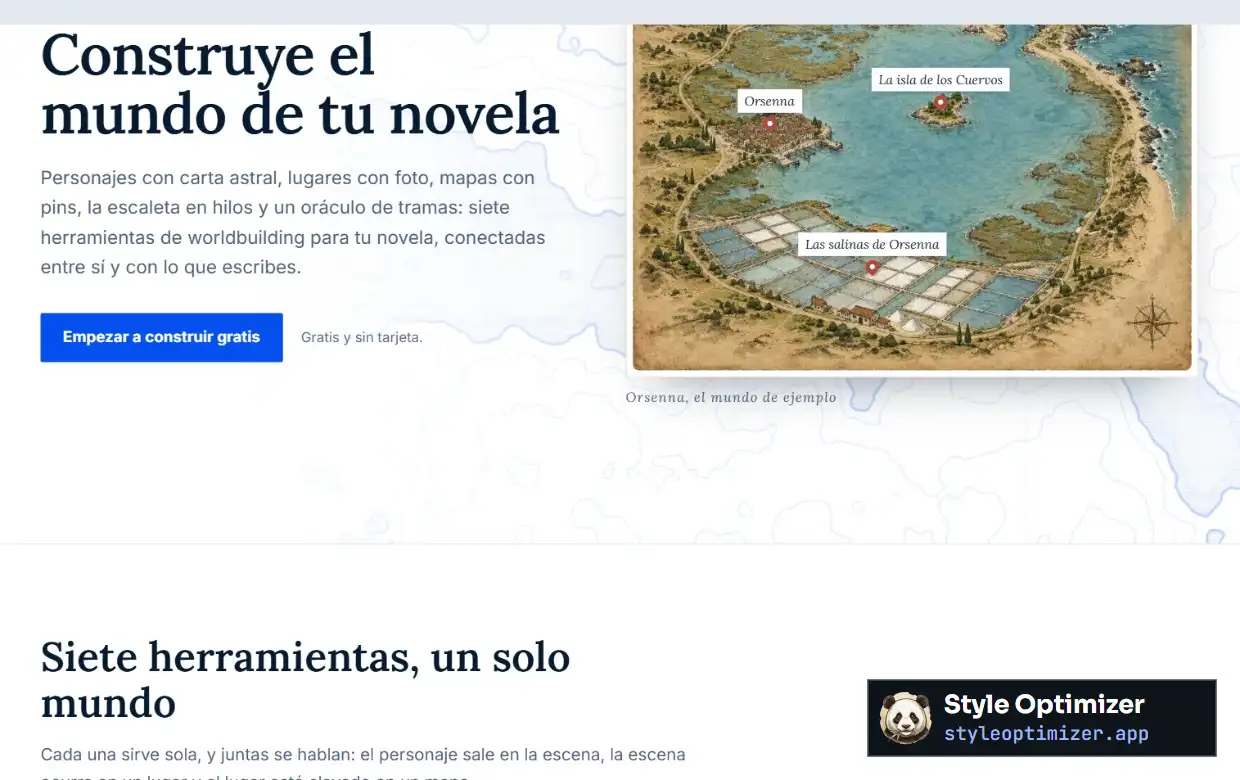
The Fiction section of Style Optimizer comes with a sample world, Orsenna, so you can see how the pieces fit: Inés Varga, keeper of the Punta Gris lighthouse; Tomé Arrieta, the salt maker; the lagoon, the salt pans and the town. Orsenna is built the way this guide recommends. Salt is what’s scarce, the auction of a salt pan shifts the balance of power, and a shipwreck weighs on everyone.
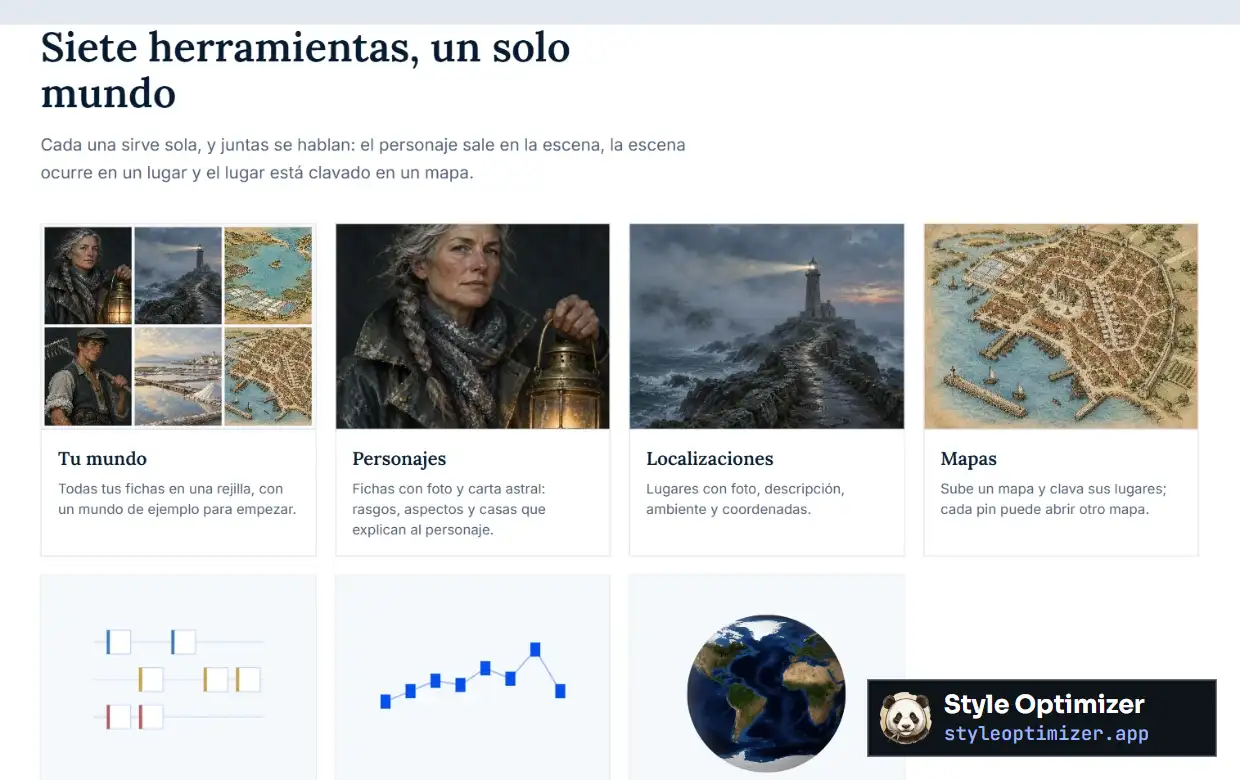
Each step has its tool: character profiles for the people who live in your world, Locations for place profiles, Maps and Globe for the terrain, the outline board for your scenes and plot prompts when you’re hunting for a story. The free plan includes 5 characters, 20 places, 3 maps and 1 globe.
FAQ: how to create a fantasy world
Where do I start building a fantasy world if I only have a vague idea?
Write one sentence: who wants what, and what stands in the way. Then answer only the world questions that sentence needs. If there’s a journey, work out geography and distances; if there’s a conspiracy, work out who rules and why. You’ll discover the rest as you write the first scenes, and you can note it down as it appears.
How do I make a magic system that doesn’t break the story?
Define the cost and the limit first, then the power. The cost can be physical, social, intellectual or personal, and the limit marks what magic can never do. When readers know both, they’ll accept magic solving small problems and understand why, at the climax, the characters have to find another way out.
How much time should I spend on worldbuilding before I start writing?
Enough to write the first scene without contradicting yourself. Many authors alternate: they write until they need a fact, invent it, note it in their world file and keep going. That way the world grows at the pace of the novel, and every piece is born with a scene that justifies it.
Do I need a map to write a fantasy novel?
It helps as soon as you have journeys, wars or several cities, because it fixes distances and prevents contradictions. A hand sketch is fine, as long as it respects how long it takes to get from one point to another. If you upload it to a tool with pins, each place links to its profile and you can check it while you write.
Which fantasy novels are good examples of worldbuilding?
Ursula K. Le Guin’s Earthsea shows magic with rules and consequences. Brandon Sanderson’s Mistborn offers a magic system with a material cost. Laura Gallego’s Memorias de Idhún builds a world with three suns and three moons. And Michael Ende’s The Neverending Story gives you a world threatened by the Nothing.