How to Write Dialogue: Punctuation, Tags and Subtext
November 21, 2026 · Equipo Style Optimizer
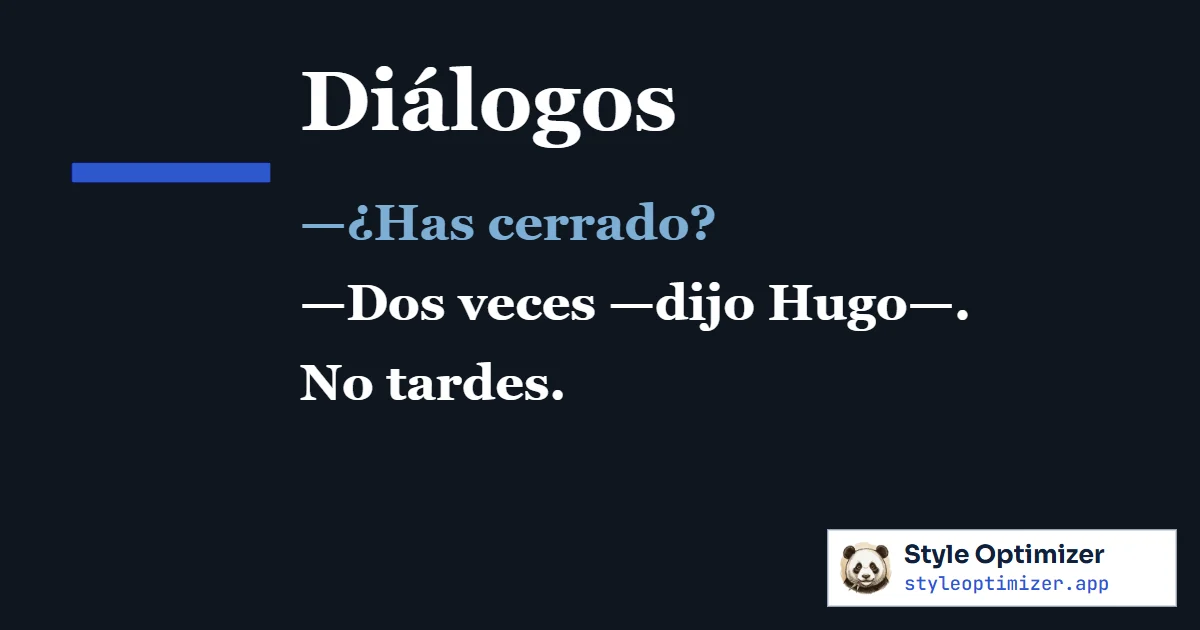
In English, dialogue goes inside quotation marks, each new speaker gets a new paragraph, and the punctuation that ends a line of speech sits inside the closing quote. Those three rules cover most of what you need. Below you’ll find the full set, the mistakes editors see most often and the craft that makes characters sound like people.
How to punctuate dialogue: seven rules
1. Each speaker gets a new paragraph
Every time the speaker changes, start a new line, even when the reply is a single word.
“Did you lock the door?”
“Twice.”
2. Punctuation goes inside the quotation marks
Commas, periods, question marks and exclamation points that belong to the speech go before the closing quote. American usage puts commas and periods inside every time; British usage often uses single quotes and is stricter about logic, but in fiction both keep the speech punctuation inside.
“Twice,” said Hugh.
3. A dialogue tag takes a comma and a lowercase letter
When a line is followed by said, asked or another speaking verb, end the speech with a comma, not a period, and keep the tag in lowercase. A question mark or exclamation point replaces the comma, and the tag still stays lowercase.
“Twice?” asked Martha.
4. An action beat is its own sentence
If what follows is an action and not a way of speaking, close the speech with a period and start a new sentence with a capital letter.
“Twice.” Hugh dropped the keys on the table.
5. A tag in the middle of a sentence takes commas on both sides
When the tag interrupts a sentence that continues, use a comma after the tag and keep the second part in lowercase. When the first part was a complete sentence, end the tag with a period and capitalize what follows.
“If you come,” she added, “I’ll wait downstairs.”
“I don’t know,” said Hugh. “We’ll look at it tomorrow.”
6. Interruptions take a dash, trailing off takes an ellipsis
A speaker who is cut off ends with an em dash inside the quotes. A speaker whose voice fades ends with an ellipsis.
“I was going to tell you—”
“Don’t.”
“I thought maybe…”
7. A long speech over several paragraphs
Leave the closing quotation mark off every paragraph except the last, and open each new paragraph with a quotation mark. That tells the reader the same person is still talking.
The most common mistakes at a glance
| Written wrong | Written right | Why |
|---|---|---|
| “Hello.” she said. | “Hello,” she said. | A tag needs a comma before it, not a period. |
| “Are you coming?” She asked. | “Are you coming?” she asked. | The tag stays lowercase after a question mark. |
| “Hello”, she said. | “Hello,” she said. | In fiction the comma goes inside the quotes. |
| “Hello,” she smiled. | “Hello.” She smiled. | You can’t smile a word: that’s an action beat. |
| “No,” he said, “Come in.” | “No,” he said. “Come in.” | “No” was a complete sentence, so the tag ends with a period. |
| Two speakers in one paragraph | A new paragraph for each | Otherwise the reader loses track of who is talking. |
Thoughts and quoted speech
Thoughts usually go in italics with no quotation marks, or with no marking at all when the narration is close to the character:
He isn’t coming back this time, Martha thought.
With a first-person narrator or a close third person, the line between narration and thought can disappear entirely, and that’s often the most natural choice. When a character quotes someone else inside their own speech, use single quotes inside double ones (or the reverse in British style).
What makes dialogue work
With the punctuation settled, the hard part is left. These are the problems that come up most often and how to fix them.
Every exchange has to change something
Cut the greetings, the goodbyes and the “how are you?” unless they reveal something about the characters. Enter the scene as late as you can and leave it as soon as the conflict has shifted.
People rarely say what they mean
Compare two versions of the same scene:
“I’m really upset because you forgot our anniversary.”
“I’m so sorry, I’ve had a lot of work.”
“I threw out the dinner.”
“There was dinner?”
“Not anymore.”
The second version gives the reader the same information and leaves them the pleasure of working it out.
Keep the characters from briefing the reader
“As you know, John, we’ve been married for ten years” is an infodump in quotation marks. If both characters already know it, neither would say it. Let someone who doesn’t know find it out, or slip it into an argument: “Ten years, and you still leave the cap off.”
Make the voices distinct
Cover the tags and read only the speech. If you can’t tell who’s talking, work on vocabulary, sentence length and the subjects each character avoids. A verbal tic helps characterize someone when only one character has it; our guide to filler words shows which ones to keep out of the narration.
Use “said” freely and add action
“Said” is nearly invisible, while “retorted,” “queried” or “expostulated” draw attention to the author. Instead of loading the verb or propping it up with an -ly adverb, give the character something to do:
“I don’t care,” she said, and went on folding the same shirt.
We go deeper into this in our guide to dialogue tags.
Read it out loud
It’s the cheapest test there is. Wherever you stumble or wince, the dialogue isn’t working.
Frequently asked questions about writing dialogue
Do you put a comma or a period before “she said”?
A comma: “I’m leaving,” she said. A period only goes there when what follows is an action rather than a speaking verb: “I’m leaving.” She picked up her coat.
Single or double quotation marks?
American publishers use double quotation marks, with single ones for a quote inside a quote. Many British publishers do the reverse. Pick one and stay consistent; if your book goes to a publisher, their house style will decide.
How do you write dialogue in a children’s story?
With the same rules. Keep the tags short and make it clear who is speaking in every exchange, because young readers lose track easily when replies come one after another. There’s more in how to write a children’s story.
What’s the difference between dialogue and monologue?
In dialogue, two or more characters respond to each other. In a monologue, one character speaks alone, to themselves or to someone who doesn’t answer.