Flash Fiction: What It Is, How to Write It, and Examples
November 21, 2026 · Equipo Style Optimizer
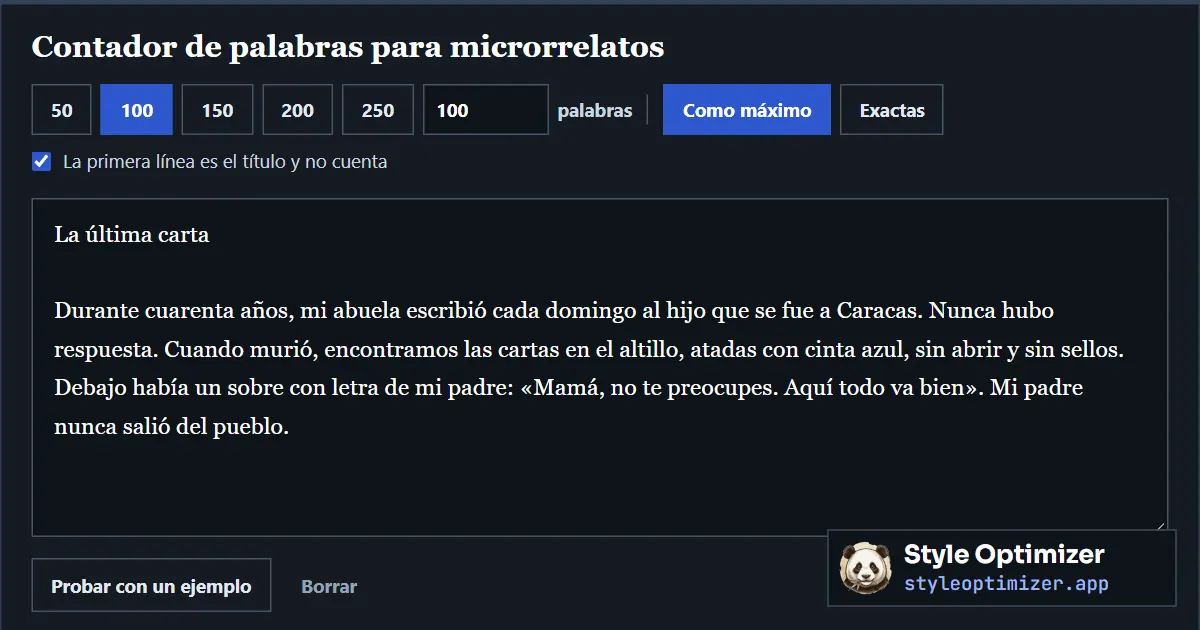
Flash fiction is a complete story told in very few words: it has a character, a conflict and an ending, and it leaves out everything the reader can imagine. There’s no official length. The term usually covers stories under about 1,000 words, and each magazine or contest sets its own limit. The shortest forms have names of their own, like the drabble (exactly 100 words) and the six-word story.
What makes flash fiction work
- A story, not a stray scene. Something changes between the first line and the last.
- Ellipsis. What goes unsaid weighs as much as what’s said. The reader fills the gap.
- A title that does work. It can set the scene, drop a clue or shift the meaning of the ending, and it almost never counts toward the word limit.
- An ending that rearranges what came before. A revelation that makes the reader go back and read the piece with new eyes.
- Precision. Every word is chosen. One extra adjective shows far more than it would in a longer story.
Lydia Davis, Amy Hempel, Etgar Keret and Augusto Monterroso are good places to start reading the form.
How to write flash fiction in six steps
- Start from a situation with tension. Someone is waiting, someone is hiding something, someone is about to leave.
- Write without counting words. Get the whole story down, even if it runs three times too long.
- Find the decisive moment and start as close to it as you can.
- Cut the explanations, the adverbs and everything the reader can work out alone.
- Sharpen the ending: the last sentence leaves something open for the reader.
- Choose the title last, once you know what the story needs that the text doesn’t say.
When you get to the cutting stage, write the target at the top of the page (100, 250, 500 or 1,000 words, or whatever the guidelines ask for), note whether it’s a maximum or an exact count and whether the title counts, and check the word count in your editor after each pass.
Five flash fiction examples
Written for this article, each with a note on what it does.
Moving Day
We packed up the house in three days. My mother labeled every box in clear block letters: BOOKS, KITCHEN, WINTER. She sealed the last one alone, without letting us look, and wrote on top: YOUR FATHER. It weighed almost nothing.
The ending turns everything before it around without explaining a thing: the reader understands what’s in the box from its weight.
Night Shift
The nurse on the fourth floor sings to the patients who can’t sleep. No one knows her name. Tonight, in bed twelve, Mr. Ruiz asked for the usual song, and she went quiet: it’s the one her mother used to sing to her, and Mr. Ruiz shouldn’t know it.
It sets up a mystery in the last line and leaves it open.
Record
My brother set the town record for holding his breath at the bottom of the public pool. Two minutes and twelve seconds. We celebrated in the square. Thirty years later, at the hospital, the doctor told us he didn’t have much air left. He smiled and held up two fingers.
A single gesture joins two moments in time.
Inventory
Three mugs, one chipped. Two toothbrushes. A note on the fridge: “Back soon.” Dust on the note.
A list that tells a story: the last item works as the ending.
The Test
She spent all night studying the French Revolution. In the morning the teacher handed out the paper and said, “Write about your father.” She wrote two lines and was the first to turn it in.
Ellipsis does the work: the story never says what she wrote or why so little.
What most often needs fixing in flash fiction
- Explaining the ending. If the last sentence spells out what the reader had already understood, cut it.
- The joke in disguise. A pun at the end is spent after one reading; a revelation holds up over several.
- Too many characters. One or two is enough. Every new name costs words.
- Starting too far back. Backstory gets one sentence, or the reader is left to sense it.
Flash fiction vs. the short story
A short story develops scenes, atmosphere and characters over a few pages; flash fiction concentrates the whole story in a single moment and trusts the reader with the rest. If your idea needs more than one setting or more than one turn, it’s probably a short story: you’ll find the guide in how to write a short story. And if you’re looking for material, browse our story ideas.
Where to share your flash fiction
Many literary magazines publish flash fiction, often with a section or an issue of its own, and contests for very short stories are common. Before you send anything, read the guidelines closely: the word limit, whether the title counts and whether the piece must be unpublished, which often rules out stories already posted online. To test a piece with readers first, try an online writing workshop.
Frequently asked questions
How many words is flash fiction?
There’s no official figure. The term usually covers stories under about 1,000 words, and each publication sets its own limit. Shorter forms include microfiction, the drabble (exactly 100 words) and the six-word story.
Does the title count toward the word limit?
Usually not, but some guidelines include it. Check every call for submissions before you trim.
What’s the difference between flash fiction and a short story?
Length and method. A short story develops scenes; flash fiction condenses the story into a single moment and leans on ellipsis.
What is the most famous piece of flash fiction?
Augusto Monterroso’s “The Dinosaur,” published in Spanish in 1959, is often cited for its extreme brevity: a single sentence in which someone wakes up and the dinosaur is still there. The six-word story “For sale: baby shoes, never worn” is just as well known, though its usual attribution to Ernest Hemingway has never been documented.