Filler Words in Writing: How to Find and Cut Your Crutch Words
November 21, 2026 · Equipo Style Optimizer
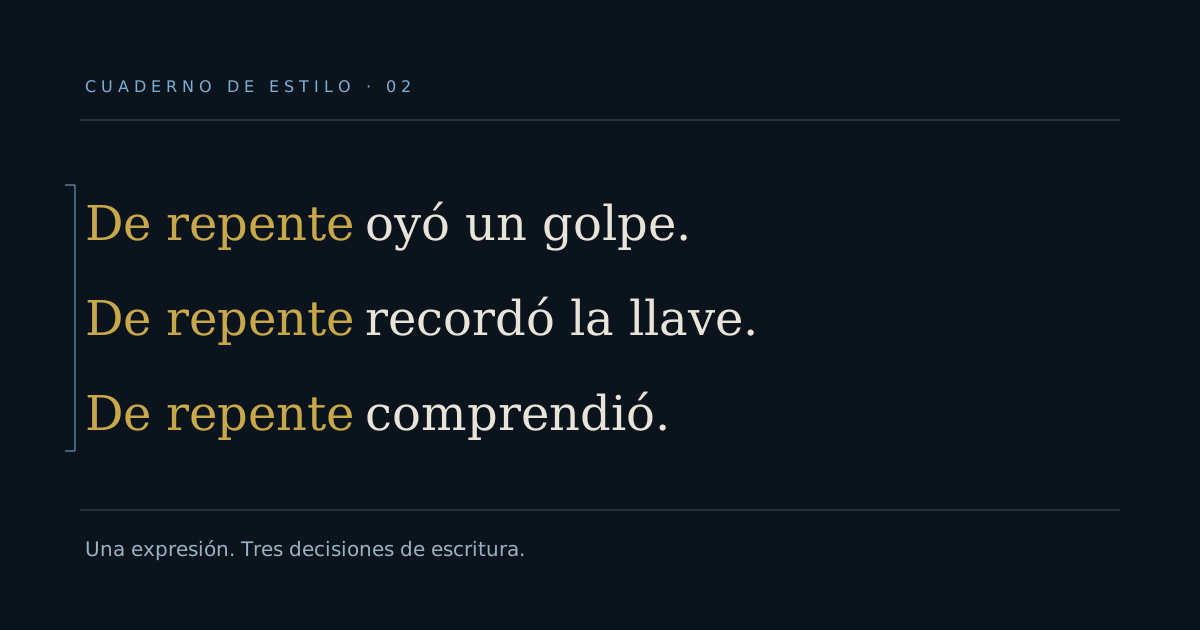
Filler words in writing tend to slip past us because they feel natural. Using “suddenly” once is fine; the trouble starts when the same word or phrase handles every situation. Every writer has a few crutch words, and the job in revision is to find yours, read them in context and decide, one by one, whether each repetition is doing something.
Common filler words and crutch phrases
| Word or phrase | What it usually does | What to try |
|---|---|---|
| just, really, very | Softens or pumps up a word that could stand on its own. | Delete it, or pick a stronger word: “very tired” becomes “exhausted.” |
| that | Joins clauses that often read fine without it. | Cut it where the sentence stays clear: “She knew he was lying.” |
| actually, basically, literally | Adds emphasis in speech and little on the page. | Delete it in narration; keep it in dialogue if it belongs to a character. |
| suddenly, all of a sudden | Announces a surprise instead of staging it. | Show the event itself and let the reader feel the jolt. |
| started to, began to | Delays the action by a beat. | Use the verb: “She ran,” unless the action really is interrupted. |
| seemed to, felt, noticed, saw | Filters the moment through the character’s senses. | Give the reader the thing itself: “The floor creaked.” |
| then, at that moment | Links events that are already in order. | Remove it, or change the order of the sentences. |
The list is a starting point. Your own crutch words are often less obvious: a gesture every character makes (a nod, a shrug, a sigh), a stock image or a two- or three-word phrase you reach for without noticing.
How to find your own filler words
- Work on a passage of several paragraphs, or a whole chapter. A single sentence rarely holds enough material to reveal a habit.
- Search your draft for each suspect, as a whole word. Write down how often it appears, and look for two- and three-word phrases that come back three times or more.
- Read every occurrence in context. Check whether it joins distinct ideas, sets up an emotion or just fills the start of the sentence.
- Try removing one occurrence, not all of them. If the link between the sentences holds, that piece probably wasn’t needed.
- Read the result aloud. The goal is to keep your voice and clear away the habit around it.
A worked example: “suddenly”
Before: “Suddenly she heard a thud. Suddenly she remembered the key. Suddenly she realized she had spent an hour waiting for someone who wasn’t coming back.”
All three sentences announce a surprise, yet they show three different kinds of change: a sound, a memory and a conclusion. Repeating the same opening can flatten them and take away their sense of progression.
Another version: “Something thudded upstairs. Clara felt in her pocket for the key. She had spent an hour waiting for someone who wasn’t coming back.”
This version drops the surprise label and chains perception, action and thought. It’s an option, and it costs something: it loses some of the hammering of the first. If that hammering was the point, keeping it may be the better choice.
When a repeated phrase is doing its job
A compound name, a polite formula or a character’s pet phrase can appear many times without being a flaw. In an essay, “collective memory” may be precisely the concept under study, and swapping it for near-synonyms would cost precision.
In dialogue, a verbal tic also characterizes. Ask who uses it: if all your characters reach for the same phrase in different situations, it may be a narrator’s habit that has spread to the cast. If it belongs to one voice and serves a purpose, it’s probably worth keeping.
Filler word, cliché and transition
- Filler or crutch word: it repeats within your own text. It’s what a search of your draft can count.
- Cliché: a phrase worn out by everyone’s use, like “a chill ran down her spine.” It can appear just once and still weaken the page.
- Transition: it expresses a relationship between ideas. “However” earns its place whenever there’s a real contrast, even though it turns up on many lists of words to cut.
Three ways to revise without flattening your prose
Delete: remove the word and check whether the sentence loses anything. Make it concrete: replace a label with the gesture or action it was announcing. Rearrange: change the order of the sentences so the relationship comes through without a repeated link.
Avoid mechanical swaps from a list of synonyms. Trading every “suddenly” for “abruptly” keeps the habit and only changes its surface. Work on one decision at a time and compare the effect.
What a word search can and can’t tell you
A search counts exact matches: it shows how often a word or phrase appears, and where. It won’t tell you whether each one works, and it misses habits you don’t think to look for. A tic can also show up only twice in a chapter and still be noticeable, especially if the two occurrences sit close together. That’s why the reading in context matters more than the count.
Single words that echo within a few lines are a related problem, covered in our guide to repetitions, alliteration and internal rhyme. If your crutch words are vague nouns and adjectives, see concrete and abstract words; and if they cluster around dialogue, our guide to dialogue tags will help.
Frequently asked questions
What are filler words in writing?
Words and phrases that add little meaning and pad the sentence, such as just, really, very, that, actually or started to. They’re harmless once; they become a problem when they turn into a habit.
What’s the difference between filler words and crutch words?
Filler words are the general category: words that add little anywhere. Crutch words are the ones a particular writer leans on, the personal habits that show up again and again in their drafts.
Should I delete every filler word?
No. Some do real work: they set the rhythm of a sentence, mark a character’s voice in dialogue or carry a contrast. Cut the ones that repeat out of habit and keep the ones you’d choose on purpose.