Repeated Words: How to Find the Echoes in Your Text
November 21, 2026 · Equipo Style Optimizer
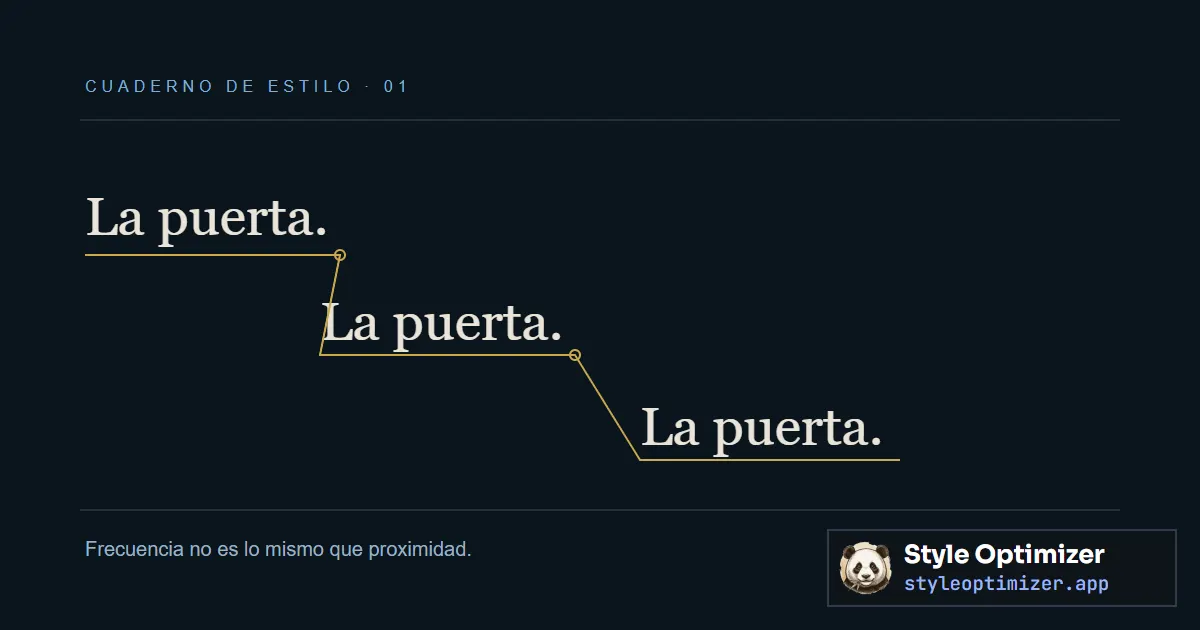
A word can appear twenty times in a novel without bothering anyone and three times in one paragraph until the reader hears it. Finding repeated words means telling two things apart: how often a word appears overall, and how close together its appearances fall. Read each one in context before deciding whether anything needs to change.
How to check a text for repetition
- Work with a scene or a passage. Keeping to one unit of reading helps you tell a sustained motif from a coincidence between distant chapters.
- Start with the words that come back most. The sentence length checker lists the ten most frequent words of any text you paste, leaving out articles, pronouns and other function words.
- Look for close echoes. A word that returns within a couple of lines is far more noticeable than one that returns three pages later. Style Optimizer’s style analysis marks words repeated within 30 words of each other, in English and Spanish texts.
- Read the context. Read the sentence before and the one after. Rewrite only when the repetition distracts, makes a reference ambiguous or takes the force out of an image.
Frequency and proximity tell you different things
“House” may be the central word of a story about moving. Replacing each one with “home,” “property” or “residence” doesn’t necessarily improve anything. Frequency describes an insistence; the context lets you decide whether that insistence makes sense.
Proximity works differently. Three appearances in a row produce two echoes. The count tells you where to look; judging the passage is still your job.
An example: change the construction instead of hunting for synonyms
Before: “The door was shut. Clara put her hand on the door and waited. On the other side of the door, someone was breathing.”
One possibility: “The door was shut. Clara put her hand on the wood and waited. On the other side, someone was breathing.”
The second version drops a reference the reader already understands and makes another one concrete. It doesn’t turn every door into a different word. You could also keep the first version if the insistence reflects Clara’s fixation. The decision depends on the scene and the tone you’re after.
Another case, with an abstract word. Before: “The company’s problem was a problem of trust, and that problem went back years.” One possibility: “The company lacked trust, and had for years.” Once you name the issue directly, the repeated word is no longer needed.
When to keep a repetition
- When it keeps the identity of a character or object clear.
- When it builds a deliberate rhythm: “She waited at the door. She waited in the kitchen. She waited until there was no more noise.”
- When a technical term has to stay the same.
- When changing it adds a shade of meaning you didn’t want. “Said” and “confessed” don’t describe the same act.
Anaphora and the other figures of repetition turn insistence into a technique. Keep them, whatever a word count says.
How to find repeated words in Word and Google Docs
Both programs search for a specific word: press Ctrl + F (Cmd + F on a Mac), type it and you’ll see how many times it appears and where. That works when you already suspect a word. To find the ones you aren’t thinking of, paste the passage into the sentence length checker and look at its list of frequent words.
Frequently asked questions about repeated words
How many times can you repeat a word in a text?
There’s no fixed number. What matters is the distance between appearances and whether the repetition adds something: the same word can grate in one paragraph and go unnoticed across a whole chapter.
How do you avoid repeating words without using synonyms?
Try changing the construction first: drop the reference if it’s already clear, use a pronoun or make the detail concrete. A synonym is the last resort, because it can add a shade of meaning you didn’t intend.
Does a word counter group “looked” and “look”?
Most count exact forms, so “looked,” “looks” and “looking” are counted separately, and none of them notice two synonyms repeating the same idea. Reading in context catches what the count misses.
The next step
If what keeps coming back are phrases like “suddenly” or “I mean,” see our guide to filler words. If what repeats is a sound, our guide to repetitions, alliteration and internal rhyme covers it. Repetition is only one part of your writing style.