How to Write a Back Cover Blurb: What Goes on It, With Examples
November 21, 2026 · Equipo Style Optimizer
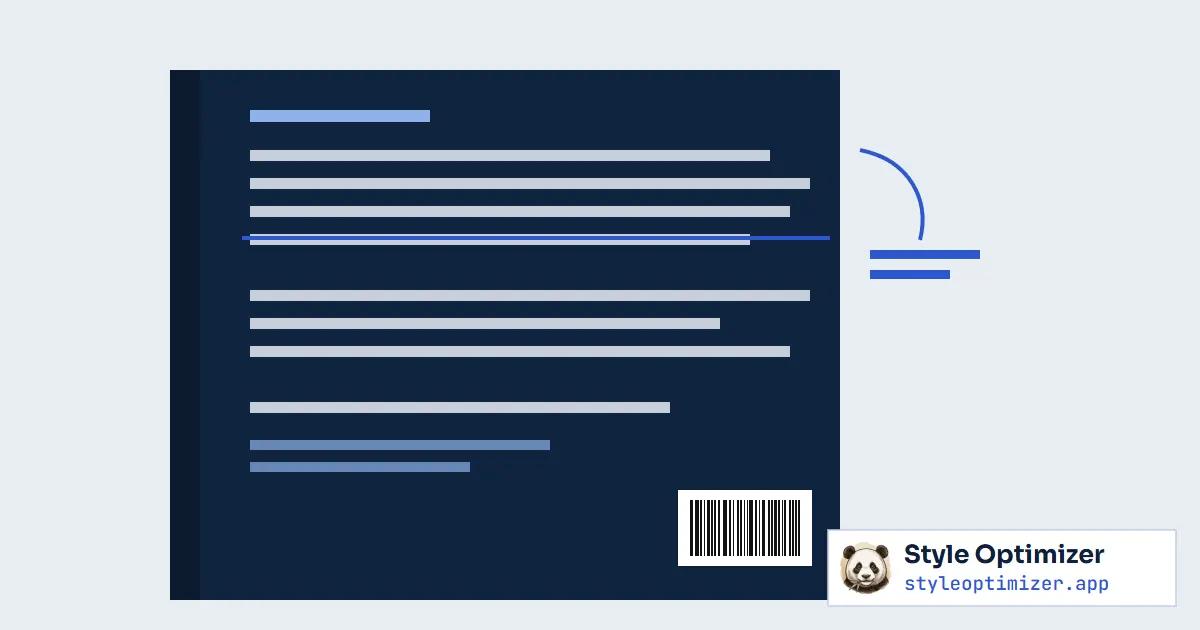
The back cover of a book is the side a reader turns to in the bookstore once the front cover has caught their eye. The text printed there is called back cover copy, and many writers and publishers call it the blurb. In a few seconds it has to answer a single question: is this book for me?
This guide explains what goes on the back cover, how the blurb differs from the synopsis you send to agents and how to write it in five steps. Further down you’ll find a checklist to test your draft against.
Blurb, back cover copy and flap copy
The words shift a little with the market. In the UK, “blurb” usually means the description on the back of the book. In US publishing, a blurb is often the short endorsement from another author or a review (“A triumph”), while the description itself is called back cover copy. On a hardcover with a dust jacket, the description usually moves to the inside front flap and is called flap copy. Self-publishers often use the same text, lightly adapted, as their online book description. In this guide, “blurb” means the description of the book.
What goes on the back cover of a book
- The description. Between 110 and 190 words that introduce the story and promise an experience. The author or the publisher writes it, and it’s the part that sells the book.
- A featured quote. A line from a review, from a well-known author or from the book itself. It works when the name or the line says something specific.
- An author bio. Two or three lines; in many editions it goes on the back flap.
- The barcode with the ISBN and, depending on the market, the price.
- The publisher’s or imprint’s logo, which places the book within a family.
The parts of a book’s exterior
If you’re looking this up for a school project, these are the outside parts of a book and what goes on each:
- Front cover: title, author, publisher and the cover image.
- Spine: the narrow edge where you read the title and author with the book on the shelf.
- Back cover: the description, the barcode and sometimes quotes.
- Flaps: the folded-in extensions of a dust jacket or a paperback cover, with the author bio or other titles in the series.
Laid out flat, the cover reads from left to right as back flap, back cover, spine, front cover and front flap.
Back cover blurb vs. synopsis
| Back cover blurb | Synopsis for agents | |
|---|---|---|
| Written for | The reader in the bookstore | The agent or editor |
| Purpose | Make people want to read | Show that the plot holds together |
| Length | 110–190 words | One or two pages |
| The ending | Kept back | Told in full |
| Tone | The book’s own | Informative, in the present tense |
If you’re going to submit your manuscript, prepare both: the synopsis goes with the submission, and the blurb becomes the pitch paragraph of your query letter.
How to write a back cover blurb in five steps
- Open with a hook. A concrete situation or a line from the book that sets the tone. “My mother climbed the lighthouse stairs counting the steps under her breath” says more than “a moving story.”
- Introduce someone with a name, and their world. Readers attach to a person: Lucy, twenty-nine, back at the lighthouse where she grew up.
- Tell the inciting incident. The moment something breaks the routine: a tin box of letters from an aunt everyone believed was living in France.
- Say what’s at stake. What the protagonist could lose or gain: forgiving her mother, or losing what little she has left of her.
- Close with a promise. A sentence that says what kind of book this is, in the book’s tone, without giving away the ending.
Back cover blurb checklist
Read your draft against these points before you send it to the designer:
- Length: between 110 and 190 words.
- Sentences: mostly short; one long sentence is fine if it carries the hook.
- Clichés: no “gripping,” “unputdownable” or “a page-turner you won’t be able to put down.”
- Spoilers: nothing that happens after the inciting incident and the stakes.
- A named protagonist and a conflict: both should be there by the second sentence.
- The last line: a promise about the book, rather than a rhetorical question.
An example, before and after
Before:
A gripping story you won’t be able to put down. Lucy returns to the lighthouse where she grew up after her mother’s death and finds a tin box full of letters. In the end she discovers that her aunt never went to France. A heart-pounding novel about family secrets, love and memory. Will Lucy ever forgive her mother?
It has two worn-out phrases (“gripping,” “you won’t be able to put down”), a self-congratulating adjective (“heart-pounding”), it gives away the final twist and it ends on a rhetorical question. And it doesn’t convey what the book sounds like.
After:
For thirty years, Lucy’s mother climbed the lighthouse’s hundred and twelve steps every night, counting under her breath like someone saying a prayer. Now that she’s gone, Lucy returns to the house on the coast to clear it out and finds, behind the winter blankets, a tin box holding the letters of an aunt nobody ever mentioned again.
Every letter ends with the same line: “Tell Mom I’m fine.” Every letter comes from a different place. And not one of them was ever mailed.
The Lighthouse is a novel about what families say so they don’t have to say something else, and about the objects that keep the rest.
It opens with an image from the book, introduces someone by name, sets up a concrete mystery and closes by saying what kind of book it is, without revealing how the mystery is solved.
The back cover of a short story collection
A collection needs one thing more: it has to say what binds the stories together. Name the common thread (a place, a theme, a line that keeps returning), introduce one or two stories through a concrete image and close with what the collection says as a whole.
Back cover examples by genre
Three short examples written for this guide. Notice what changes from one to the next: the tone and what each one promises the reader.
- Crime fiction. “Detective Vera Shaw hasn’t set foot in Baltimore in nine years. Now she’s been called back to close the case that cost her father his badge, and the only witness has just asked to speak to her. A novel about what a city chooses to forget.”
- Nonfiction. “Why do we still read on paper? Martha Reed visits printers, libraries and laboratories to explain what the body does while it reads. A book for anyone who wants to understand their own attention.”
- Poetry. “Forty poems written during the last year of a family home, before it was sold. A voice taking inventory of everything that stays inside.”
To calibrate your own, pull five recent books in your genre off a bookstore shelf, or look up their online descriptions, and compare length, tone and how far into the plot each one goes.
How to design the back cover
- Readable type. A 10- to 12-point size and a narrow block of text can be taken in at a glance.
- Contrast. If there’s a background image, mute it behind the text.
- Room for the barcode. Reserve the space before you place the text. It usually goes at the bottom, on a white box.
- Safety margins. Keep text clear of the trim edge. Your printer’s cover template gives the exact measurements and the spine width.
- Continuity. Use the front cover’s colors and fonts so the whole cover reads as one piece.
The back cover of a school project or a picture book
If a class assignment asks you to design the back cover of a book, include what a real one has: a short description that stops before the ending, a quote, two lines about the author and a space for the barcode. For a report or a portfolio, the back cover is usually left blank or carries whatever the teacher asks for, such as your name, class and date; check if you’re unsure.
A homemade storybook or notebook works like any book: a sentence about the story, a drawing and the name of whoever made it.
Common back cover mistakes
- Self-praise. “Gripping,” “masterful,” “essential”: readers distrust what a book says about itself. A quote from someone else, with their name, carries more weight.
- Summarizing the whole plot. A good blurb picks one moment and tells it well.
- Too many characters. One or two names are enough.
- Spoiling the ending. Tell the story up to the inciting incident and what’s at stake.
- A string of rhetorical questions. One question can work; three in a row sound like an ad.
- A tone that doesn’t match the book. A quiet novel with an action-movie blurb disappoints the reader who buys it.
Back cover blurb: FAQ
Where does the blurb go on a book?
On the back cover of a paperback, or on the inside front flap of a hardcover with a dust jacket. Online, the same text usually becomes the book description.
What’s the difference between a blurb and back cover copy?
In the UK they’re usually the same thing: the description on the back. In the US, “blurb” often refers to an endorsement quote from another author, and the description is called back cover copy or flap copy.
How many words should a back cover blurb be?
Between 110 and 190 words is typical for fiction. With less, it’s hard to introduce a character, a conflict and a tone; with more, the text no longer fits alongside the barcode and a quote.
Who writes the back cover copy, the author or the publisher?
At a traditional publisher, the editorial or marketing team writes it, often starting from the author’s draft. If you’re self-publishing, you write it yourself. Either way, it pays to have your own version: it’s also the heart of your query letter.
Can I use a line from the book itself?
Yes, and it often works better than an adjective, because it lets readers hear the author’s voice. Choose a line that makes sense on its own.
Does the back cover give away the ending?
The ending is saved for the reading. The place where it goes in full is the synopsis you send to agents and publishers.
If the book isn’t finished yet, start with how to write a novel.