Fantasy Names: Elvish, Dwarven, Kingdom and City Names
November 21, 2026 · Equipo Style Optimizer
Fantasy names work when each people sounds different and every name from the same people sounds like family. Elvish names tend to be fluid and full of vowels; dwarven names, short and hard-edged; kingdoms and cities mix invented roots with plain English words. Below you’ll find tables of examples invented for this guide and the method for creating your own.
If your story is set in the real world or in a recognizable past, the lists of medieval names are a better place to start.
Our fantasy name generator rolls ten elvish, dwarven, kingdom or city names at a time: lock the ones that fit and keep rolling. For characters from the last two centuries, the same name generator gives you first names and surnames by country and birth era, and the character generator adds a job, a goal, a fear and a secret.
Elvish names
The elves of modern fantasy descend from Tolkien, who invented his languages before his stories: Quenya draws on Finnish and Sindarin on the sounds of Welsh. That’s where the pattern every reader recognizes comes from: lots of vowels, liquid consonants (l, r), nasals (m, n), the combination th and words of three or four syllables ending in a vowel or a soft consonant.
The examples in this table were invented for the occasion, from roots of our own. Use them as a starting point or to see how a name is put together.
| Name | Invented roots | Meaning in its language |
|---|---|---|
| Ilvaren | ilv (light) + aren (one who carries) | Light-bearer |
| Saelith | sae (sea) + lith (voice) | Voice of the sea |
| Orivael | ori (dawn) + vael (leaf) | Leaf of dawn |
| Liraneth | lira (song) + neth (small) | Little song |
| Taelis | tae (high) + lis (water) | High water, the name of a waterfall |
| Saeloria | sae (sea) + lor (house) + ia (place) | House by the sea, the name of a port |
Notice that Saelith and Saeloria share the root for sea. Repeating roots is what makes a language feel real: readers don’t know what sae means, but they notice it coming back.
Dwarven names
For dwarves, tradition leans Norse: the names of the dwarves in The Hobbit come from a list of dwarves in the Poetic Edda. The sound pattern is the opposite of the elvish one: closed syllables, consonant clusters (gr, br, kr), the letters k, g, d and r, and names of one or two syllables you say with your mouth nearly shut.
| Name | Invented roots | Meaning in its language |
|---|---|---|
| Grumtak | grum (rock) + tak (hammer) | Rock hammer |
| Bresvok | bres (iron) + vok (oath) | Iron oath |
| Holdrek | hol (tunnel) + drek (keeper) | Keeper of the tunnel |
| Takka | tak (hammer) + a (feminine) | She of the hammer |
| Vorna | vor (seam of ore) + na (daughter of) | Daughter of the seam |
| Kelgrom | kel (cold) + grom (forge) | Cold forge, the name of an abandoned mine |
A mining people names its world with mining words. If your dwarves are sailors or herders, change the vocabulary of the roots and keep only the sound.
Kingdom names
A kingdom can carry an invented name, a descriptive name in plain English or a mix of the two. Invented names sound more distant; descriptive ones stick in the memory and tell you something about the place. George R. R. Martin took the second route for the capital in A Song of Ice and Fire: King’s Landing explains its own origin in two words.
| Name | How it’s built | What it suggests |
|---|---|---|
| Valmora | Invented root + Latin-style ending | An old kingdom of valleys, with a Mediterranean air |
| Kestria | Hard root + place suffix -ia | A northern, military kingdom |
| Aldeval | Two roots joined | A small country of villages and valleys |
| Tarvenia | Invented root + -enia | An empire with a bureaucracy and a distant capital |
| The Kingdom of the Seven Salts | Description in English | A specific source of wealth and a story of how it was shared out |
| The Gray Marches | Feudal term + color | A poor borderland, always at war |
Fantasy city names
Real cities are almost always named after something they have: a river, a bridge, a tower, a saint, a spring. Think of Cambridge, Oxford or Holywell. Copy that mechanism and your cities will feel lived in for centuries. English compounds work very well for ports, villages and neighborhoods; names in an invented language suit ancient capitals or cities belonging to another people.
| Name | How it’s built | What it tells you |
|---|---|---|
| Mistharbor | Place + weather | A fog-bound port where ships go missing |
| Deepcleft | Adjective + landform | A city carved into rock or set at the bottom of a gorge |
| Ashtower | Building + color or event | Something burned there, and the name remembers it |
| Eastsalt | Compass point + product | A city that lives off a single trade |
| Calavrin | Invented language | An old capital, older than the present kingdom |
| Odresca, called Oddsker by its neighbors | Invented root, reshaped by another people’s speech | A city of another people that the locals pronounce their own way |
How to create your own fantasy names
- Choose each people’s sound inventory. Make a short list of the consonants and vowels it uses and another of those it never uses. If the elves have no k or g and the dwarves have no th, readers will tell them apart by sound before they know who’s speaking.
- Set the syllable shape. Consonant plus vowel (la-ri-na) gives open, soft names; closed syllables (grum-tak) give compact ones. One rule per people is enough.
- Invent ten or twenty roots with meanings. Water, stone, light, iron, father, daughter, high, old. Combined, they give you hundreds of consistent names, and if you ever need to translate one, you already have the answer.
- Decide on two or three endings. One for places, another for people, perhaps one for feminine names. They’re the most visible family resemblance.
- Check readability. Avoid decorative apostrophes, doubled letters with no reason behind them and accent marks readers won’t know how to pronounce. Make sure your main characters start with different letters and that every name can be read aloud on the first try.
To test a people’s rules on paper, write its sounds on one line, its endings on another and combine them until you have twenty candidates. Keep the five that sound most alike and drop the rest.
| People | Sounds | Endings | Examples |
|---|---|---|---|
| Forest folk | l, r, n, v, th; lots of vowels | -el, -eth, -ia | Orivael, Liraneth, Saeloria |
| Mine folk | k, g, d, r, br, gr; closed syllables | -ak, -ek, -om | Grumtak, Holdrek, Kelgrom |
| Coast folk | s, l, n, k; two syllables | -a, -en, -is | Askala, Neren, Toris |
Fantasy literature has taken this idea further. In the Earthsea cycle, Ursula K. Le Guin gives everything a true name in the Old Speech, and knowing it gives you power over it: names are the magic system. If you want your names to come from a language with rules of its own, continue with our guide on how to create a fictional language.
Every kingdom and city in its profile and on its map
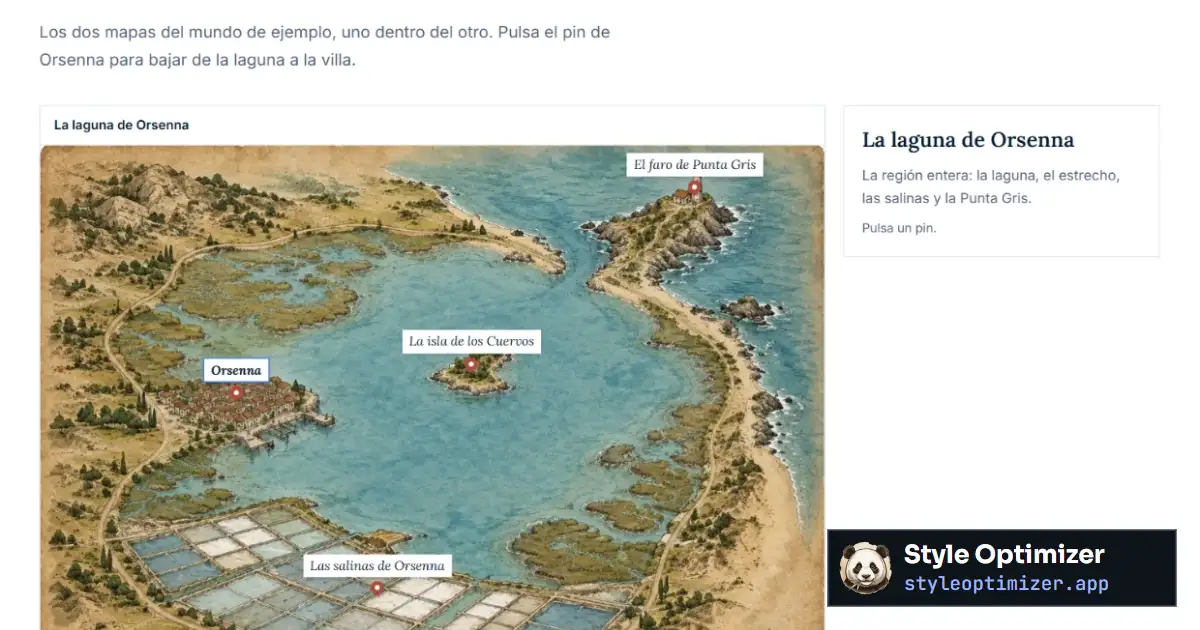
Over the course of a novel, an invented name gets forgotten or spelled three different ways. Save it as soon as you have it. In Locations, every place has a profile with a photo, description, atmosphere and the chapters where it appears, so the spelling is fixed from day one.
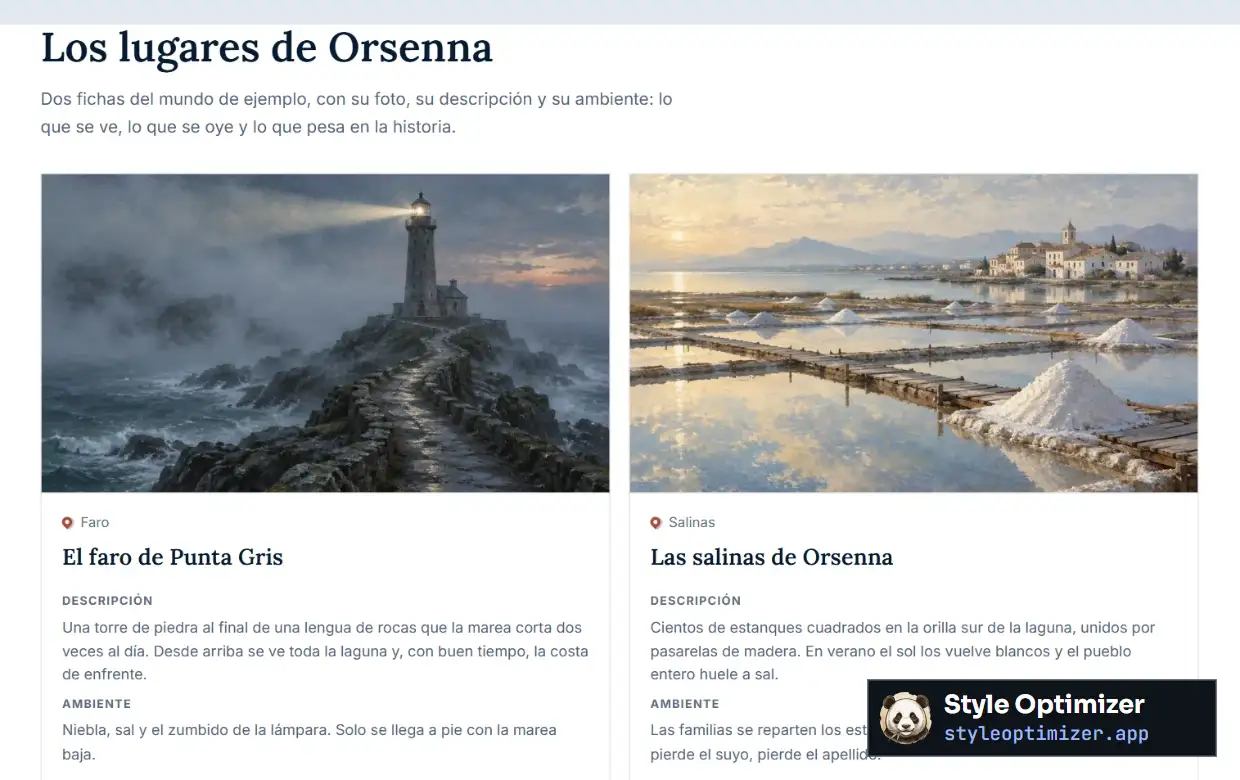
Then place them. In Maps, you upload your map, add a pin for each place and every pin opens a pop-up profile with its photo. Seeing the names together on the map is the best consistency test: if one sounds as if it belongs to another people, it jumps out.
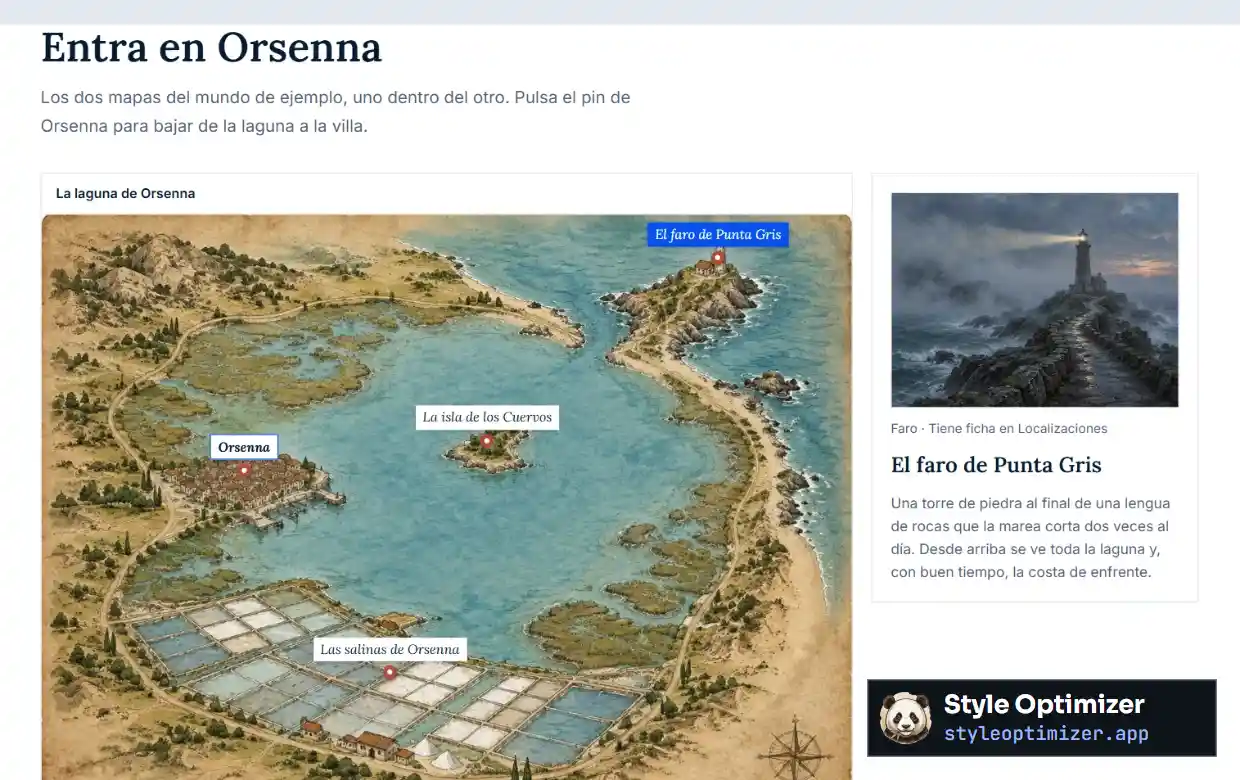
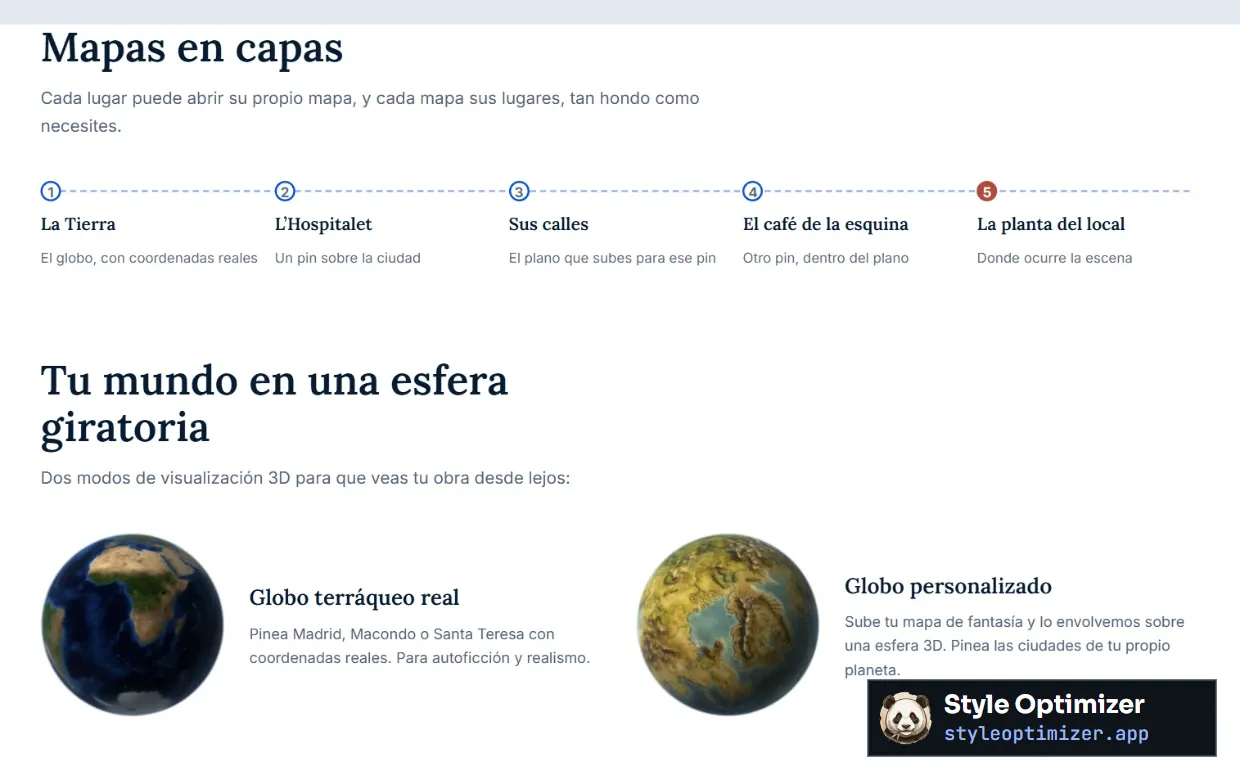
Maps nest inside one another: from the continent you drop down to the kingdom, from the kingdom to the city and from the city to a single street. Each level has its own names, and street names should sound more everyday than kingdom names. If the whole world is invented, you can wrap your map around a custom globe.
For the characters of each people, open their profiles in Style Optimizer’s Fiction section. And if you’re building the world from scratch, our guide on how to create a fantasy world tells you where to begin.
FAQ: fantasy names
How do I make a name sound elvish?
Lean on vowels and soft consonants: l, r, n, m, v and the combination th. Build words of three or four syllables that end in a vowel, an -l or an -n, and avoid k, hard g and consonant clusters. Repeat two or three roots across several names and readers will sense a language behind them even if they never see it.
Can I use names from Tolkien or other series in my novel?
Borrowing specific names from a well-known series makes readers think of it on every page, and some are protected as trademarks. What belongs to everyone is the method: liquid sounds for one people, hard consonants for another, roots that repeat. Invent your own roots and endings and you’ll get the same effect with names that are yours.
Is an invented name or an English one better for a fantasy city?
It depends on who named it and from where the story is told. If your narrator belongs to that world and the book is in English, descriptive names like Mistharbor sound natural and stay in the memory. Invented names work for places belonging to another people, ancient ruins or far-off capitals. Mixing both types with a clear logic gives the map historical depth.
How many invented names can readers handle?
Fewer than you think. In the opening pages, introduce only a few new names and anchor each one to something concrete: a trade, a color, a place. Every invented name asks for a small effort of memory, so save the strangest ones for what matters and refer to minor things by their function or with ordinary English words.
How do I keep my fantasy names from sounding alike?
List every name in the book alphabetically and check the pairs that start the same way or share final syllables. Give each people its own sounds and make sure your main characters don’t share an initial. Keeping each name in its own profile lets you see the whole cast at a glance.