Medieval Names for Women and Men, by Kingdom and Century
November 21, 2026 · Equipo Style Optimizer
Medieval names change a great deal from one kingdom to the next. An Englishwoman of the tenth century might be called Æthelflæd or Edith; three centuries later, Alice, Agnes or Joan; a Norsewoman, Astrid or Gudrun; a Castilian, Urraca or Jimena. Below you’ll find documented names for women and men from England, the Celtic lands, Scandinavia, the Frankish and French world and medieval Iberia, how a full name was built from bynames, patronymics, trades and places, and the mistakes that turn up most often in historical fiction.
Medieval women’s names, by kingdom
Every name in this table appears in records, chronicles or sagas of the period. The last column gives real women who bore them.
| Kingdom | Women’s names | Real examples |
|---|---|---|
| Anglo-Saxon England | Æthelflæd, Edith, Hild, Godgifu, Ælfgifu, Eadgyth, Wulfrun, Mildred | St. Hild of Whitby (7th c.), Æthelflæd, Lady of the Mercians (10th c.), Godgifu, the Lady Godiva of legend (11th c.) |
| England after 1066 | Matilda (Maud), Alice, Agnes, Joan, Isabella, Cecily, Margery, Juliana, Margaret | Empress Matilda (12th c.), Julian of Norwich (14th c.), Margery Kempe (14th–15th c.) |
| Wales and Ireland | Gwenllian, Angharad, Nest, Gormlaith, Derbforgaill, Órlaith | Gwenllian ferch Gruffydd (12th c.), Nest ferch Rhys (11th–12th c.), Derbforgaill of Meath (12th c.) |
| Norse | Astrid, Gudrun, Ingrid, Sigrid, Freydís, Gunnhild, Thora, Ragnhild, Aud | Freydís Eiríksdóttir, from the Vinland sagas (11th c.), Aud the Deep-Minded, settler of Iceland (9th c.) |
| Frankish and French | Bertha, Hildegard, Gisela, Rotrude, Ermengarde, Judith, Adelaide, Eleanor, Héloïse | Hildegard, wife of Charlemagne (8th c.), Judith of Bavaria (9th c.), Eleanor of Aquitaine (12th c.) |
| Castile, León and Aragon | Urraca, Jimena, Sancha, Elvira, Teresa, Mayor, Berenguela, Petronila, Violante | Urraca of León (12th c.), Jimena Díaz, wife of El Cid (11th c.), Petronila of Aragon (12th c.) |
| al-Andalus | Wallada, Subh, Hafsa, Itimad, Fatima, Aisha, Maryam, Zaynab | Wallada bint al-Mustakfi, poet of Córdoba (11th c.), Hafsa bint al-Hajj, poet of Granada (12th c.) |
Medieval men’s names, by kingdom
| Kingdom | Men’s names | Real examples |
|---|---|---|
| Anglo-Saxon England | Alfred, Edward, Edmund, Æthelred, Harold, Godwin, Leofric, Wulfstan, Oswald, Cuthbert | Alfred the Great (9th c.), Leofric of Mercia (11th c.), Harold Godwinson (11th c.) |
| England after 1066 | William, Robert, Richard, Henry, John, Walter, Geoffrey, Ralph, Hugh, Roger, Thomas | William the Conqueror (11th c.), Thomas Becket (12th c.), Geoffrey Chaucer (14th c.) |
| Wales and Ireland | Llywelyn, Gruffudd, Owain, Rhys, Hywel, Brian, Domnall, Áed, Conchobar | Hywel Dda (10th c.), Brian Boru (10th–11th c.), Owain Glyndŵr (14th–15th c.) |
| Norse | Harald, Olaf, Erik, Leif, Björn, Sigurd, Gunnar, Ivar, Knut, Halfdan, Thorfinn | Harald Fairhair (9th c.), Leif Eriksson (11th c.), Cnut the Great (11th c.) |
| Frankish and French | Charles, Pepin, Carloman, Louis, Lothair, Hugh, Robert, Odo, Roland, Godfrey, Baldwin | Charlemagne (8th–9th c.), Hugh Capet (10th c.), Godfrey of Bouillon (11th c.) |
| Castile, León and Aragon | Rodrigo, Fernando, Alfonso, Sancho, García, Gonzalo, Diego, Nuño, Ramiro, Jaime, Ramón | Rodrigo Díaz de Vivar, El Cid (11th c.), Ramiro II the Monk (12th c.), James I the Conqueror (13th c.) |
| al-Andalus | Abd al-Rahman, Hisham, al-Hakam, Muhammad, Ahmad, Yusuf, Umar, Sulayman | Abd al-Rahman III (10th c.), Almanzor (10th c.), Ibn Rushd, known as Averroes (12th c.) |
In England, 1066 splits the list in two: after the Norman Conquest, names like William, Robert and Matilda push the Anglo-Saxon ones aside within a few generations.
How a full name was built: bynames, patronymics and surnames
Across most of medieval Europe, a person had a given name and, to tell them apart from everyone else with the same one, people added their father’s name, their place of origin, their trade or a nickname. These additions are called bynames. Surnames passed down unchanged from parent to child arrived late, and at a different pace in each kingdom.
England
Anglo-Saxon names were compounds of two roots: Æthelred joins “noble” and “counsel,” which is why that king’s nickname, Unræd (“ill-advised,” later turned into “the Unready”), was a pun on his own name. After the Conquest, bynames multiply and slowly harden into surnames, and they fall into four families:
- Occupational: Smith, Baker, Fletcher (the arrow maker), Thatcher, Chapman (the trader).
- Place and landscape: Atwood, Hill, Brook, or the Norman “de” plus an estate, as in Richard de Clare.
- Patronymic: Johnson, Dickson, or the Norman Fitz-, as in FitzWalter, “son of Walter.”
- Nickname: Brown, Long, Little, Fox.
Wales, Ireland and Scotland
The Welsh named people by their father with ap or ab (“son of”) and ferch (“daughter of”): Llywelyn ap Gruffudd, Gwenllian ferch Gruffydd. When English officials later fixed these as surnames, the particle often fused with the name, so ap Hywel became Powell and ap Rhys became Price. In Ireland and Gaelic Scotland, Mac means “son of” and the Irish Ó means “grandson” or “descendant of”: the O’Briens claim descent from Brian Boru.
Norse
The patronymic combines the father’s name with -son or -dóttir: Leif Eriksson, son of Erik; Freydís Eiríksdóttir, daughter of the same Erik. Iceland still uses this system today. The nicknames in the sagas are a gold mine for a novelist: Erik the Red, Harald Bluetooth, Ivar the Boneless, Aud the Deep-Minded.
Frankish and French
The Franks carried a single name, nearly always Germanic, and chroniclers added nicknames to tell apart kings who shared one: Pepin the Short, Louis the Pious, Charles the Bald, Charles the Simple, Louis the Stammerer. From the eleventh century on, the nobility begins to add its lordship with “de”: Godfrey of Bouillon.
Castile, León and Aragon
The patronymic ending -ez or -iz means “son of”: Fernández is the son of Fernando; Sánchez, of Sancho; Díaz, of Diego; Muñoz, of Muño or Nuño. For centuries it changed with each generation, so El Cid, Rodrigo Díaz de Vivar, had a son called Diego Rodríguez. His full name tells you everything: Rodrigo, son of Diego, from Vivar. Women used the same formula (Jimena Díaz), and kings gained nicknames as eloquent as any Viking’s: Alfonso X the Wise, Alfonso I the Battler.
al-Andalus
An Arabic name was built from parts. The ism is the personal name (Muhammad); the nasab, the chain of ancestors with ibn, “son of,” or bint, “daughter of”; the kunya, a name as father or mother with Abu or Umm; the nisba, the place of origin (al-Qurtubi, “the man from Córdoba”); and the laqab, an epithet or title. Averroes was Abu l-Walid Muhammad ibn Ahmad ibn Rushd. Almanzor was Muhammad ibn Abi Amir, and the name Christians knew him by comes from his title, al-Mansur, “the Victorious.” Jewish communities used ben (“son of”) alongside ibn: Moses ben Maimon is Maimonides.
Common mistakes with names in historical fiction
- Fixed surnames too early. If a father and son in the eleventh century both go by Johnson, you’ve imported a modern habit. Let the patronymic change with each generation, or give each person a byname of their own.
- Modern names with an old-fashioned air. Jonathan Swift coined Vanessa in the eighteenth century; Jessica first appears in Shakespeare’s The Merchant of Venice; Wendy caught on thanks to Peter Pan. It works the other way too: Julian sounds like a man’s name today, yet in medieval England it was commonly a woman’s, as Julian of Norwich shows.
- Too much variety. The medieval stock of names was small, and a village might have five Johns. To tell them apart, people used a trade, a place or a nickname: John the Smith, John atte Wood. Doing the same adds realism and helps your reader.
- Mixing kingdoms without a reason. A Björn in a Castilian village, or a Rodrigo in a Yorkshire one, needs a story to explain him. If he has one, that foreign name becomes an excellent narrative device.
- Inconsistent spellings. Decide whether you write Æthelflæd or Ethelfleda, Thora or Þóra, Cnut or Canute, and keep the choice throughout the book. For general readers, the familiar English forms are easier to read.
- Titles in the wrong place. In medieval England, “Sir” belonged to knights and, by custom, to parish priests; putting it in front of a peasant’s name moves him to another class. Castile had the same rule with “don” and “doña,” which for centuries were marks of rank reserved for the nobility and high clergy.
Give every character a time and a place
A medieval name is only correct in relation to a kingdom and a century, so note all three together. In Style Optimizer’s Fiction section, each character profile keeps the name, photo, tags and the chapters where they appear, and you can see the whole cast at a glance.
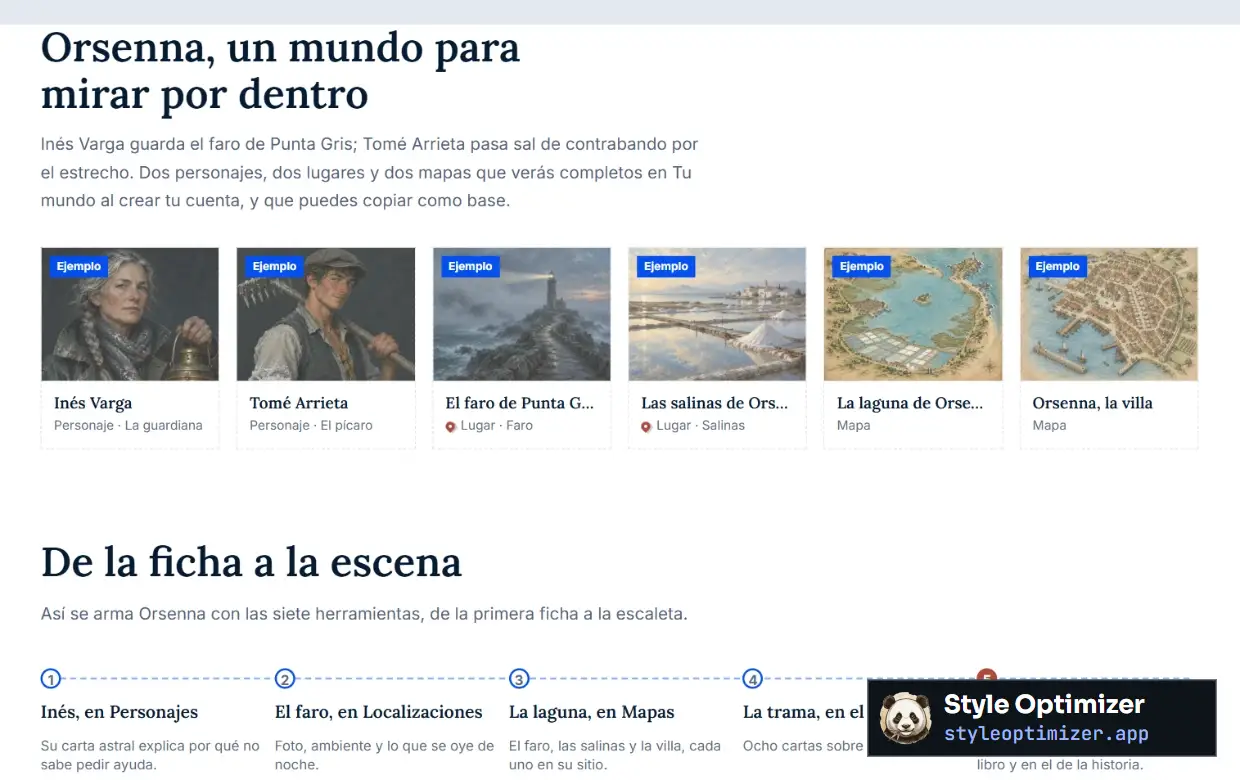
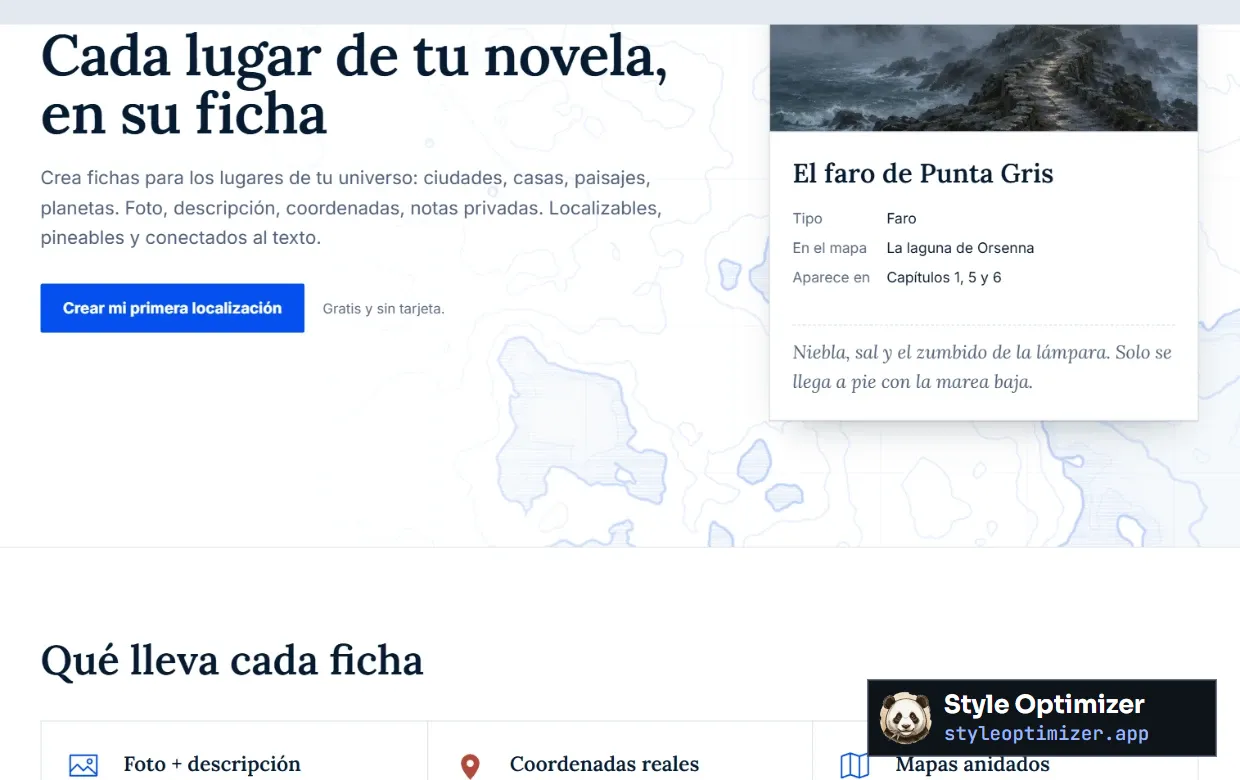
Places call for the same care. A town changes its name when it changes hands, and a fortress in al-Andalus can have both an Arabic and a Castilian name. In Locations, you record the type of place, the map it’s on, the chapters where it appears and its atmosphere.
For an invented Middle Ages, with elves or kingdoms that never existed, turn to the tables of fantasy names. And for the rest of the character, use our character profile template.
To roll medieval names, open the medieval name generator: ten per roll for England, Scotland, Wales, Ireland, the Norse world, France, Castile and al-Andalus, in two periods, with a patronymic, an epithet or a place if you want them. For characters born in the nineteenth century or later, the same name generator gives you first names and surnames by country and era, and how to name characters explains how to choose among them.
FAQ: medieval names
What were the most common women’s names in medieval England?
In thirteenth- and fourteenth-century English records, Alice, Agnes, Joan, Matilda (often written Maud), Margaret, Isabel, Emma and Cecily come up again and again. Before the Conquest, Anglo-Saxon names like Edith, Ælfgifu and Godgifu were the norm. Many names passed down within a family, from grandmother to granddaughter, just as kings’ names repeated within a dynasty.
When did surnames become hereditary in England?
It was a slow process. The Norman nobility brought family names tied to their estates in the eleventh and twelfth centuries, and among ordinary people bynames gradually stopped changing from one generation to the next over the thirteenth and fourteenth centuries. By the end of the Middle Ages most English families had a surname they passed on to their children.
What is a patronymic?
A name formed from the father’s name. In English it shows up as -son (Johnson) or the Norman Fitz- (FitzWalter); in the Norse languages as -son or -dóttir (Eriksson); in Welsh with ap or ferch; in Spanish with -ez or -iz (González, son of Gonzalo); in Arabic with ibn or bint; and in Hebrew with ben. In the Middle Ages it identified each person by their father, and over time many became surnames.
How do I invent a believable medieval nickname for a character?
Look at real ones: they come from a physical trait (the Bald, the Red), from character (the Pious, the Wise), from a deed (the Battler, the Conqueror), from a trade or from a place. Choose something the neighbors would see at a glance or tell about the character at the tavern. A good nickname sums the character up and sometimes follows them through the whole novel.
Can I use medieval names in a fantasy novel?
Yes, and plenty of series do it to give an invented world a period flavor. Choose a single tradition as the base for each people, for example Frankish names for one kingdom and Norse names for another, so readers can tell the peoples apart by sound. If you want to move away from the familiar, change a syllable or the ending.