How to Create a Fictional Planet for Your Sci-Fi Novel
November 21, 2026 · Equipo Style Optimizer
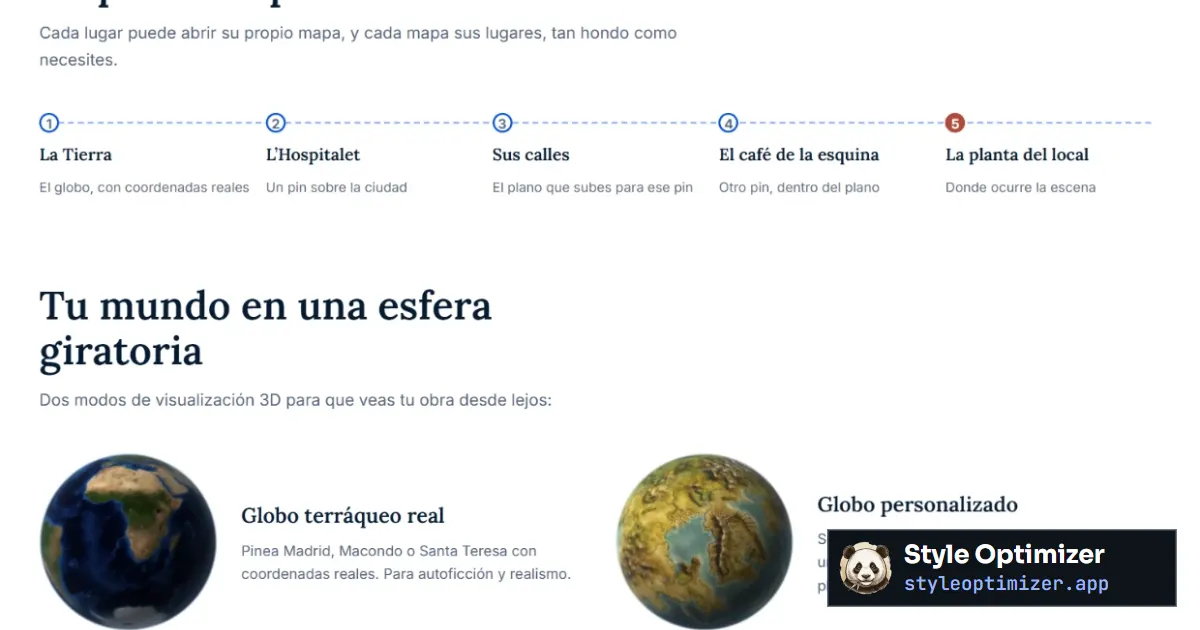
To create a fictional planet that feels believable in a science fiction novel, decide six physical facts and let everything else follow from them: the star, the planet’s distance from it, the gravity, the length of the day, the tilt of the axis and the moons. Rough orders of magnitude are enough, with no fine calculations. Each fact has consequences readers will feel in your characters’ bodies, in the weather and in the sky.
Questions to build your planet
Work through gravity, the length of the day and the year, the moons, the axial tilt and seasons, the climate and what shows up in the night sky. Answer each with a rough figure and one consequence: “Gravity at 1.3 times Earth’s: nobody climbs stairs if they can help it.” The figure keeps you consistent, and the consequence gives you scenes. Once you have a map, you can wrap it around a sphere with Style Optimizer’s custom planet globe.
How to create a planet, step by step
1. The star: color, light and distance
The Sun is a G-type star, with a surface temperature of about 5,800 kelvins and a white light we see as yellowish. Red dwarfs, the most common stars in the galaxy, are cooler and far less luminous, so a temperate planet has to orbit very close to one. The useful rule is that the habitable distance grows with the square root of the star’s luminosity. A star a hundred times dimmer than the Sun has its temperate zone at one-tenth of the Earth–Sun distance.
A planet that close tends to become tidally locked, with one side always facing the star and the other always in night, the way the Moon always shows Earth the same face. Now you have a world with a scorched side, a frozen side and a twilight band where everyone lives. And under reddish light, plants might be dark, almost black, to make the most of it. Astrobiologists take that idea seriously, and it makes a striking detail of landscape.
2. The year: how long one orbit takes
Kepler’s third law gives you the year with little fuss: the square of the period in years equals the cube of the distance in astronomical units divided by the star’s mass in solar masses. Mars, at 1.5 times Earth’s distance, takes almost two Earth years. A planet 0.1 astronomical units from a red dwarf with one-fifth of the Sun’s mass goes around in about 26 days. With years that short, people count their age some other way.
3. Gravity: your characters’ bodies
Surface gravity depends on mass and radius. At the same density as Earth, it grows in proportion to the radius: a planet with a radius one and a half times larger has 1.5 times the gravity and more than three times the mass. Mars has 38 percent of Earth’s gravity, and the Moon about 17 percent.
- High gravity: lower mountains, a denser atmosphere the planet holds on to more easily, more dangerous falls, stocky bodies and low buildings.
- Low gravity: huge mountains (Olympus Mons on Mars rises more than 20 kilometers, or 13 miles), long leaps, tall bodies and an atmosphere that escapes more easily.
A newcomer feels it in the first scene: how they climb a step, how heavy their luggage is, how long a cup takes to hit the floor.
4. The day: how long a day lasts
Earth turns in 24 hours; Jupiter in about 10. Venus takes 243 Earth days to spin once on its axis, longer than its own year. A 60-hour day means sleeping twice per day and leaves long, cold nights. A 10-hour day speeds up social life.
5. Axial tilt: the seasons
Seasons depend on how far the axis tilts relative to the orbit. Earth tilts about 23.4 degrees and Mars about 25. With an upright axis, the seasons almost vanish and climate depends only on latitude. Uranus spins nearly on its side, at almost 98 degrees, and each pole spends about 42 straight years in daylight and as many in darkness. An extreme tilt gives you a culture that migrates, stockpiles or hibernates for half a lifetime.
6. Moons: tides and calendars
Moons drive the tides and mark the months. Tidal force grows with the moon’s mass and falls with the cube of its distance, so a moon like ours at half the distance would raise tides about eight times stronger. Our Moon looks the same size as the Sun in the sky, which is why we get total eclipses. Two moons with different periods give you two calendars, nights with double shadows and conjunctions someone will turn into prophecy.
7. Climate and the night sky
With the six facts above, the climate almost works itself out: how much light arrives, how it spreads across latitudes, how much water there is and whether there are seasons. Then add the night sky: how many moons, whether there are rings, whether another star in the system is visible, or a band of the galaxy. What people see every night feeds their myths, their navigation and their calendars.
Fictional planets that work
| Planet | Book | Central physical fact | What it creates in the story |
|---|---|---|---|
| Arrakis | Dune, Frank Herbert (1965) | A desert with almost no water; two moons | A whole culture organized around water: suits that recycle sweat, water as currency and debt |
| Gethen (Winter) | The Left Hand of Darkness, Ursula K. Le Guin (1969) | A planet in the grip of an ice age | A crossing of the ice that is the heart of the novel, and a society where cold weighs on every decision |
| Solaris | Solaris, Stanisław Lem (1961) | An ocean covering the planet, in a system with a red sun and a blue one | The novel’s mystery: the ocean seems to be alive, and the scientists can’t understand it |
| Trisolaris | The Three-Body Problem, Liu Cixin (2008) | Three suns in chaotic orbits | Stable eras and chaotic eras that no one can predict, and a civilization that needs to flee |
All four have one thing in common: a single physical trait, pushed all the way, holds up much of the world. Arrakis is water, Gethen is cold, Solaris is the ocean, Trisolaris is unpredictability. Choose your planet’s trait and let the other facts support it.
From fact to scene
Readers get to know a planet through what it costs to live there. Here are three examples from a world invented for this guide, Teskel, with 1.3 g and 40-hour days:
- The body: the heroine arrives from an orbital station, and by mid-afternoon she can no longer carry her pack.
- The custom: on Teskel, people sleep twice a day, and calling someone during “second sleep” is an insult.
- The conflict: the elevator up to the plateau is the only way to get there with cargo, and whoever controls it controls trade.
None of the three needs explaining: readers work out the gravity and the day from what they see. If you’re tempted to put the whole physical profile in chapter one, review how to avoid an infodump. And for the rest of your world (who rules, what’s scarce, what magic or technology costs), follow our guide on how to create a fantasy world, which works just as well for science fiction.
Your planet on a custom globe
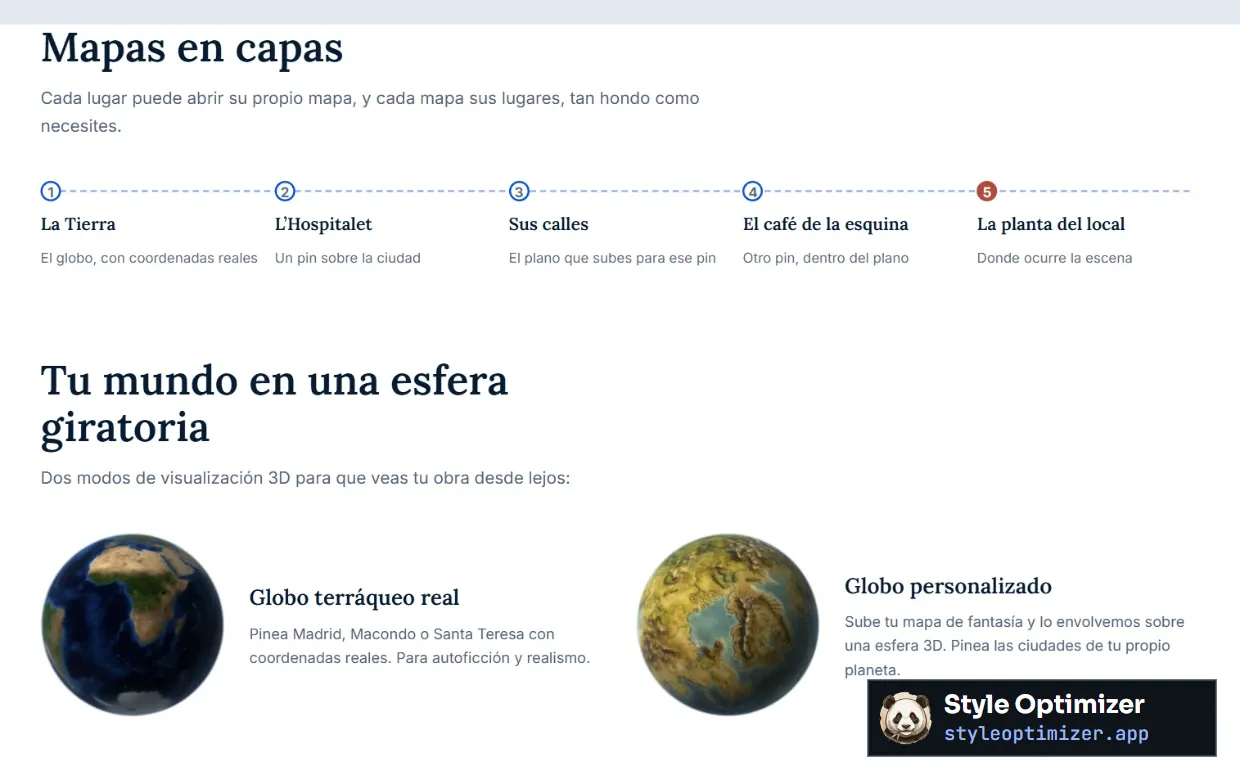
Once you have your planet’s map, Style Optimizer’s custom globe wraps it around a 3D sphere you can spin. Then you pin its cities with their own latitude and longitude, and each pin opens a profile with its coordinates. You can adjust how the planet looks: atmosphere color, clouds, rings, up to three moons, axial tilt and the starfield behind it.
A tip for the map: the ideal image has a 2:1 ratio, twice as wide as it is tall, which is the equirectangular projection used for world maps. The top and bottom edges become the poles and get squeezed, so put ice or sea there and keep the cities that matter well away from the poles. Their names can come from a language of your own.
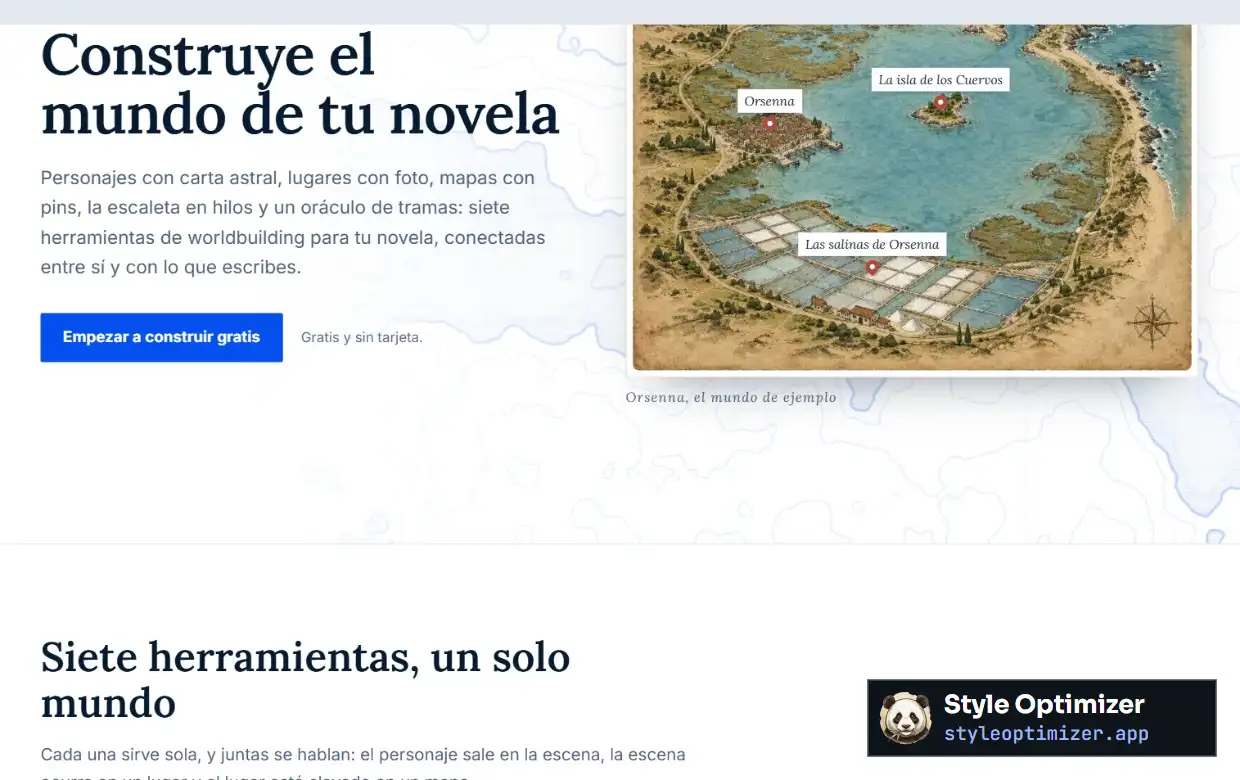
The globe lives in the Fiction section, alongside character and place profiles, maps with pins and an outline board for your scenes. The free plan includes one globe, 3 maps, 20 places and 5 characters.
FAQ: how to create a fictional planet
What do I need to decide to create a believable planet for a novel?
Six facts are enough: the type of star, the planet’s distance from it, the gravity, the length of the day, the axial tilt and the moons. From those you can work out the year, the seasons, the tides, the climate and the night sky. Approximate values will do, as long as the consequences show up consistently in your scenes.
How do I calculate the length of a year on a fictional planet?
Use Kepler’s third law: the period in years, squared, equals the distance in astronomical units, cubed, divided by the star’s mass in solar masses. A planet at Earth’s distance from a Sun-like star takes one year; farther out, or around a less massive star, it takes longer.
What gravity can a planet have and still be habitable for humans?
For a novel, stay between a little under half and a little over one and a half times Earth’s gravity. With more, every effort is exhausting and health suffers; with much less, the body loses muscle and bone over the years, and the atmosphere is harder to hold on to. Within that range, any figure gives you interesting scenes.
What happens if a planet has two moons?
The tides add up when the moons line up and offset each other when they don’t, so the sea follows a more complex rhythm. There will be two cycles of phases, nights with double shadows and rare conjunctions a culture might turn into festivals or prophecies. Arrakis, the planet of Dune, has two moons in its sky.
Can I see my fictional planet in 3D?
Yes. In Style Optimizer’s custom globe, you upload your planet’s map, ideally in a 2:1 ratio, and it wraps the map around a sphere you can spin. Then you add pins with their own latitude and longitude, each with its profile, to place cities, ruins or spaceports while you write the novel.